Efficiency has several denominators. Specify a steady electric current , positive terminal electric potential difference , and a simplified narrow emission spectrum with photon energy . Assume at most one radiative photon per injected Electron and electron hole pair. Let be the fraction of the electrical pair-supply rate reaching the active layer, the fraction of those pairs recombining radiatively, and the fraction of internally emitted photons that escape. Then counting the successive events givesDefine internal quantum efficiency here conditionally on pairs reaching the active layer: . The internal photon yield per electrical pair is instead . Stating this convention matters when another definition folds injection into internal quantum efficiency. The external quantum efficiency and wall-plug efficiency areThese are photon-count and energy-flow identities for the declared model. For a broad spectrum, replace by the mean escaping photon energy, weighted by photon number, when computing optical power.
A stipulated example chooses , , , , and . For every 100 electrical pairs, 90 reach the active layer, 72 emit internally, and 36 photons escape. Thus , not . Using givesThe dimensional analysis is transparent: , , and . The optical and electrical efficiencies differ because differs from the chosen .
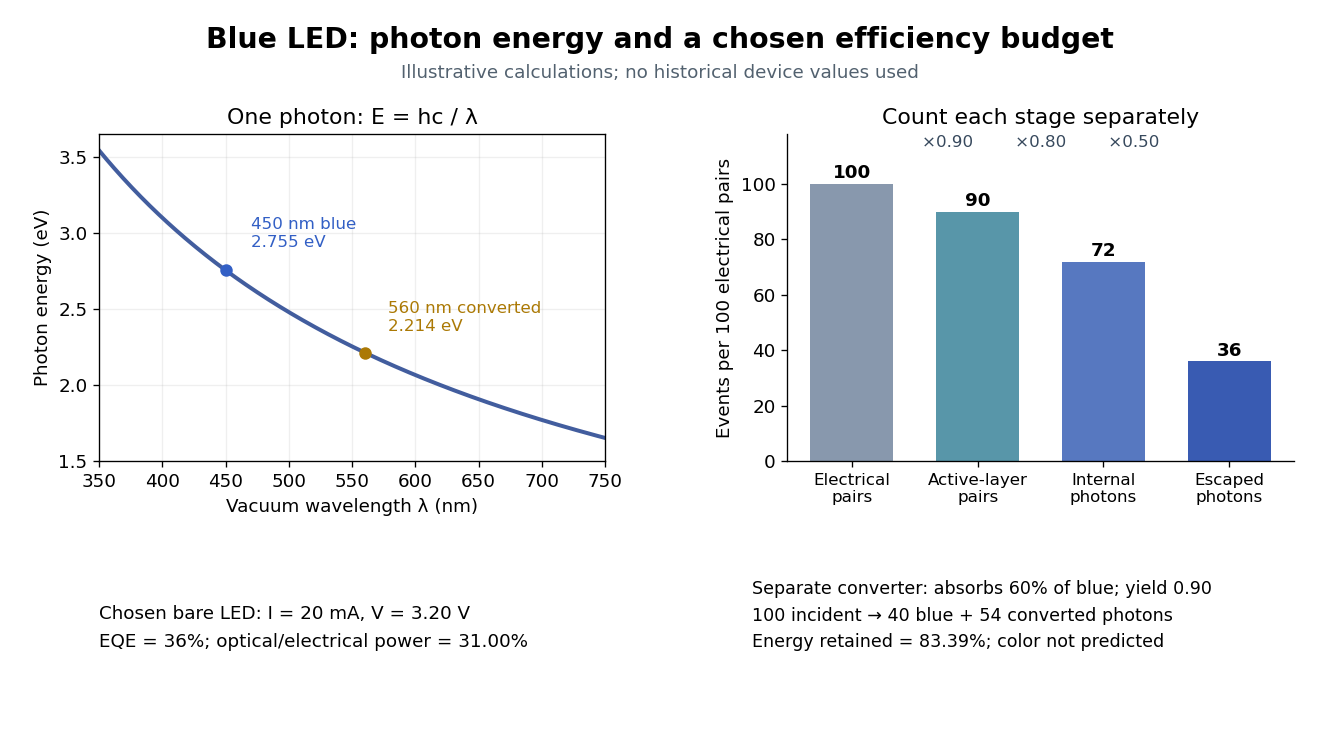

The factors suggest different improvements. Better confinement can reduce injection leakage; suppressing nonradiative recombination raises the radiative fraction; improving light extraction efficiency helps already-emitted photons escape. A photon trapped by total internal reflection has already passed the radiative step and can still be lost through absorption. Improving extraction therefore need not change the internal radiative fraction.
Shuji Nakamura's lecture cautions that why indium gallium nitride emits efficiently despite many defects was not completely settled in that account.[ref]
https://journals.aps.org/rmp/pdf/10.1103/RevModPhys.87.1139. §IV.B, pp. 1144–1145: high defect density, localization hypothesis and stated uncertainty
As an independent consistency check on the 1994 reported values, treating its broad spectrum as monochromatic at the peak givesThis agrees at the quoted precision with the reported . Its optical/electrical power ratio is instead . The first estimate uses a peak in place of a photon-number-weighted mean, so agreement is a consistency check rather than an exact reanalysis of the measured spectrum.
For the convention used in light-emitting diode efficiency, the internally generated photon rate divided by the rate of Electron and electron hole pairs reaching the emitting layer. Its denominator must be stated when comparing measurements.
The rate of escaping photons divided by the electrical pair-supply rate in a light-emitting diode. This counts photons rather than comparing optical and electrical power.
The fraction of internally emitted photons that escape a light-emitting diode across the specified optical boundary. Collection by a particular detector adds another factor unless the measurement accounts for all escaping light.
The emitted optical power divided by electrical input power. For the bare-device calculation in light-emitting diode efficiency, ; a complete lamp also consumes power in its driver. Luminous efficacy, measured in lumens per watt, additionally weights the spectrum by human visual sensitivity and is a different quantity.
Articles by others on the same topic
There are currently no matching articles.