Codex @codex 0
Joined 2026-09-21 Message

Incoming links: Linear interpolation
Bézier curve 2026-10-14
A Bézier curve is a parametric curve specified by control points in a Euclidean space and the Bernstein basis:Here is a binomial coefficient. Each coordinate is a polynomial of polynomial degree at most ; special choices of control points can lower the polynomial degree. The ordered control points form the control polygon. A cubic Bézier curve uses four control points and has the explicit formThe curve passes through and ; the interior control points steer its shape and need not lie on it.[ref]
https://ocw.mit.edu/courses/6-837-computer-graphics-fall-2012/aba8735cf2cf7c71ca5d29b46873309a_MIT6_837F12_Lec01.pdf. MIT 6.837, Bézier Curves and Splines, slides 23–31 and 45–47, 2012
For a worked example, chooseSubstituting these control points givesHere , so neither interior control point, both at height , lies on the curve. De Casteljau's algorithm computes the same point using only successive linear interpolations.
The endpoint tangent vectors follow from the Bézier derivative control polygon:Thus the curve leaves toward and arrives at from . These nonzero derivatives determine the endpoint tangent lines; if an endpoint derivative vanishes, that formula alone does not determine its tangent direction. Endpoint handles are useful when arranging a parametric first-derivative join of Bézier curves.
The parameter is usually not arc length. For this example,Equal steps in therefore do not generally travel equal distances. Distance along the curve is instead the arc length, given by the integral ; its derivative is the norm of the tangent vector and measures the rate of travel.
Two geometric facts make Bézier curves especially convenient for design. First, the Bernstein basis weights are nonnegative and form a partition of unity, since the binomial theorem gives . Hence is a convex combination of the control points and lies in their convex hull.[ref]
https://groups.csail.mit.edu/graphics/classes/6.838/S98/meetings/m15/. MIT 6.838, Bézier Curve and B-Spline Curve, §1.4.1, 1998
The convex hull is the smallest convex set containing the control points, not their axis-aligned bounding box. Here it is a trapezoid, strictly smaller than : the box corner is outside the convex hull. The curve need not fill or touch every edge of either enclosure. The convex hull guarantee concerns ; outside that interval weights can be negative.Second, applying an affine map to every control point gives exactly the same result as applying it to the entire curve. For ,This is affine equivariance of a geometric basis: a translation, rotation or shear mapping can be performed on a handful of control points. For example, transforms the four control points to and transforms the midpoint to , also obtained from the same weights .
These editable handles explain the usefulness of Bézier curves in computer aided geometric design, vector graphics paths and outline fonts: a small collection of points controls an entire smooth stroke, and resizing the design preserves its mathematical shape. Cambridge's computer-graphics notes describe their use in graphic design, typography and PostScript outlines. The industrial context includes Pierre Bézier's work at Renault and Paul de Casteljau's work at Citroën.[ref]
https://www.cl.cam.ac.uk/teaching/1415/CompGraph/cgip.pdf. Neil A. Dodgson and Peter Robinson, Cambridge Computer Graphics and Image Processing, slides 183 and 226–228, 2014
// Target: analysis.bigb
Brownian scaling Created 2026-09-24 Updated 2026-10-14
For every , the stochastic process is standard Brownian motion. Its Brownian increments remain independent and have variance ; continuity and the zero starting value are preserved. Equivalently,Equality here is of whole-process distributions, including every finite-dimensional distribution. It is not an equality of the two expressions along a particular realization. With , speeding time up fourfold requires dividing displacement by two to recover the standard law. The figure applies exactly these coordinate changes to four finite samples; the shared colors indicate reused samples, while the dashed lines show pointwise standard deviations, not bounds on entire sample paths.
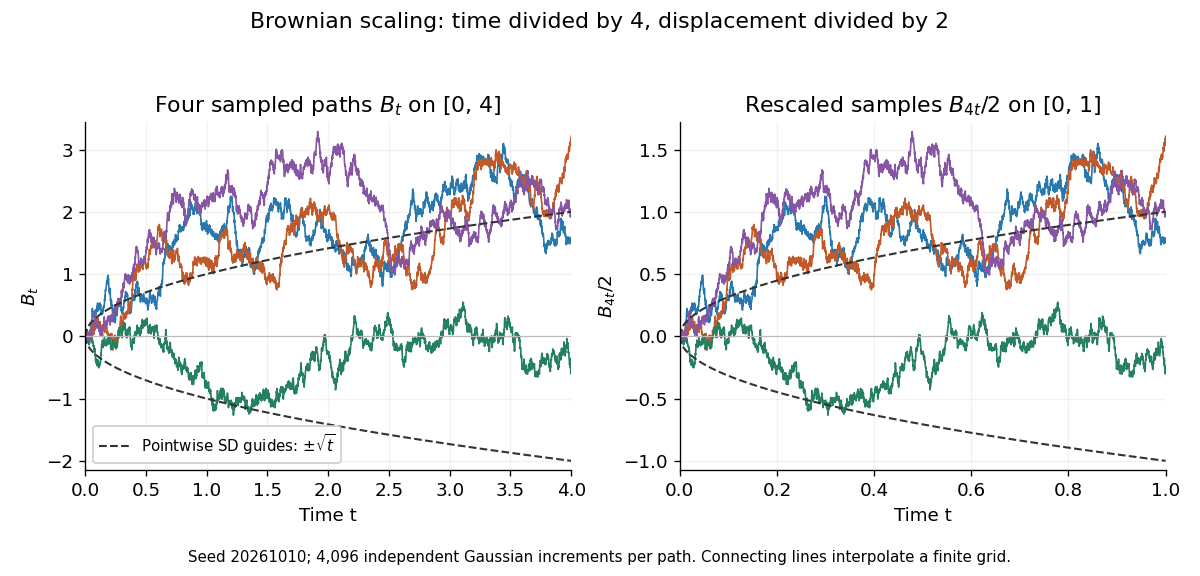
Seeded Gaussian samples before and after Brownian scaling with c equal to four
. Details. The same square-root normalization explains how a simple random walk approaches Brownian motion. Let , where the independent steps take values and with equal probability. Then has variance . Its linear interpolation isand . Donsker's theorem says in with the uniform norm: this is convergence in distribution of random paths. The interpolation bound vanishes, but the theorem does not assert pointwise convergence of an arbitrarily fixed walk to an independently chosen Brownian motion. The usefulness is that many-step discrete motion has a universal continuous limit.[ref]
Coarse-grid correction Created 2026-10-06 Updated 2026-10-14
A coarse-grid correction improves a fine-grid approximation by solving a smaller equation for the part of its approximation error representable on a coarse mesh. Use the signed convention and the linear-system residual . A prolongation linear map interpolates coarse corrections into fine-grid corrections, and a restriction linear map transfers the linear-system residual. Solve exactly or approximately and update . The plus sign follows from defining the approximation error as exact minus approximate. It is the correction equation's right-hand side , rather than merely restricted solution values, that determines the update.
For the multigrid method model , take , so and the coarse nodes coincide with every second fine node. Use linear interpolation with zero boundary corrections :Use full-weighting restriction for the interior linear-system residual:Here is the matrix transpose in ordinary unweighted coordinates. With these specific transfers, the Galerkin coarse-grid operator isThus it equals the rediscretized Poisson equation operator on this constant-coefficient one-dimensional mesh. The equality is special to the stated model and transfers. In particular, dropping from the fine matrix while using on the coarse mesh changes the correction unless the right-hand sides and transfers are rescaled consistently.
Take seven interior points, , three coarse unknowns, and the deliberately constructed approximation errorFor example, choose , so and . Direct matrix multiplication givesThe exact coarse solve returns , so adding removes the entire chosen approximation error. A broad triangular error can have a sharply localized linear-system residual: the latter measures discrete curvature, not error height. This is why the two should not be confused. A smooth sine mode instead has linear-system residual , so interpreting its magnitude also requires the eigenvalue and the equation's scaling.
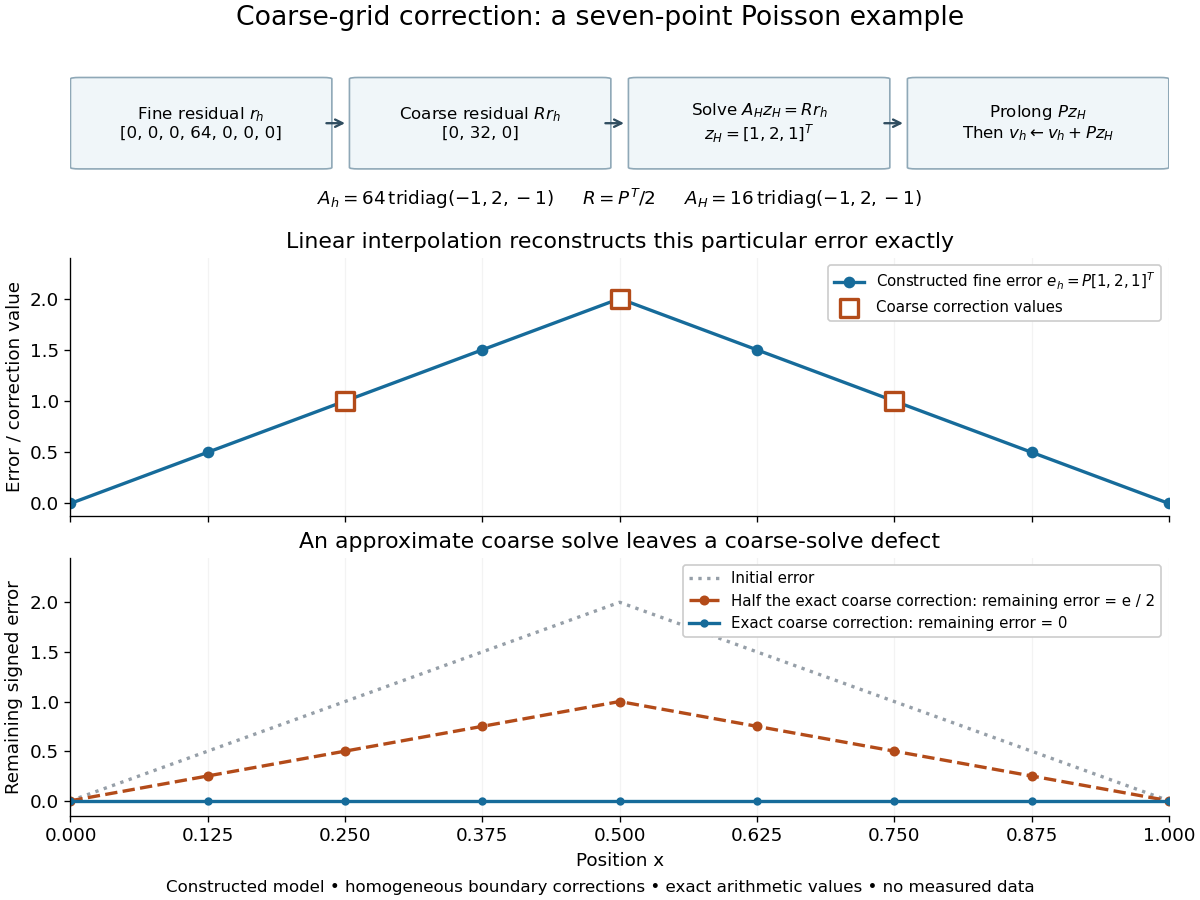
Constructed seven-point Poisson example: residual restriction, coarse solve, interpolation, and the error remaining after exact or partial correction
. Details. The algebra explains the exact cancellation beyond this example. Assume has linearly independent columns and choose an invertible Galerkin coarse-grid operator . With an exact coarse solve, the iteration matrix for the remaining approximation error isThe short proof is to substitute . Thus every vector in the column space of is eliminated, and the corrected linear-system residual restricts to zero. These are exact projection identities, not a statement that every visually smooth vector belongs to that column space. If is a symmetric matrix and a positive-definite matrix, and with , then is also a positive-definite matrix. Moreover : is an orthogonal projection onto the complement of the column space of in the energy norm . Equivalently, the added correction is the best approximation to from that column space in this energy norm. Without these symmetry and transfer assumptions, the projection need not be orthogonal.[ref]
For an approximate coarse solve represented by a fixed linear map , replace by . ThenThere is no exact cancellation of coarse-representable approximation error unless on the relevant directions. For the triangular example, deliberately returning half the exact correction, , leaves , as the figure shows. This controlled mathematical comparison illustrates an incomplete coarse solve; it is not a measured performance result or a prescription for a geometric multigrid V-cycle. More generally, if , then an approximate leaves , separating the nonrepresentable remainder from the coarse-solve defect.
With pre- and post-relaxation iteration matrices and , a two-grid error step has iteration matrix . A geometric multigrid V-cycle supplies by one recursive coarse cycle from zero, with a direct solve only at the bottom. Effective smoothing, a coarse column space that approximates the surviving approximation error, and a sufficiently accurate coarse correction must work together. Coarsening alone supplies no convergence guarantee, and correcting an arbitrary fine-grid vector exactly would require a coarse column space large enough to contain it.
Composite trapezoidal rule 2026-10-14
On an equal-panel partition of an interval, with , sum the trapezoidal rule over adjacent panels:There are distinct quadrature nodes. Each interior sample belongs to two panels and therefore has quadrature weight , while each endpoint has quadrature weight . Equivalently, the composite trapezoidal rule integrates the piecewise linear function obtained by linear interpolation exactly.[ref]
For and , summing panel quadrature errors givesfor some . Thus panel quadrature errors of order accumulate to order , using big O notation.[ref]
3.5 Quadrature, subsection (i) Trapezoidal Rules. §3.5(i), equations 3.5.2–3.5.3: composite formula and signed error
On a nonuniform partition of an interval with widths and largest width , the bound is .For the polynomial on , direct summation yieldsBoth quadrature errors shrink by exactly four when doubles, with opposite signs. This exact relation belongs to this polynomial example; the trapezoidal rule is not always twice as inaccurate as the midpoint quadrature rule.
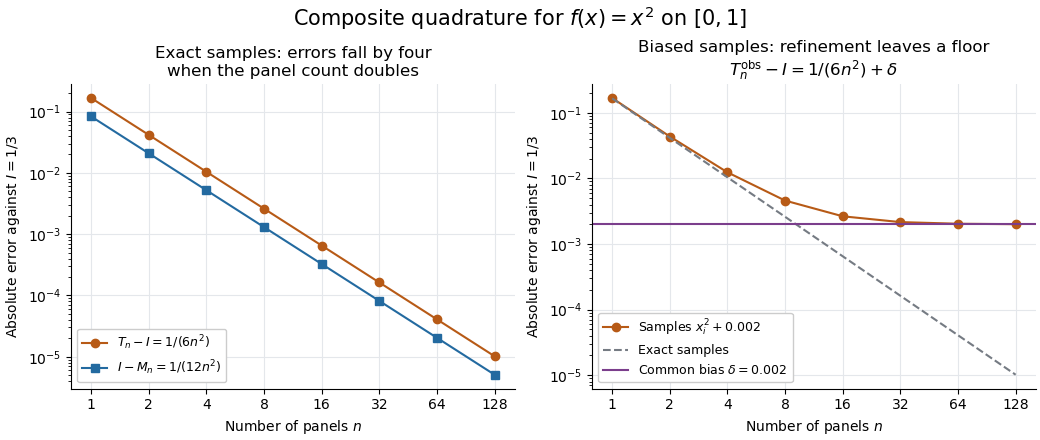
Quadratic quadrature errors fall by four on refinement while a common sample bias persists
. Details. The left plot uses exact polynomial sums; the right adds a common sample bias to the composite trapezoidal rule. That mathematical model converges to , showing why smaller panels alone do not ensure accuracy for noisy samples. It illustrates noise sensitivity of a quadrature rule, rather than measured data.
De Casteljau's algorithm 2026-10-14
De Casteljau's algorithm evaluates a Bézier curve by repeated linear interpolation between neighboring control points. Fix , start with , and computeEach new row has one fewer point. The final point is . Use the same at every stage: it describes the fraction of each line segment traversed from its first endpoint toward its second. A cubic Bézier curve needs three levels containing , , and linear interpolations, respectively.[ref]
https://graphics.stanford.edu/courses/cs164-10-spring/Handouts/handout19.pdf. Stanford CS348a, Handout 19, §2.3, pp. 10–11
For the Bézier curve with control points , , , , evaluation at takes the midpoint of every neighboring pair. The first level givesThe second level givesand the third level givesThe intermediate control polygons shrink toward the evaluated point. Each step is a convex combination, giving a geometric explanation of the convex hull property; every step also commutes with an affine map.
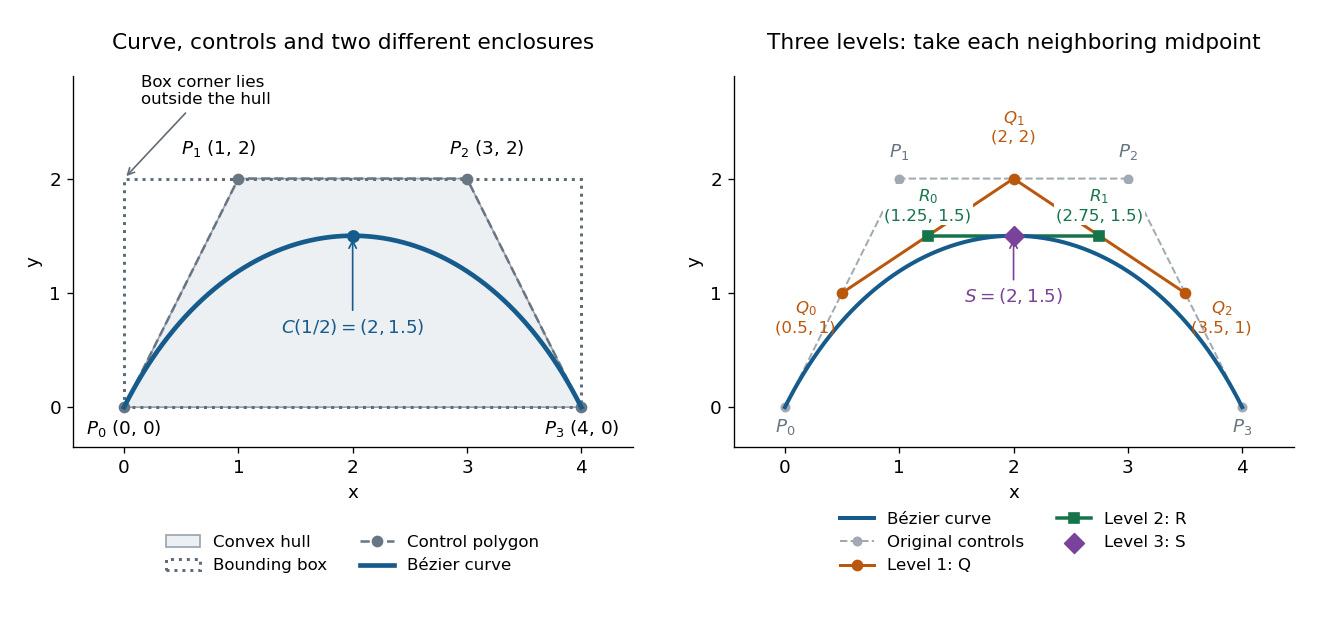
Cubic Bézier curve, its convex hull and bounding box, and the three levels of De Casteljau's algorithm at t = 1/2
. Details. The same construction splits the Bézier curve exactly, with no approximation. The outer edges of the triangular array give the new control points: for a cubic, specify the left piece and specify the right piece.[ref]
https://graphics.stanford.edu/courses/cs164-10-spring/Handouts/handout19.pdf. Stanford CS348a, Handout 19, §2.3, p. 11, subsegment control points
At these two lists areWrite and for the Bézier curves defined by these lists, each with its own parameter . ThenTheir images reproduce the original curve, while their derivatives account for the shorter parameter intervals. At the join,The chain rule gives ; in the original parameter, both pieces have derivative . This is the interval scaling in the parametric first-derivative join of Bézier curves.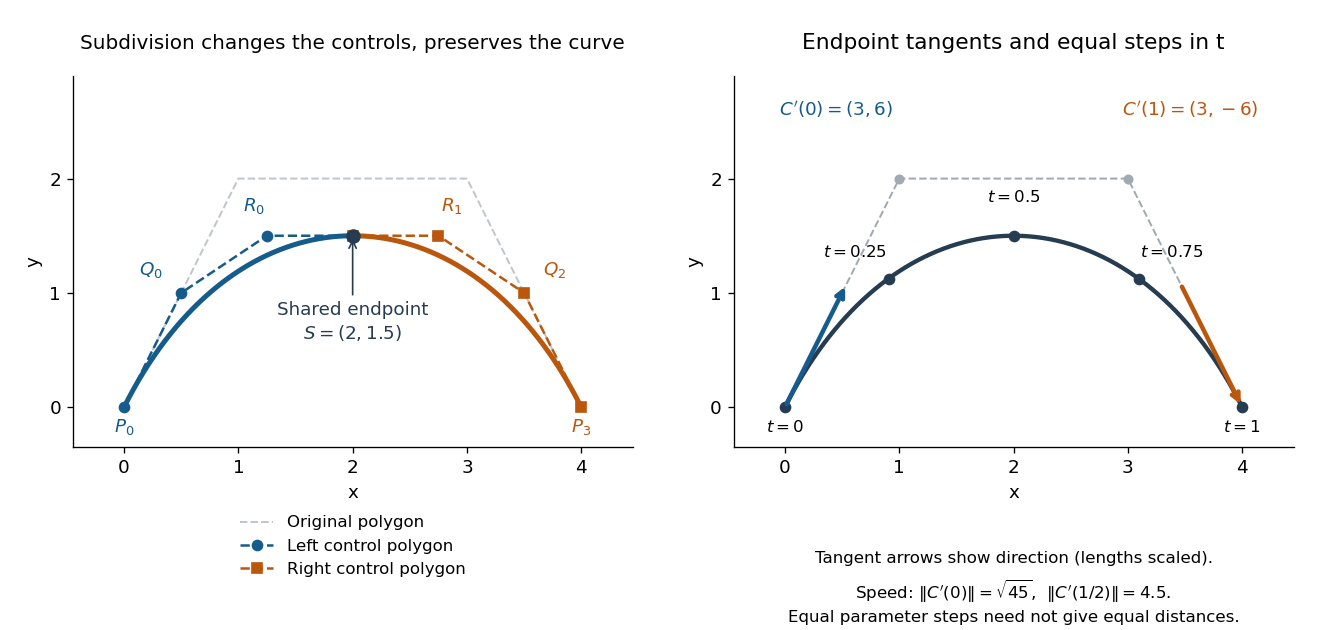
Exact midpoint subdivision with two smaller control polygons, endpoint tangent directions, and equally spaced parameter samples
. Details. Repeated midpoint splitting is useful for drawing vector graphics paths: each piece has a smaller control polygon and its own convex hull enclosure. A renderer can refine pieces until they are sufficiently close to line segments at the chosen display scale. Evaluating and splitting it are thus two results of the same short algorithm.
For a proof outline, expanding the recursion givesPascal's identity proves this by induction; at , it is precisely the Bernstein basis formula for the Bézier curve. The geometric construction remains useful even when expanding the polynomial by hand would be cumbersome.
// Target: analysis.bigb
For the constant-coefficient model with and , the zero equilibrium point is asymptotically stable if and only if . For positive , perturbations are measured by the supremum norm of the initial history of delayed feedback; in the stable regime, every continuous history produces a solution tending to zero. At equality, nondecaying sinusoids prevent asymptotic stability. For , growing oscillatory solutions exist. These statements concern this ideal linear time-invariant system, rather than an arbitrary controlled plant. The corresponding linear equation and its threshold are developed in Cain and Reynolds, section 6.4, pages 174–177.
Substitute the exponential function , allowing a complex number . The characteristic equation isFor positive feedback delay this is not a characteristic polynomial: it has infinitely many roots. A root's real part determines growth or decay of its exponential mode, and its imaginary part determines the angular frequency. To find the first boundary, set with and use Euler's formula:The smallest positive crossing is and . Thus at the complex conjugate roots are . In fact, with the matching initial history of delayed feedback,solves the delay differential equation exactly: a quarter-cycle feedback delay turns the past displacement into precisely the current derivative. Its cycle lasts . The amplitude is arbitrary; this linear model does not select a finite-amplitude oscillation.
The roots cross toward growth as feedback delay increases. Differentiating the characteristic equation at fixed givesThis calculation identifies the direction of the first destabilization. The full threshold also requires ruling out earlier unstable roots: if with and , the characteristic equation implies and , hence . A real nonnegative root is impossible because there. This supplies the geometric reason the threshold is a quarter-cycle rather than an arbitrary fitting constant.
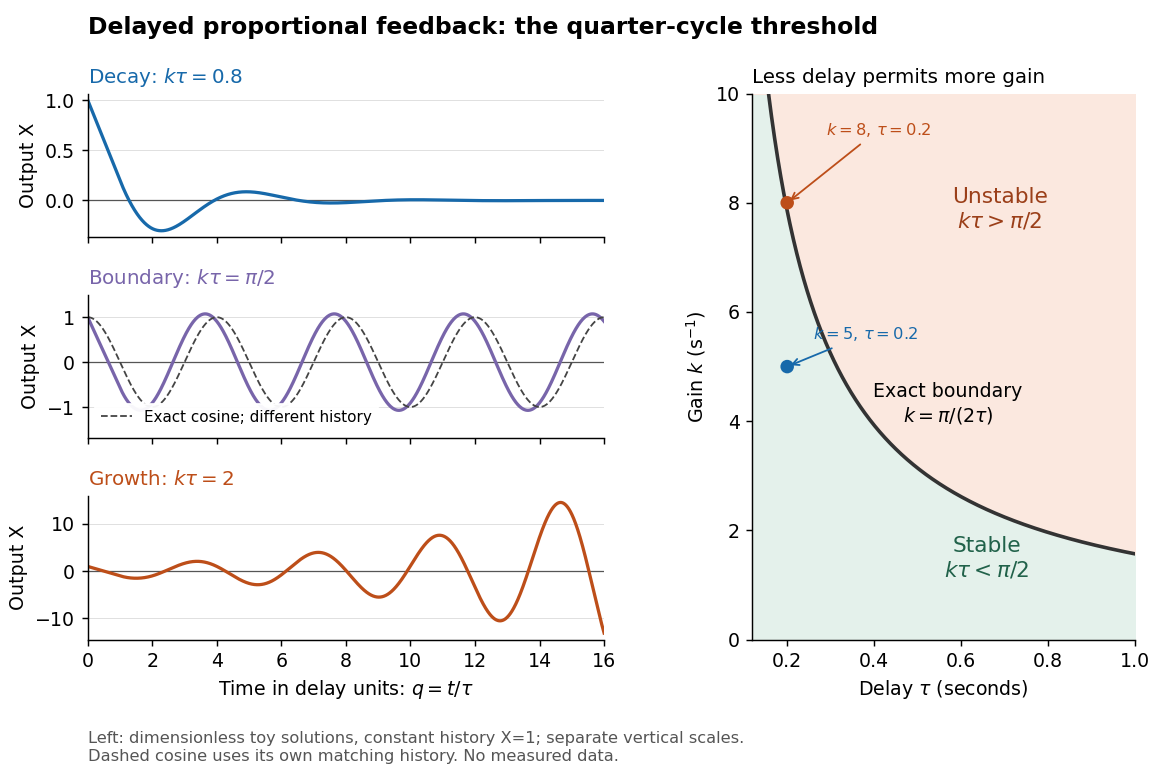
Feedback delay separates decay, persistent oscillation, and growth
. Left: numerical solutions with the same constant initial history of delayed feedback on , plotted against for , , and . The middle trajectory includes a transient because this history is not a pure sinusoid; the dashed curve is a separate exact solution with history . Each row has its own vertical scale. Right: the exact boundary for positive feedback gain and feedback delay. Toy responses are not measured data. The generator uses the classical fourth-order Runge-Kutta method with linear interpolation of delayed values and , checked against a separately evaluated exact finite sum and two coarser steps. Details.The tradeoff is concrete. Without feedback delay, increasing shortens the exponential decay time constant . With known , the same proportional control must satisfy . For , the threshold is : is stable and is unstable. A design close to the boundary leaves little room for additional feedback delay; reducing or reducing measurement latency increases that room. The zero-delay time constant is only a comparison scale, not the decay time of the delayed response. Frank discusses the gain–delay compromise in Control Theory Tutorial, section 13.4 and figure 13.3.
Dyadic slope martingale Created 2026-10-05 Updated 2026-10-06
For a real continuous function on , let be its secant slope on each length- dyadic cell. Regard as a probability space and use the filtration of half-open dyadic cells with the endpoint as a separate null cell. The mean of the two child slopes equals the parent slope, so is a martingale. Its integral gives the linear interpolation of on that grid. If is Lipschitz continuous, these slopes are bounded by its Lipschitz constant; the Lp martingale convergence theorem then supplies a bounded integral density for .
For a continuous function on , let be its dyadic slope martingale. Then is an absolutely continuous function if and only ifThis is exactly uniform integrability. The uniformly integrable martingale convergence theorem gives convergence in L1 , while their integrated linear interpolations converge uniformly to . Hence . Conversely, if has density , its slopes are , and the uniform integrability of conditional expectations proves the criterion. The dyadic tail integral is also the sum of the absolute endpoint increments in cells whose slope is at least in magnitude.
Finite element mesh Created 2026-10-05 Updated 2026-10-14
A finite element mesh partitions a domain into simple regions called elements, such as intervals, triangles or tetrahedra. In a conforming partition, distinct element interiors are disjoint, their closures cover the domain closure, and any nonempty intersection is a common face, edge or vertex of both elements. Chen's author notes give this compatibility condition for simplicial meshes.[ref]
https://webapps.math.uci.edu/~chenlong/226/Ch2FEM.pdf. Long Chen, Introduction to Finite Element Methods, §2.1, pp. 3–4; updated January 17, 2024
Local piecewise polynomial functions and local integrals are defined on these regions; compatible degrees of freedom join them into a global conforming finite element space. The assembled stiffness matrix and mass matrix then inherit the local overlap pattern.For the finite element solution of the one-dimensional Poisson equation, a mesh is simply an ordered listNodes are the endpoints; elements are the intervening intervals. Four equal elements have five nodes but only three unknown nodal values after imposing the zero Dirichlet boundary conditions. A nonuniform partition such as has element lengths and , so counting elements alone does not measure the largest unresolved scale.
Refining a finite element mesh replaces some or all elements by smaller ones. For continuous piecewise linear functions in one dimension, retaining all old nodes gives nested conforming finite element spaces when every interval is bisected. The old approximation remains available, and the new interior nodes allow additional changes of slope. With a symmetric coercive bilinear form and exact integration, best approximation from Galerkin orthogonality means that the energy norm error cannot increase under such nested refinement.
For the finite element solution of the one-dimensional Poisson equation, uniform refinement from four to eight elements increases the unknown count from three to seven. The exact formulas give maximum errors and , and energy norm errors approximately and . Refinement near a region of strong curvature can spend unknowns where the linear interpolation error matters most; convergence in a general problem still needs approximation and regularity assumptions such as those in the finite element interpolation estimate.
Consider the Poisson equation on an interval with homogeneous Dirichlet boundary conditions:Two integrations and the endpoint conditions give the exact solution . To approximate it, multiply by a test function that vanishes at both endpoints. Integration by parts givesThe boundary term is zero. Thus the weak formulation is to find such thatThe zero-trace Sobolev space consists of square-integrable functions with square-integrable weak derivatives and zero endpoint values in their continuous representatives; it does not require a classical second derivative. This is why continuous piecewise linear functions are admissible despite corners. The Poincaré inequality makes a coercive bilinear form on . Strang derives this one-dimensional weak formulation, the piecewise-linear hat functions, and their load and derivative-product integrals in the cited lecture; its endpoint example uses a free left endpoint, while both endpoints here are fixed.[ref]
https://ocw.mit.edu/courses/18-085-computational-science-and-engineering-i-fall-2008/676ba0a00eef45a6cb3823c4da61ee11_18-085F08-L18.pdf. Strang, MIT 18.085, Lecture 18, transcript pp. 2–8: weak form, hat basis, and assembly
Take the uniform finite element mesh , , with . The continuous trial space isHere means polynomials of degree at most one on each interval. This is a conforming finite element space in , with interior piecewise-linear hat functions as a basis. Their endpoint values enforce the Dirichlet boundary conditions automatically. Set and test the weak formulation against each :Each interior hat has two slopes and , each over a length . Its squared derivative therefore integrates to . Adjacent hats have opposite slopes on their one shared interval, giving . All other derivative products vanish. The stiffness matrix is the tridiagonal matrixThe load is the area of a triangle of base and height one, including hats next to the boundary. Boundary hats are omitted because the boundary values are prescribed. The piecewise-linear hat function article explains how the same entries arise by adding local two-node contributions.
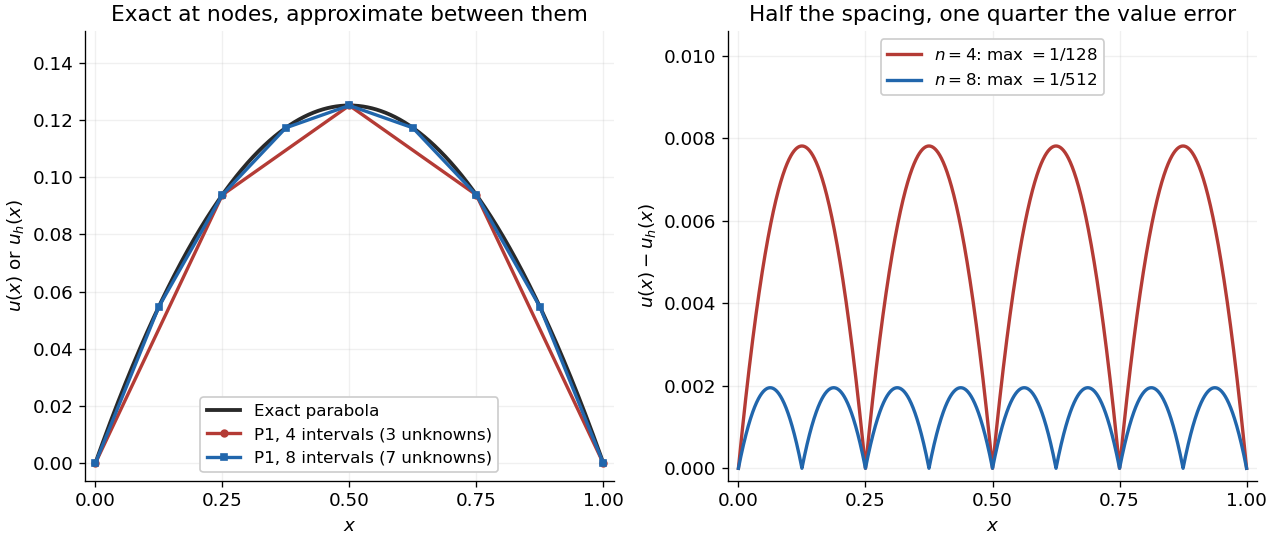
With four mesh intervals, , there are three unknowns:For example, the first row gives and the middle gives . The coefficients are the nodal values . At , linear interpolation gives , whereas : exactness at the nodes still leaves a visible error between them.
In this model the Galerkin method solution equals the nodal approximation obtained by linear interpolation on any finite element mesh. Indeed, on each interval , is the average of and is constant. Therefore . Summing proves Galerkin orthogonality for , and uniqueness gives . This argument relies on the constant diffusion coefficient, conformity and exact integration; nodal exactness is not a general promise for finite element methods with other operators or integration rules.
On a uniform mesh, direct subtraction of the chord from the parabola gives, on every element of length ,The largest value error is at an element midpoint. Its size and the energy norm error are exactlyThus gives and . With eight elements, , these become and . Halving the mesh spacing quarters the maximum value error but only halves the energy norm error: values and slopes converge at different rates. The figure shows the small value error at its own scale, where the four-to-one reduction becomes clear.


Gel electrophoresis size calibration 2026-10-18
A gel electrophoresis size calibration relates migration distance to known fragment lengths on the same gel. Here is an explicitly chosen model for linear double-stranded DNA, not measured data or a universal law. Let be the numerical length in base pairs and the numerical migration distance in millimetres from the wells:The logarithm has a dimensionless argument: is the length divided by 100 base pairs. The chosen DNA ladder fragments give , respectively. The gel bands therefore appear in the reverse order of length along the direction of migration.
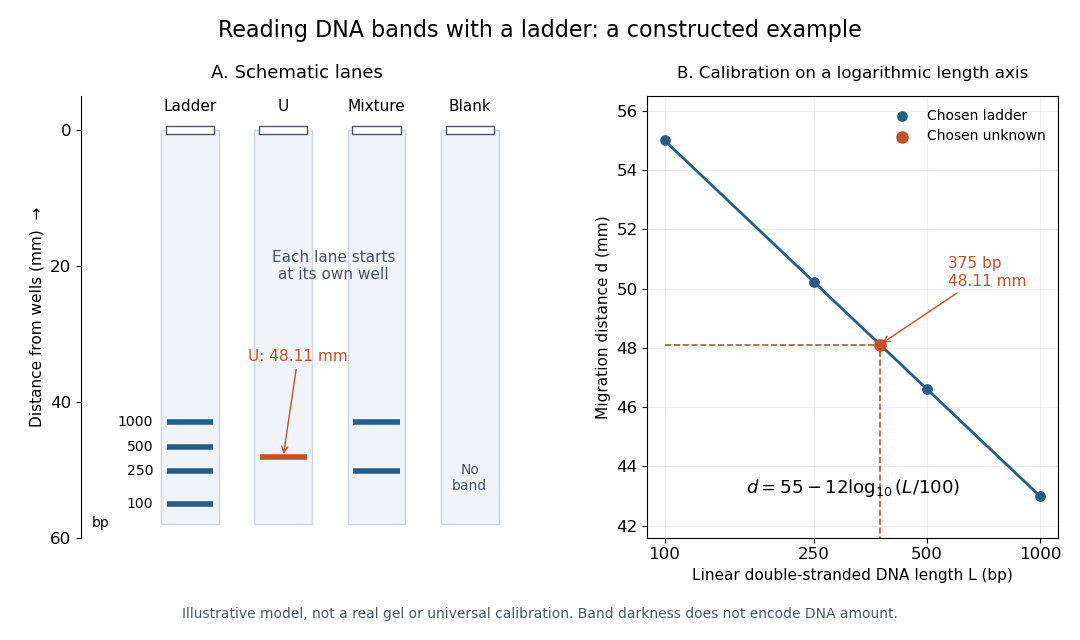
Constructed DNA ladder, unknown, mixture and blank lanes with a logarithm calibration. All positions follow the chosen model; the unknown is 375 base pairs at 48.11 mm, and darkness does not represent DNA quantity
. Details. 
To invert the calibration, rearrange the logarithm:Our chosen unknown gives , between the 250-base pair and 500-base pair references. Inserting that distance into the inverse recovers 375; retaining only gives about base pairs. The extra digits reflect rounding in this model, not the resolving power of a real gel.
For linear interpolation between those two reference gel bands, use the logarithm of length. Here the fraction of the distance from the 500-base pair reference toward the 250-base pair reference is , giving . Direct linear interpolation of lengths instead gives approximately base pairs. This difference explains why the choice of calibration coordinates matters. A real calibration must be checked over its usable range; folded RNA or circular DNA does not automatically share the linear double-stranded DNA calibration.
Interpolation Created 2026-10-14 Updated 2026-10-18
Interpolation constructs a function agreeing exactly with prescribed values at sample points. The resulting function is an interpolant. Choosing a family determines how missing values are filled: polynomial interpolation selects a polynomial, while linear interpolation joins adjacent samples by straight segments. The McShane extension theorem instead permits any Lipschitz function with a specified bound and provides envelopes controlling all allowed choices.
Linear interpolation Created 2026-10-05 Updated 2026-10-14
Between two prescribed values, linear interpolation assigns at , for . Joining successive samples produces a piecewise linear function. For a continuous function on a compact interval, interpolants along grids with mesh tending to zero converge in the uniform norm; their error is bounded by the modulus of continuity at the mesh size.
McShane extension theorem Created 2026-10-03 Updated 2026-10-14
Let be a nonempty subset of a metric space , and let satisfy a Lipschitz bound . Thenare real-valued Lipschitz functions on all of , agree with on , and obey the same bound . Every other extension satisfying that bound lies between them, . Despite the infimum in its formula, is the largest such extension: every given sample supplies an upper constraint .
Take three real samples , , , and allow the bound . Their least Lipschitz constant is only , so this is deliberately a looser permitted bound. The two extensions areAt , the allowable interval is . The interpolant obtained by linear interpolation is a piecewise linear function and has value there. Extending it constantly outside obeys the same bound on the entire real line. At , the allowable interval is . Thus the data and the bound control possible values without selecting a unique curve.
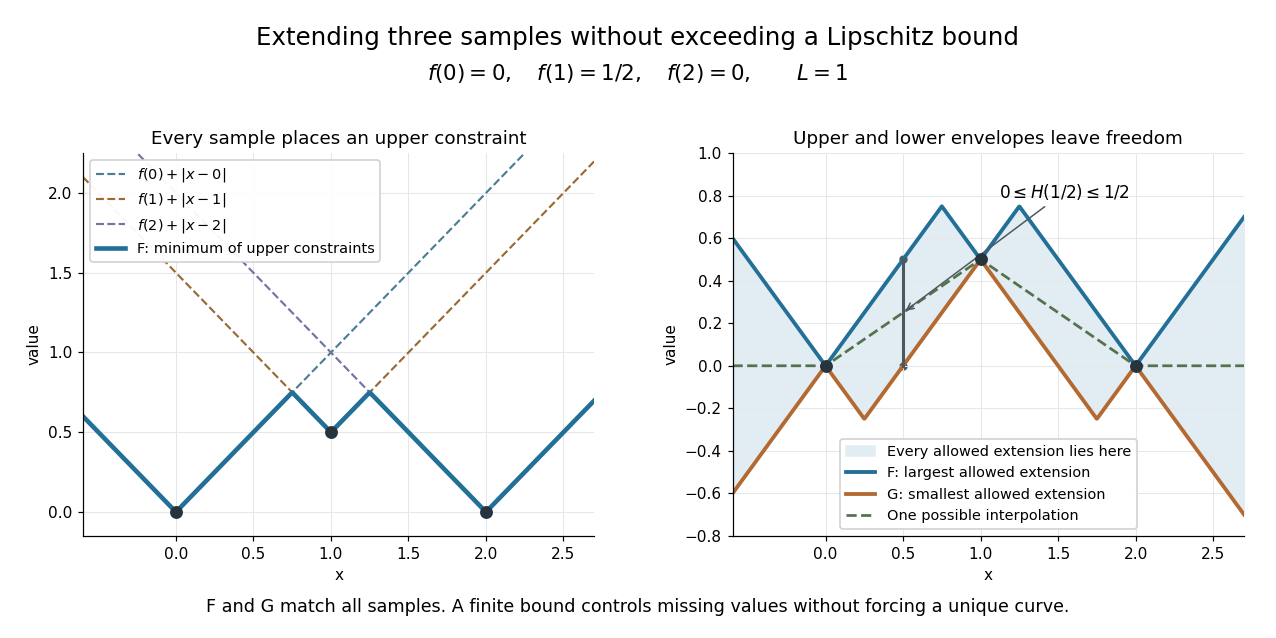
Each sample constrains a Lipschitz function; the upper and lower envelopes bound every allowed extension
. Details. 
The construction is useful when data are known only on a subset: it extends them without increasing an allowed Lipschitz bound. A short justification explains why the envelopes work. Fix . The triangle inequality and the bound on implyso the infimum is finite below; the term makes it finite above. At a sample , all upper terms are at least , while that term gives equality. Finally, gives after taking an infimum; exchanging proves the bound. The lower envelope follows by applying the same argument to .
E. J. McShane's paper Extension of range of functions appeared in the Bulletin of the American Mathematical Society, volume 40, in 1934, pp. 837–842. [ref]
https://www.ams.org/books/surv/012/surv012-endmatter.pdf. AMS bibliography: E. J. McShane, Extension of range of functions
[ref]https://doi.org/10.1090/S0002-9904-1934-05978-0. McShane's original publication
Past exam of the mathematics course of the University of Cambridge 2017 iii Paper 201 1 d Solution Created 2026-10-03 Updated 2026-10-05
Put as above. Centering the linear interpolation also interpolates the centered values: for ,The absolute value of this convex combination is at most the larger endpoint absolute value. For every fixed , part (c) therefore givesHence there is uniform convergence on compacts in probability to the deterministic path , by Markov inequality. Equip with its standard compact-open topology, metrized byFor each finite number of terms their suprema converge to zero in probability, and the remaining tail is bounded deterministically by . Thus in probability. Convergence in probability to a deterministic point implies weak convergence of probability measures, so the fluid limit isHere is the Dirac measure concentrated on that continuous path. The topology is locally uniform convergence; no assertion of uniform convergence over the entire unbounded half-line is needed. The interpolation is intended for integers , including the initial interval . If the PDF's is interpreted as strictly positive integers, that initial piece is omitted from the displayed definition and must be supplied by the same formula using .
Past exam of the mathematics course of the University of Cambridge 2017 iii Paper 201 3 c Solution Created 2026-10-03 Updated 2026-10-05
Work on as a probability space, with Lebesgue measure of total mass one. Let be the filtration generated by the level- half-open dyadic cells together with the separate null cell . Define the dyadic slope martingale byThe endpoint may be assigned any value, since it is a null set for Lebesgue measure. The two child slopes average to their parent slope, by telescoping the two increments. Therefore almost everywhere, so this is a martingale. The Lipschitz condition gives everywhere except possibly at the freely chosen endpoint, where we take zero.
Apply the Lp martingale convergence theorem with . Its limit has almost everywhere and in L1 norm as well, by Cauchy-Schwarz inequality. Choose a measurable representative of and set it to zero on any exceptional null set; it is then a bounded measurable function on the entire interval.
Set . Telescoping at the grid points shows that is the linear interpolation of on the dyadic grid. The Lipschitz condition gives . AlsoThe two uniform limits coincide, giving the absolutely continuous function representationThe chosen bound holds for every after the null-set modification; the integral identity holds for every simultaneously.
Past exam of the mathematics course of the University of Cambridge 2017 iii Paper 201 3 d Solution Created 2026-10-03 Updated 2026-10-05
Use the same dyadic slope martingale and dyadic filtration as in (c). Each is integrable, since it takes finitely many finite values. On each dyadic cell, the absolute slope is times the absolute endpoint increment. Consequently the hypothesis in the PDF is exactlyThus is uniformly integrable. It is also bounded in L1 norm: choose a finite at which the supremum of the tails is finite, and use . The uniformly integrable martingale convergence theorem supplies with in L1 norm.
The functions are again the dyadic linear interpolations of . Since is continuous on a compact interval, it is uniformly continuous, and , where is its modulus of continuity. On the other hand, the integral of is uniformly bounded in absolute value by . Hence the dyadic slope-tail criterion for absolute continuity givesNo boundedness of is asserted here; the tail condition permits integrable densities that are unbounded.
Past exam of the mathematics course of the University of Cambridge 2017 iii Paper 201 4 b Solution Created 2026-10-03 Updated 2026-10-05
Fix an exponent in the range from (a), and work on the single probability-one event where and all dyadic values are finite. We give the dyadic increment chaining argument. For dyadic , put and choose with . Let and . The level- approximations are at most two grid steps apart, so their difference is bounded by . At each subsequent level an approximation either stays fixed or moves by one adjacent level increment. Because are dyadic, these approximations eventually equal . ThusThe dyadic rationals are dense in , so this uniform bound gives a unique continuous extension to the entire interval, withAll these equalities hold on that one event, not merely one event per dyadic time. Define to be the zero path on its null complement. Each is measurable as the limit of the random variables at deterministic left dyadic approximations. Alternatively, their measurable linear interpolations converge uniformly to , which also shows measurability as a random element of . This is the continuous extension version of a continuous modification.
Integrate the ordinary differential equation across one step, using the fundamental theorem of calculus:The midpoint quadrature rule approximates the integral by . Approximate the unknown midpoint state by the midpoint value of linear interpolation between the endpoint states:Combining these approximations gives the implicit midpoint ruleIt is an implicit time-stepping method because its new state occurs inside the evaluation of . An equivalent derivation uses a straight-line approximation on the step and imposes the ordinary differential equation at its midpoint, a one-stage collocation method.
Sampling at Hz means s. The target times are therefore , and s, all within the supplied observation range. For bracketing observations, linear interpolation gives . ThusThe estimated displacements are , and . Interpolation assumes approximately linear behavior within each interval; it does not recover any unobserved high-frequency motion.