The ideal measurement calibration is a straight line through the equal-pressure zero. For the stipulated water mass density and gravitational acceleration above, its slope is per vertical millimetre. A lower liquid mass density gives a larger length change for the same pressure, improving the height-reading contribution to measurement resolution but requiring more vertical space for a given pressure range. The pressure scale depends on the actual mass density, which depends on temperature; here is a chosen model value, not an exact property of all water samples.
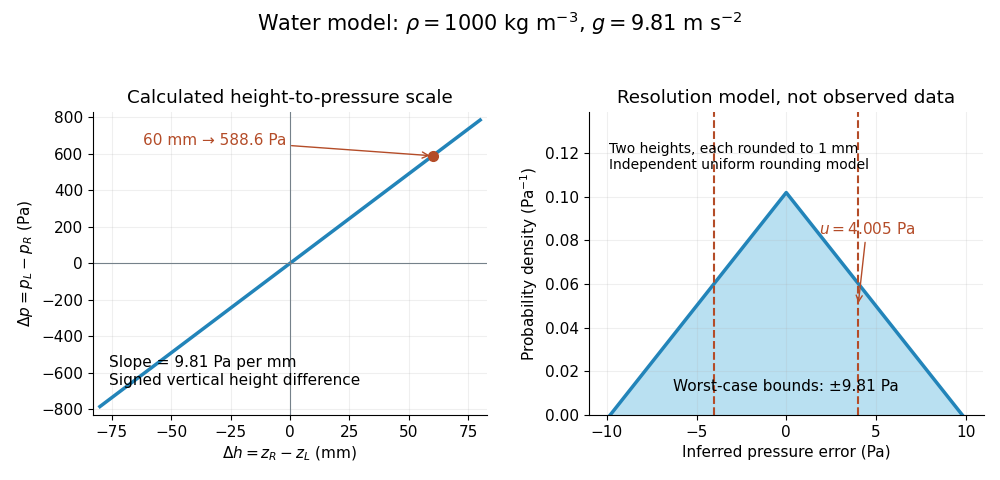

Suppose each liquid meniscus height is rounded to the nearest scale division . Each height measurement error lies within , so the error in their difference lies within . The resulting pressure error is bounded by . To quantify a standard uncertainty, make the additional model assumption that the two rounding errors are independent random variables, each having a continuous uniform distribution on . Each then has variance ; adding the two variances givesHere denotes standard uncertainty. The worst-case bound and standard uncertainty answer different questions. At they are respectively and of the reading. Shared reading bias or a different reading method can violate the assumed independence.
If the mass density, gravitational acceleration and height difference also have small independent standard uncertainties, a first-order estimate follows from the partial derivatives of :This displays why a finer scale does not remove uncertainty in mass density or gravitational acceleration. A pressure transducer compared against the column needs its own differential-pressure calibration to establish an electrical response.
Articles by others on the same topic
There are currently no matching articles.