Let be an integer and let be independent and identically distributed random variables with an exponential distribution of rate . Their sample maximum is nonnegative. Substituting the exponential distribution's cumulative distribution function into the distribution functions of independent minima and maxima gives the exact lawFor example, at each observation is below the threshold with probability , but all observations are below it with probability . Thus an individual observation's median becomes an increasingly unlikely upper bound for the whole batch. The general order statistic density in Siegrist's treatment, with , also gives this law on integration. [ref]
https://www.randomservices.org/random/sample/OrderStatistics.html. Siegrist, Random Services: exponential order statistics
.Solving gives the exact quantile function, for ,In a toy model with , the median maximum is seconds for , seconds for , and seconds for . All three use the exact distribution function; the increase comes from taking a maximum over more observations. The case connects to the existing maximum of two exponentials as a scaled sum.
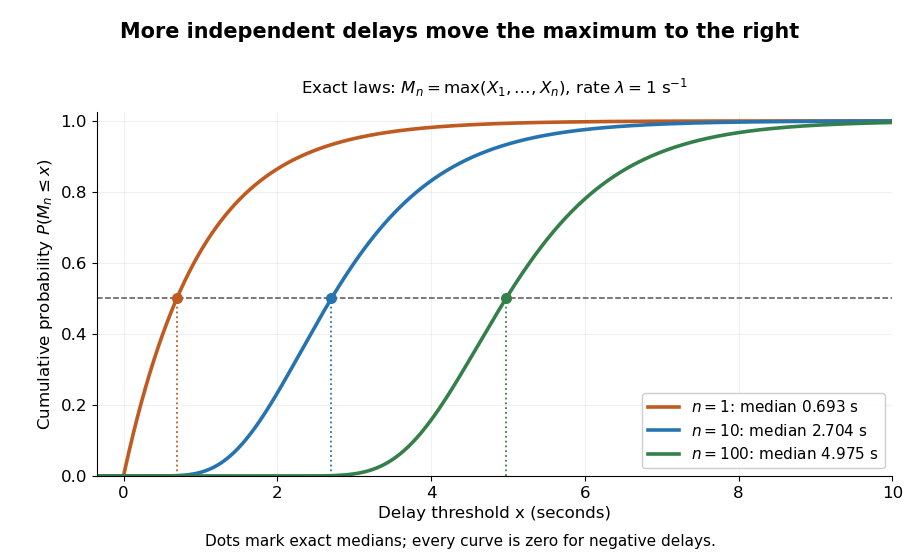
Exact cumulative distribution functions of exponential sample maxima, with rate one per second and median markers
. Details. 
The Gumbel distribution explains the logarithmic shift visible here: after subtracting and measuring deviations in units of , the distribution functions approach one fixed shape. The next derivation makes that convergence in distribution explicit.
Articles by others on the same topic
There are currently no matching articles.