Take a homogeneous material exhibiting superconductivity in the half-space , bounded by vacuum at . Fix the temperature below the superconducting transition temperature, take a constant positive London penetration depth , and assume a local, linear London equation description in a Meissner state. The applied magnetic field is weak enough that it neither nucleates a quantum vortex nor appreciably suppresses the material's superconductivity. Assume translation invariance in , no imposed transport electric current, and a tangential boundary magnetic field . Here is the local surface magnetic flux density, equal to the imposed vacuum magnetic field in this infinite planar geometry; it is not automatically the far-away applied value for a finite object.
For a bounded, decaying interior solution, the London equations, magnetostatic Ampère law and Gauss's law for magnetism giveThe solution isAt one London penetration depth the magnetic field is of its surface value; at five it is . There is no finite depth where this exponential is exactly zero. The differential equation excludes the growing exponential through the deep-interior boundary condition. A constant normal component cannot decay in this geometry: Gauss's law for magnetism would require . A perpendicular applied magnetic field on a finite plate therefore requires a different spatial problem.[ref]
Lecture notes on the electrodynamics of metals and superconductors. §2, p. 13, Eqs. (68)–(74): London screening equation; the planar boundary-value solution here follows directly
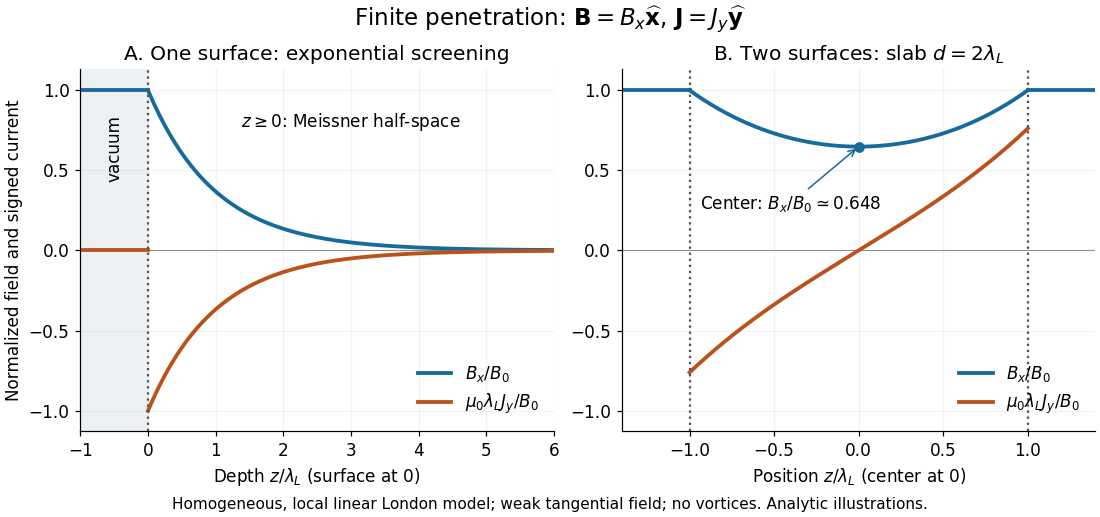

In SI units, the magnetostatic Ampère law gives the current density supporting Planar London screening:Here is the vacuum permeability. The sign follows from in the chosen coordinates. Thus requires electric current along . Its own magnetic field opposes the imposed magnetic field inside the material. The electric current is distributed over a finite layer; its depth integral is the effective surface current densityThe units are for and for . Shrinking at fixed increases the surface current density, while this integrated surface current density stays fixed. The current sheet approximation is the large-length-scale limit of this layer, not a claim that an actual sample carries an infinitely thin electric current. It reproduces the magnetic-field jump across a surface current between the exterior and a field-free interior, with outward unit normal .
Articles by others on the same topic
There are currently no matching articles.