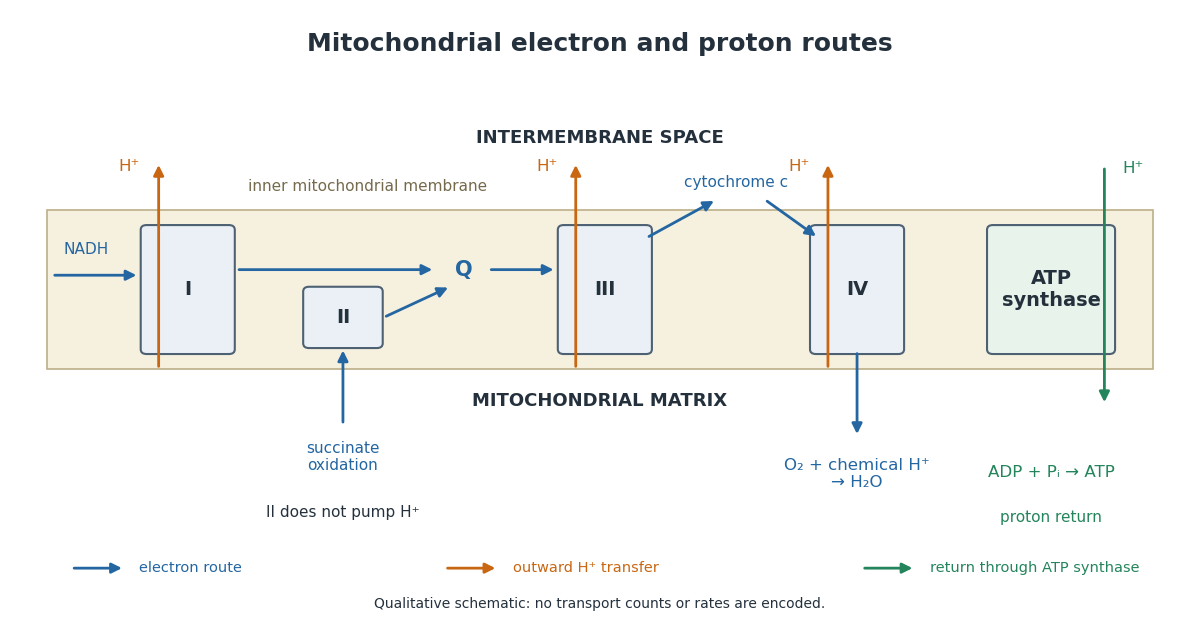
NADH supplies two electrons to respiratory complex I, then ubiquinone, respiratory complex III, cytochrome c and cytochrome c oxidase; terminal oxygen reduction forms water. Succinate dehydrogenase, or respiratory complex II, supplies another entry to ubiquinone. Respiratory complex I, respiratory complex III and cytochrome c oxidase move protons outward; respiratory complex II does not.[ref]

For an original electron balance, supply exactly of NADH to an ideal preparation with no other electron donor or competing electron acceptor. The donor supplies of electrons. Complete reduction of one oxygen molecule needs four electrons, so the corresponding oxygen consumption is . Adding the two formal half-reactions makes the result explicit:The cancelling electrons determine the donor-to-oxygen ratio. These chemical equations do not count transmembrane protons or determine an ATP yield. Chemical protons consumed in water formation and transported protons have different roles in the ledger.
Respiratory complex I, or NADH:ubiquinone oxidoreductase, transfers electrons from NADH to ubiquinone and couples the process to proton translocation across the inner mitochondrial membrane. Its flavin and iron-sulfur centers form part of the electron-transfer pathway.
The resulting contribution to the proton gradient can support ATP synthesis. Electron transfer and proton movement are coupled molecular processes; the complex does not directly phosphorylate ADP. Its physiological direction and behavior depend on redox and membrane-potential conditions.
Succinate dehydrogenase oxidizes succinate to fumarate and transfers the electrons through bound cofactors to ubiquinone. In mitochondria it is respiratory complex II, linking the citric acid cycle with the respiratory chain.
Unlike complexes I, III, and IV, it does not itself pump protons across the membrane. This distinction explains why electrons entering through succinate contribute differently to the proton-motive output than electrons entering through NADH.
Respiratory complex III, the cytochrome bc1 complex, transfers electrons from ubiquinol to cytochrome c. Its Q-cycle mechanism separates the two electrons from a quinol and couples their transfer to vectorial proton movement.
Cytochrome c carries one electron at a time, whereas ubiquinol carries two. The mechanism therefore connects carriers with different electron stoichiometries while contributing to the membrane electrochemical gradient.
Cytochrome c oxidase is respiratory complex IV. It receives electrons from cytochrome c and reduces molecular oxygen to water at metal-containing catalytic centers.
This reaction consumes substrate protons and is coupled to additional proton translocation across the membrane. Distinguishing chemical proton consumption from pumped protons is essential in counting the complex's contribution to the proton-motive force.
Articles by others on the same topic
There are currently no matching articles.