A multiwire proportional chamber is a proportional counter: parallel anode wires between cathodes in a gas. Charged particle ionization frees Electrons; an electric field drives them toward wires, triggering an electron avalanche read by electronic amplifiers.[ref]
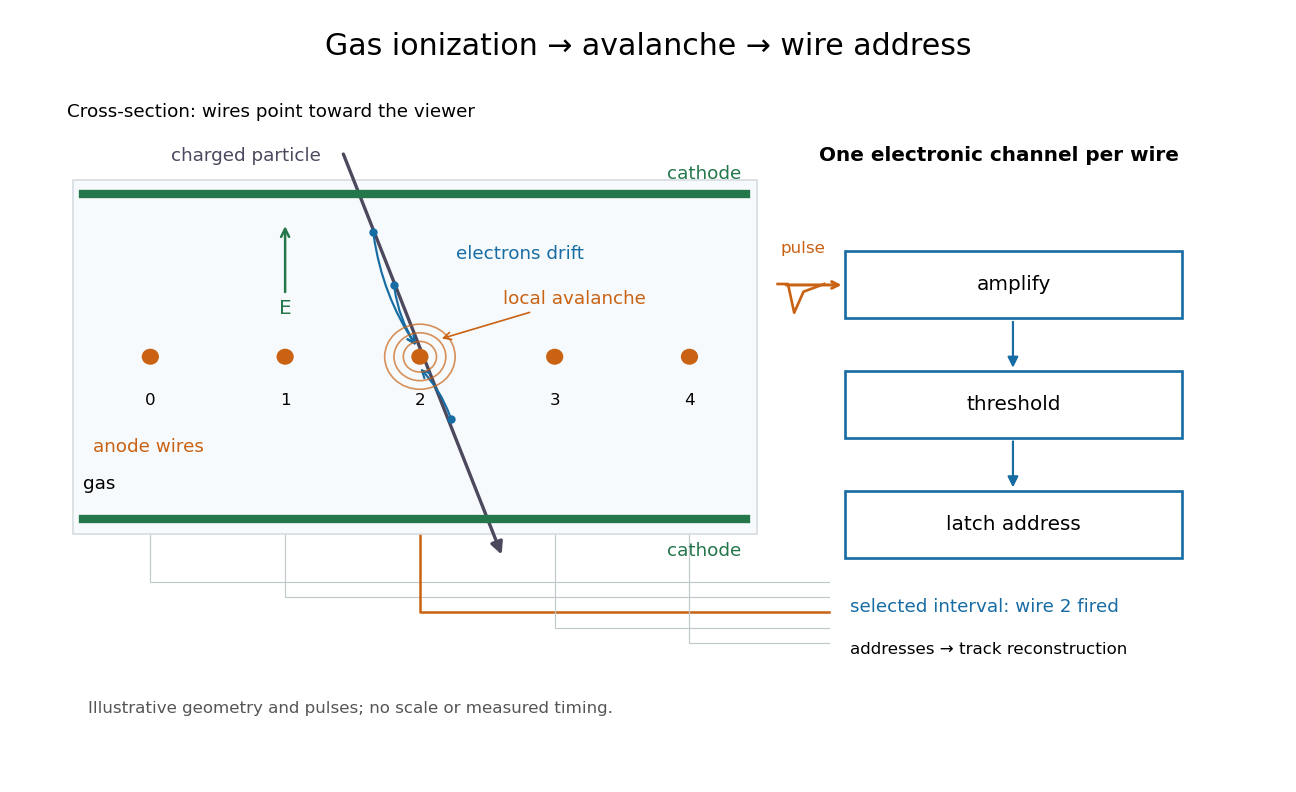

Opposite polarities identify the avalanche wire. Positive ion motion dominates integrated signal; detection precedes complete collection. Calibrated Electron travel times enable drift chambers.[ref]
The original apparatus used stainless-steel wires between meshes away, flowing argon with organic vapor, negative mesh voltage and individual electronic amplifiers. A X-ray source calibrated pulse height while voltage was varied.[ref]
A coincidence circuit defined a narrow proton or pion beam. Scanning it across wires tested localization; the response edge matched the beam width, limiting the inference. Distant counts were attributed to accidental coincidences. Separate Electron scans measured pulse delay versus position, comparing gas mixtures and pulse-height-dependent electronics.[ref]
Thresholds rejected small pulses, reducing detection efficiency. Wire-independence tests did not establish unlimited separation of overlapping tracks.[ref]
The centre-to-centre spacing of adjacent wires. A wire address alone specifies a cell, rather than a continuous position.
Consider an original idealized track reconstruction model. Let equally spaced wires have positions and assign each event to the nearest wire, reporting . Assume exactly one correct wire address, perfect detection efficiency, exact wire positions and a uniform distribution of true positions within each cell. These assumptions explicitly exclude missed pulses, false addresses and several unresolved tracks.
Writing , the measurement error is , with uniform on . Symmetry gives zero expected value. Its variance and standard deviation follow by integration:For chosen wire pitches and this gives and respectively. These are model standard deviations, not measured chamber spatial resolutions. The largest possible absolute error in this model is , which is a different quantity.
A useful subtlety is that the formula depends on the illumination. For an unresolved pencil beam fixed at , every reconstructed position is . The repeated estimates have zero variance, but every error is . Small repeat-to-repeat spread can coexist with a biased position. The uniform-cell result therefore cannot be transferred to an arbitrary beam profile or detector selection.
The wire address supplies one transverse coordinate in this model. Combining several separated measurements supports track reconstruction; a single address does not specify a complete trajectory. If two charged particles enter the same cell during one accepted interval, an address-only record can be identical to that from one particle. No reconstruction of that record can recover the lost multiplicity without additional information.
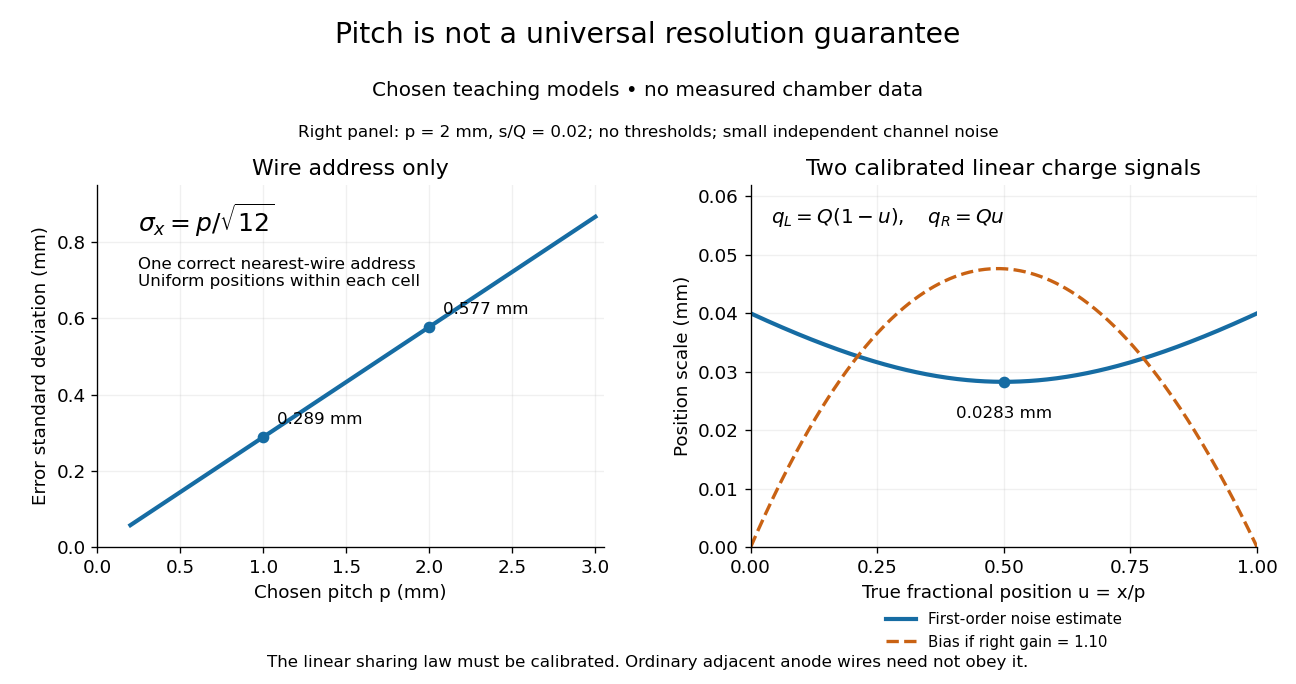

Can two readout values locate a hit between wires? Only with a specified response model. Place two readout wires at and , put , and stipulate calibrated, noiseless electric chargesThese are assumptions for a toy sensor response, not the natural response law of adjacent anode wires. Under these assumptions the centroidrecovers position exactly. The apparent gain in precision comes from adding calibrated analogue information. Taking the mean of two fired wire addresses without their electric charges would instead give the fixed midpoint .
For a chosen noise model, replace the two electric charges by and , with independent random variables of zero expected value and common standard deviation . Assume and no threshold censoring. First-order expansion of the ratio givesFor stipulated and , this approximation gives at the midpoint and at either endpoint. The endpoint values describe uncensored signed channel readouts, including small negative values after baseline subtraction. They do not assume that both channels would pass a positive threshold. A ratio with a fluctuating denominator also need not have exactly zero bias; this is a local small-noise approximation.
Three original counterexamples show why calibration and selection matter:
- If the right channel retains a relative gain , then . At , the bias is for the chosen pitch, larger than the midpoint noise estimate above.
- Suppose symmetric electronic leakage transforms the normalized right signal to . Treating as gives a position bias . A known permits inversion; destroys position information entirely. This is a stipulated crosstalk model, not a measurement.
- Requiring both noiseless channels to exceed accepts only : of uniformly distributed hits. Computing a position spread after that cut describes a selected sample. It does not establish improved spatial resolution for all incident hits.
Likewise, two equal hits at and have exactly the same total two-channel response as one hit at with twice the electric charge. A centroid can hide multiplicity even when each charge measurement is exact.
Articles by others on the same topic
There are currently no matching articles.