Neutrino astronomy infers properties of astronomical sources from detected neutrino reactions. Solar neutrino detection probes ongoing stellar nuclear fusion; the SN 1987A neutrino burst probes a brief episode of core-collapse supernova evolution. A detector observes reaction products, so source inference depends on cross sections, neutrino flavor, thresholds and detection efficiency.
Kamiokande, associated with Masatoshi Koshiba, was an underground water Cherenkov detector viewed by photomultipliers. Improved water purity and reduced background enabled solar neutrino observations. A concentration of reconstructed recoil directions toward the Sun distinguished a source signal above an approximately direction-independent background.[ref]
For solar neutrinos, Electron elastic scattering supplies a directional recoil, with different cross sections for active neutrino flavors. Neither the Homestake experiment deficit nor the SN 1987A neutrino burst alone established neutrino oscillation; later evidence compared complementary channels and propagation effects.[ref]
Nobel Lecture: Birth of neutrino astrophysics by Masatoshi Koshiba. pp. 1013, 1016–1018: scattering and combined oscillation evidence
Water Cherenkov neutrino reconstruction infers a vertex, time and charged particle direction from photomultiplier pulses. The 1987 analysis recorded charge and timing, calibrated with decaying muons and source-produced gamma rays, and rejected outer-detector activity and events following muons.[ref]
Observation of a Neutrino Burst from the Supernova SN1987A by K. Hirata and others. pp. 1490–1491; Fig. 1 and event-selection criteria
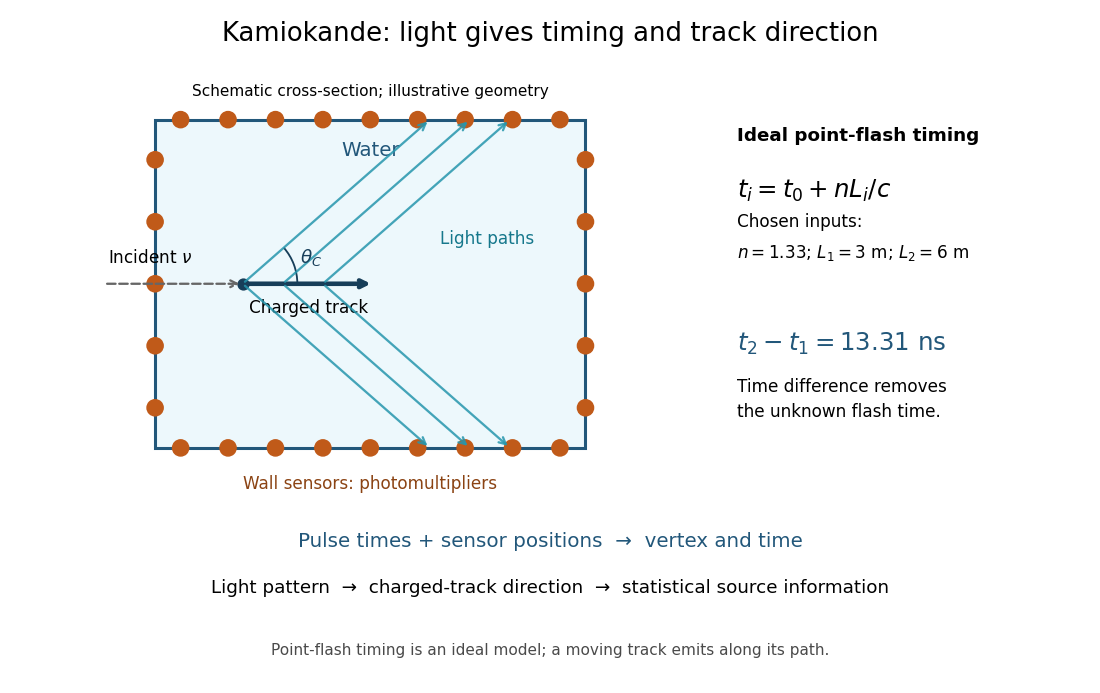

In an ideal point-flash approximation, a light source at and time gives the displayed travel-time relation at sensor in a medium of refractive index . Subtracting two times eliminates . With a chosen constant and path lengths and , the arrival-time difference is . These are synthetic inputs, not detector measurements. Several sensors constrain the vertex; an extended moving track requires the light-emission position and time along that track as well.
For a charged particle moving at , the Cherenkov cone angle satisfies when . With and the illustrative , . The geometrical cone carries track-direction information; Electron deflections and the spread of emission positions broaden the observed pattern. The neutrino itself does not draw the light cone.
A Cherenkov radiation threshold and an analysis threshold are different constraints. For a fixed , an Electron must exceed . With and the chosen , this gives about . Recording and selecting a useful event requires much more light: the 1987 detector's trigger accepted Electrons with 50% efficiency.[ref]
Observation of a Neutrino Burst from the Supernova SN1987A by K. Hirata and others. p. 1491: trigger acceptance
Articles by others on the same topic
There are currently no matching articles.