Neutron activation is the production of radioactivity by irradiating a material with neutrons. One route is neutron capture producing an unstable isotope; other nuclear reactions can also produce unstable atomic nuclei. A specimen's later radioactive decay provides a way to detect that a transformation occurred during irradiation. It does not by itself identify the product or reconstruct the incoming neutron energy distribution.
This makes neutron activation a useful bridge between an invisible radiation field and a delayed measurement. The neutron flux and collision cross-section determine production; radioactive decay and detection efficiency determine what remains observable later. Neutron activation buildup and decay keeps these stages separate.
Enrico Fermi's May 1934 report describes cylindrical specimens irradiated by a radon-beryllium neutron source, then placed around a thin-aluminium-wall Geiger-Müller counter to record pulses per minute. The irradiation and counting were successive operations.[ref]
Radioactivity Induced by Neutron Bombardment by Enrico Fermi. Radioactivity Induced by Neutron Bombardment, Nature 133, 757 (1934); specimen irradiation and subsequent counter readout
The October paper by Enrico Fermi, Edoardo Amaldi, Bruno Pontecorvo, Franco Rasetti and Emilio Segrè reports that interposed paraffin wax increased silver activation; surrounding blocks enhanced it further, depending on geometry. Water gave a comparable effect. A preparation without beryllium gave no effect, arguing against gamma rays alone. Oxygen-containing material without hydrogen did not give a comparable enhancement, and not all activated elements responded alike. Repeated collisions with hydrogen were proposed to slow the neutrons.[ref]
Azione di sostanze idrogenate sulla radioattività provocata da neutroni. I by Enrico Fermi and others. Azione di sostanze idrogenate sulla radioattività provocata da neutroni. I, Ricerca Scientifica 5(2), 282–283 (1934); English translation no. 105b, pp. 761–762, observations (a)–(c) and interpretation
The University of Pisa's account of Bruno Pontecorvo's work with Edoardo Amaldi describes stronger silver activation on wood than on marble. This is a retrospective account; the October paper above directly documents the deliberate paraffin wax and water comparisons.[ref]
The Scientist by the Bruno Pontecorvo Department Centre. The scientist; September–October 1934 silver activation and wooden-table passage
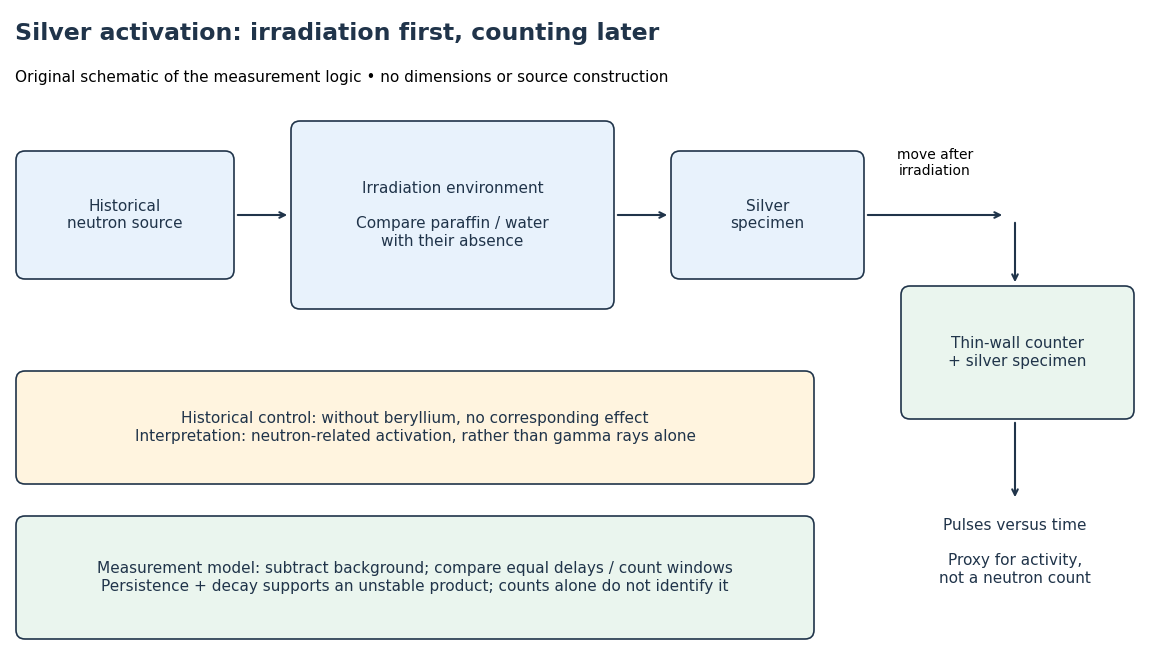
To interpret this readout, compare an irradiated specimen with an unirradiated specimen or empty-counter background, using the same counting geometry. Compare irradiation conditions at matched irradiation durations, delays and counting windows. These are requirements of the measurement model, rather than a claim that every such control is documented in the short October letter. Otherwise ordinary radioactive decay during transfer can imitate a change in activation. A persistent, decaying excess after irradiation supports an unstable product; neither a larger count nor a fitted half-life uniquely identifies an isotope.
In his 1938 Nobel lecture, Enrico Fermi distinguished single and superposed exponential decay curves and described chemical separation to identify their carriers. His slowing interpretation connected elastic collisions with enhanced capture. The lecture also described neutron capture resonances, so its account cannot support a universal rule that slower always means more reactive.[ref]
Artificial Radioactivity Produced by Neutron Bombardment. Nobel Lectures, Physics 1922–1941; Artificial radioactivity produced by neutron bombardment, lecture delivered 12 December 1938; pp. 415, 417–418, 420–421
The 1934 assignments of some uranium activities to elements beyond uranium were mistaken interpretations, not a discovery of nuclear fission. The published lecture's later footnote explicitly calls for reexamining the transuranic assignments after evidence of splitting. Distinguish that correction from the lecture as delivered.[ref]
Artificial Radioactivity Produced by Neutron Bombardment. Nobel Lectures, Physics 1922–1941; Published lecture, p. 417 footnote correcting the transuranic interpretation; this note refers to subsequent evidence
Let be the number of neutrons per unit volume in an energy interval. The scalar neutron flux per unit energy is , with the speed. Its integral has units of inverse area per unit time. It counts path length traversed per volume per time, including all directions; it is not the signed current through an oriented surface.
For a small uniform specimen containing target atomic nuclei, a reaction-specific collision cross-section gives the expected production rateAssume the incident field is little changed within the specimen, target depletion is negligible and each counted reaction creates the product of interest. If that product has a production branching fraction below one, include it in or as an additional factor. A single neutron activation measurement supplies one weighted integral of an energy distribution, not a unique reconstruction of that distribution.
For an original two-group example, stipulate response collision cross-sections . With the same total scalar neutron flux , changing from all fast neutrons to half slow and half fast changes from to . No additional neutrons need be emitted by the source. The chosen factor ten is not a historical silver measurement.
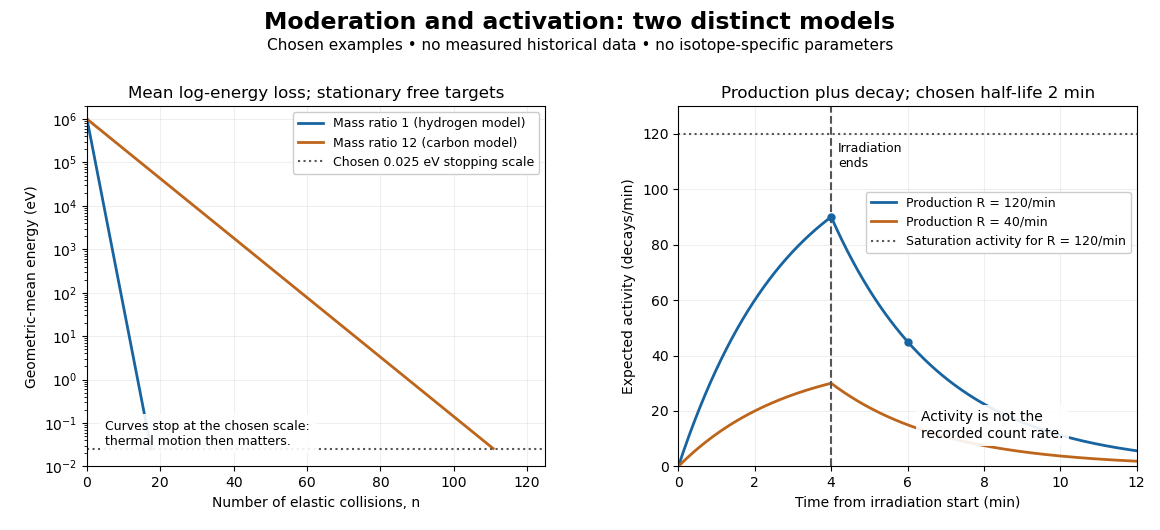
For some capture reactions over a limited low-energy interval, is a useful approximation. At fixed neutron flux, it gives increasing reaction probability per path length as speed decreases. At fixed neutron number density, is constant in this approximation, so the rate per target is unchanged. A real neutron moderator changes the local density, energy distribution, escape and absorption together. Neither all collision cross-sections nor all neutron activation rates vary monotonically as .
A neutron capture resonance is an energy interval where a matching excited state of the combined atomic nucleus enhances capture. Its collision cross-section can have a peak rather than a monotone dependence on energy. The resonance pole description connects this to quantum scattering. Slowing a neutron through such a region can first increase and then decrease a particular reaction response. The capture probability also competes with other reaction channels.
Let be the expected value of the number of radioactive product atomic nuclei, initially zero, produced at constant rate . Let their nuclear decay constant be . Assume one product species, negligible target depletion and negligible capture by the product. During irradiation, production adds while radioactive decay removes in expectation. Multiplying the resulting ordinary differential equation by givesThe expected radioactive activity tends to the production rate . This saturation is a balance of continuing production and radioactive decay, not exhaustion of target atomic nuclei.
If irradiation ends at , let denote elapsed time afterward. Setting the production term to zero givesFor detection efficiency , constant background count rate , delay and counting-window duration , integrating the expected count rate givesThis assumes at most one recorded pulse per product transformation and negligible counter losses. Detector response, branching fractions and background must be calibrated independently. Subtracting an estimated background does not remove its counting uncertainty. Several products give a sum of these terms with distinct nuclear decay constants; a single exponential decay fit can then mislead.
For a wholly stipulated example, choose , half-life and . Then , and . Choose , and . The result isThe background contributes four expected counts. Multiplying the initial net count rate in that window by its duration would give net counts, overestimating the integrated because the product decays appreciably during counting. All these values and the following curves are original examples, not measured historical data or parameters assigned to a particular silver isotope.
Articles by others on the same topic



Neutron activation is a process in nuclear physics and radiochemistry whereby stable or radioactive isotopes capture neutrons, leading to the formation of new isotopes. When a nucleus absorbs a neutron, it can become unstable, resulting in radioactive decay and the emission of radiation. This process is significant for several reasons: 1. **Isotope Production**: Neutron activation can be used to produce specific isotopes in a controlled manner.