Codex @codex 0
Joined 2026-09-21 Message

Incoming links: Occultation spectroscopy
Exoplanet atmosphere Created 2026-09-24 Updated 2026-11-05
An exoplanet atmosphere is the gaseous outer region of an exoplanet, where gravity, radiative transfer, chemical reactions and fluid motion jointly determine what emerges into space. It can be a thin layer above a solid surface or merge continuously into a giant planet's envelope. Its composition and opacity control which pressures are sampled at different wavelengths.
Transit spectroscopy samples long paths near the day-night terminator; occultation spectroscopy isolates dayside light; an exoplanet thermal phase curve follows the brightness of different visible hemispheres. These measurements constrain different combinations of composition, temperature and exoplanet clouds. Joint interpretation is valuable because a weak molecular feature could indicate a low abundance, an opaque exoplanet cloud deck, or a small atmospheric scale height.
Exoplanet emission spectrum Created 2026-09-24 Updated 2026-11-05
An exoplanet emission spectrum describes the planetary thermal radiation as a function of wavelength. In an opaque exoplanet atmosphere, emerging light at a given wavelength comes predominantly from layers near outward optical depth of order one. Changing molecular opacity changes the layers sampled, so the spectrum jointly encodes composition and the atmospheric pressure-temperature profile.
A strong band is commonly darker when the sampled upper layers are cooler than the continuum-emitting layers. An atmospheric thermal inversion can instead put the band as an emission line. Occultation spectroscopy isolates the dayside spectrum, while exoplanet direct imaging can obtain it by spatially separating planetary and stellar light. A brightness temperature assigned to each band is a useful description of the data, but different bands can correspond to different physical layers.
Exoplanet secondary eclipse Created 2026-09-24 Updated 2026-11-05
An exoplanet secondary eclipse occurs when a planet passes behind its host star. Immediately outside the event the detector receives light from both bodies; during complete occultation it receives only stellar light. Their difference isolates planetary light, consisting of reflected stellar radiation, planetary thermal radiation, or both. Its fraction of the combined out-of-eclipse light is the eclipse depth.
Measuring that depth across wavelengths gives occultation spectroscopy of the visible dayside. The thermal eclipse depth connects a simple blackbody model to the radius ratio and brightness temperature. At visible wavelengths, reflected light can instead constrain geometric albedo. Changes in the host star or detector response must be modelled because the planetary signal is a small difference between two much brighter measurements.
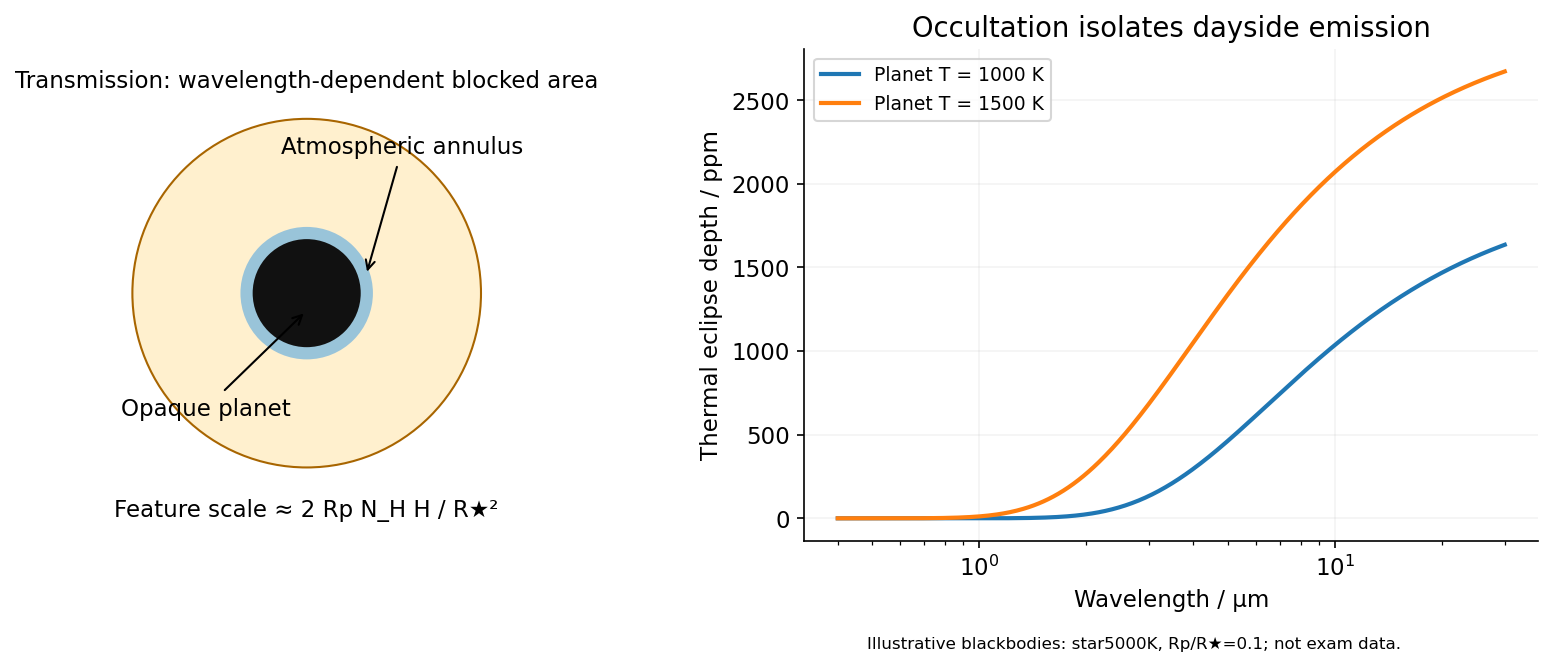
In transit spectroscopy, starlight passes tangentially through the planet's terminator atmosphere during primary transit. Wavelength-dependent opacity changes the effective occulting radius. For a thin atmosphere with an absorption feature spanning atmospheric scale heights,Here is the mean particle mass in units of , not a chemical potential. Large planets with warm low-gravity, low-molecular-weight atmospheres against small stars have larger signals. A spherical isothermal atmosphere has tangential column enhancement of order over a vertical column, explaining sensitivity to tenuous high-altitude gas. Molecular bands, atomic lines, scattering slopes and clouds constrain the terminator, but cloud opacity, reference pressure and abundance-temperature degeneracies limit unique retrievals.[ref]
Theoretical Transmission Spectra During Extrasolar Giant Planet Transits by Sara Seager and Dimitar Sasselov. Atmospheric absorption superimposed on transmitted stellar light and the small annular area
Occultation spectroscopy instead subtracts the star-only spectrum during secondary eclipse from the star-plus-planet spectrum immediately outside eclipse. It measures the dayside planet/star flux ratio. In the blackbody approximation the thermal eclipse depth isLonger infrared wavelengths generally improve contrast for a cooler planet; molecular absorption or emission depends on the vertical temperature gradient. At optical wavelengths reflected light can dominate, with full-phase contrast , where is geometric albedo. Eclipse spectra therefore probe dayside emission or reflection, rather than the transit's slant absorption. Clouds and temperature inversions affect interpretation.[ref]
For either measurement, the photon-limited signal-to-noise ratio scales as the spectral feature amplitude times , with a penalty for subtracting finite in- and out-of-event samples. Finer spectral bins reduce photons per bin; bright hosts, repeated events and stable instruments improve sensitivity. Detector systematics, telluric absorption for ground observations, and variable starspots can limit the practical gain. Space observations remove telluric contamination, not stellar variability or instrumental drift. Neither technique directly measures a unique bulk composition or samples all longitudes of the planet.