An exoplanet atmosphere controls the planet's spectrum, heat redistribution, chemistry, clouds, and atmospheric escape.
A secondary planetary atmosphere is supplied or replenished after the original nebular-envelope stage, through outgassing, volatile delivery and processing. The present atmospheres of Earth, Venus and Mars are predominantly secondary. The distinction from a primary planetary atmosphere concerns origin, not merely current molecular weight.
A primary planetary atmosphere is a retained gas envelope acquired from the protoplanetary nebula, commonly rich in molecular hydrogen and helium. The solar-system giant planets retain such envelopes, while escape and subsequent processing can substantially change their composition.
The lower part of a planetary atmosphere where temperature generally decreases outward and convection can carry intrinsic or surface heat. Its upper boundary is a tropopause. Stellar irradiation, composition gradients and clouds affect the extent of this region; pressure alone does not universally identify it.
The transition above a planetary troposphere, usually near a temperature minimum or the change to a weakly varying or outward-increasing temperature profile. The overlying planetary stratosphere is stable against ordinary thermal convection. Its pressure is planet- and location-dependent.
For , , and physical , the atmospheric pressure-temperature profile is equivalent toThe branch restriction is essential: squaring does not create a second physical branch. Its temperature gradient is . Thus, in hydrostatic equilibrium, gives an atmospheric thermal inversion, while gives outward cooling. At the inverse branch has zero derivative; gives constant pressure and cannot describe a nontrivial hydrostatic vertical interval.
For a homogeneous ideal gas of constant specific-heat ratio , the Schwarzschild criterion applied to the square-root exponential atmospheric profile givesFor and , put and . The quadratic inequality has solutions precisely when , between . This is a local instability of the imposed temperature gradient; actual convection adjusts that gradient and the prescribed profile need not survive.
The atmospheric lapse rate is the decrease of temperature with altitude, . In an ideal gas with constant gravity, a constant lapse rate produces a power-law relation between temperature and pressure.
An irradiated planetary atmosphere receives stellar energy from above while internal heat emerges from below. Their competition creates radiative, convective, and sometimes thermally inverted regions.
An atmosphere that absorbs and reemits thermal radiation can reduce outgoing energy at a given surface temperature, requiring a warmer surface to balance absorbed stellar energy. The planetary equilibrium temperature refers to the radiation budget, not the resulting surface temperature. Water, carbon dioxide and clouds can alter this balance.
A greenhouse gas absorbs and emits planetary thermal radiation and therefore contributes to the greenhouse effect. Its climatic impact depends on absorption spectrum, concentration, lifetime and chemical effects. Carbon dioxide, methane and water vapour are important examples.
Global warming potential compares the time-integrated radiative forcing of equal-mass emission pulses of a greenhouse gas and carbon dioxide, over a stated time horizon . It is not an instantaneous temperature ratio, and its numerical value depends on the horizon and included chemical and climatic responses.
A single-layer greenhouse model represents an atmosphere by one uniform layer that absorbs and emits a fraction of thermal radiation. With infrared emissivity , the layer emits both upward and downward.
For a planet of Bond albedo orbiting a blackbody star of radius and temperature , complete global redistribution and negligible internal heat giveUniform dayside-only reradiation replaces by . The planetary equilibrium temperature describes absorbed stellar power; including an intrinsic cooling flux gives a total effective temperature , distinct from . Neither quantity is necessarily the greenhouse-warmed surface temperature.
A semi-grey atmosphere uses separate mean visible and infrared opacities. Their ratio controls where stellar energy is deposited.
The irradiation temperature is defined from the incident stellar flux, commonly by before redistribution and albedo factors are applied.
The internal effective temperature parametrizes the intrinsic cooling luminosity of a planet through .
An atmospheric thermal inversion is a region where temperature increases outward. In a strongly irradiated atmosphere it can arise when shortwave opacity exceeds thermal infrared opacity and stellar energy is absorbed high in the atmosphere.
An upper atmospheric region above the tropopause in which shortwave heating can produce an atmospheric thermal inversion. Ozone on Earth, and methane and aerosols on giant planets, are examples of absorbers that help heat it. Its positive altitude temperature gradient makes it stable against homogeneous-gas thermal convection.
For the usual semi-grey irradiated atmosphere with downward thermal optical depth , an inversion occurs where , with the visible-to-thermal opacity ratio. At negligible intrinsic flux the threshold reduces to .
A strong-opacity line forms higher than the nearby continuum. Under the Eddington-Barbier approximation, an outward-decreasing temperature therefore makes an absorption line, while an atmospheric thermal inversion makes the line-forming layer hotter and reverses it into emission.
The radiative-convective boundary is where radiative transport first requires a temperature gradient steeper than the adiabatic gradient, causing convection below.
This model solves a vertical atmospheric pressure-temperature profile consistent with heating, radiative transfer and a convective adjustment where the radiative gradient exceeds the adiabatic temperature gradient. Irradiation, intrinsic flux, gravity and opacity determine the radiative-convective boundary. A one-dimensional model describes a column or average rather than resolving all atmospheric winds.
A constant radiative-diffusion coefficient and constant gravity give . Thus for . A diatomic ideal gas has adiabatic temperature gradient , so this idealized profile never becomes convective. A physical radiative-convective boundary requires additional opacity, flux, or thermodynamic variation.
The radiative temperature gradient is the logarithmic pressure gradient required to carry the flux by radiation. Convection begins when it exceeds the relevant adiabatic gradient.
For a homogeneous dry ideal gas in a hydrostatic adiabat, , where increases upwards and is the specific heat capacity at constant pressure per unit mass. It follows from and hydrostatic equilibrium. The altitude version of the Schwarzschild criterion is for instability; equality is marginal. Moisture, composition gradients and nonideal equations of state modify the criterion.
A dry parcel in rapid pressure balance with an ambient ideal gas has . Ambient hydrostatic equilibrium gives , hence . At a temperature-matched launch point this equals the dry adiabatic lapse rate, supplying the local linear stability test. A substantially hotter parcel does not exactly follow the ambient density's hydrostatic adiabat.
Secondary eclipses are one of the methods of detecting exoplanets and also probe planetary emission.
During secondary eclipse the planet passes behind its star. The lost system light measures the planet-star flux ratio from reflected starlight and planetary thermal emission.
Geometric albedo compares a body's full-phase brightness with that of a flat, perfectly diffusing reference disc of the same cross-section.
The orbital variation of a planet's reflected stellar light as the visible illuminated area changes. In a simple spherical model, , where and is the star-planet-observer angle. Exoplanet clouds can alter the geometric albedo and the angular scattering law; this observable differs from an exoplanet thermal phase curve.
The phase integral converts a monochromatic geometric albedo into the corresponding reflected power fraction. The bolometric Bond albedo is the incident-spectrum-weighted average of .
Bond albedo is the fraction of total incident power reflected in all directions and over all wavelengths.
This idealized surface follows Lambertian reflectance, with projected-area dependence governed by Lambert's cosine law.
A Lambertian surface has direction-independent radiance. A perfectly reflecting Lambertian patch receiving normal flux emits specific intensity into its outward hemisphere.
For blackbody star and planet, define the planet-star contrastA complete exoplanet secondary eclipse removes the planet's light from the combined out-of-eclipse light. Its exact normalized depth is . The common approximation requires . This thermal model omits reflected light and spatial variations.
For blackbodies with , the contrast increases with wavelength, where . Indeed , with increasing for because . The contrast approaches in the Rayleigh-Jeans law limit. This behavior differs from the peaked absolute blackbody flux.
For blackbody star and planet observed at one common wavelength sufficiently long for the Rayleigh-Jeans law to hold for both,This follows by substituting in the thermal eclipse depth. A radiative flux ratio alone does not determine the radius without a planetary brightness temperature and a stellar temperature. Spectral peaks interpreted with Wien's displacement law must refer to , not or .
Transit spectroscopy infers the properties of an exoplanet atmosphere from the wavelength dependence of an exoplanet transit. Its measured product is an exoplanet transmission spectrum, while an annulus model for transmission spectroscopy connects the spectrum to atmospheric optical depth. The observing technique is described by NASA.
An exoplanet transmission spectrum measures the wavelength-dependent area blocked as starlight passes tangentially through the atmosphere during transit.
Take a planet with opaque radius and an atmosphere of thickness , projected against a uniform stellar disc of radius . If the atmospheric annulus has one representative slant optical depth , its additional transit depth isThe general exoplanet transmission spectrum instead uses an integral over impact parameter ,The annulus model replaces this varying slant opacity by an effective constant. The atmospheric signal scales with optical depth when optically thin and saturates at the annular area when opaque.
An exoplanet cloud deck divides the projected atmospheric annulus into cloudy and clear radial zones. Their contributions to the exoplanet transmission spectrum add as projected areas multiplied by for each zone's slant optical depth.
This is the atmospheric instance of a scale height.
For an isothermal ideal-gas atmosphere, . A strong transmission feature spanning scale heights has approximate transit-depth amplitude .
For an isothermal thin atmosphere with number density and extinction cross-section , a tangent ray near radius has height at distance along the ray. The resulting Gaussian integral gives slant optical depthThe effective transit height is near , so if composition is constant. This explains the scattering slope of a transmission spectrum.
If an isothermal thin atmosphere has surface radius , surface pressure , and nearly constant gravity, the radius of a pressure level is
The column mass between pressures and is . A thin atmosphere over a spherical planet therefore haswhen its top pressure is negligible.
If extinction scales as , an isothermal hydrostatic atmosphere has . The measured continuum slope can therefore estimate atmospheric temperature when gravity and mean molecular mass are known.
For and , the logarithmic slope is . The opaque planetary baseline generally dilutes the slope. In the optically thin limit, the atmospheric excess has logarithmic slope .
The day-night terminator is the boundary between the illuminated and dark hemispheres of a planet. During transit, stellar rays probe morning and evening limbs that can have different temperatures, clouds, and compositions.
If the morning and evening limbs have effective radii and and each occupies half the annulus, the transit area is .
An exoplanet emission spectrum is the wavelength-dependent thermal radiation emerging from the planet. Vertical temperature gradients turn opacity differences into absorption or emission features.
The brightness temperature at a frequency or wavelength is the temperature for which a blackbody has the measured specific intensity there: . It need not equal a physical temperature shared by the entire emitting object.
A brightness temperature equates a measured intensity with a Planck function; it does not determine its contribution pressure. In hydrostatic equilibrium, . Estimating therefore needs gravity and opacity, as well as a model of the contribution function. Different pressures can produce the same band brightness.
An exoplanet cloud is a suspended condensate aerosol that scatters or absorbs radiation. Its particle sizes, composition, vertical extent, and horizontal coverage shape transmission, reflection, and thermal-emission spectra.
Condensation followed by gravitational settling removes chemical elements from an atmospheric layer. The remaining gas may be in local chemical equilibrium with a depleted elemental inventory, while the column is not a closed equilibrium system.
A sufficiently cold layer condenses a volatile or refractory carrier and limits its transport to higher layers. Water depletion above the terrestrial tropopause and titanium-bearing condensates in some hot Jupiter models illustrate this process.
An exoplanet cloud deck is an optically thick cloud layer whose top pressure fixes the deepest level visible over a wavelength interval. A high deck can truncate a transmission spectrum and mute molecular features.
With constant gravity and mean molecular weight, hydrostatic equilibrium gives , where is the atmospheric scale height. A flat exoplanet transmission spectrum alone does not determine or a unique cloud-top pressure.
With constant atmospheric scale height , a molecular band at height above the measured continuum satisfies . If an opaque exoplanet cloud deck sets that continuum, then ; the band pressure is not the cloud pressure. If the clear band height would be above a clear continuum at and the cloud reduces the visible feature to , thenWithout the clear-atmosphere band opacity or , the measured feature amplitude alone cannot locate the cloud top. This follows directly by subtracting the two hydrostatic height relations.
Atmospheric haze consists of small suspended particles, often produced photochemically. A haze can flatten molecular features or produce a wavelength-dependent scattering slope.
Exoplanet atmospheric dynamics includes day-night circulation, zonal jets, waves, vortices, storms, and heat redistribution under irradiation, rotation, drag, and magnetic effects.
Day-night heat redistribution transports absorbed stellar energy from an irradiated hemisphere to a dark hemisphere through atmospheric or oceanic motion. Its efficiency controls the thermal phase-curve amplitude and nightside temperature of a synchronously rotating planet.
This factor converts substellar incident flux into the representative flux used in an atmospheric model. Uniform global averaging gives ; dayside averaging gives if albedo is treated separately. The convention must be stated when defining an irradiation temperature.
A column near pressure contains mass per area of order . Linearizing its blackbody cooling around temperature gives the estimatewhere is specific heat capacity at constant pressure. This estimate omits details of wavelength-dependent radiative transfer, but captures faster relaxation in hotter and lower-pressure atmospheric layers.
The atmospheric advection time over length at wind speed is . Day-night heat redistribution tends to be efficient when this time and the relevant wave-adjustment time are shorter than the radiative relaxation time in a planetary atmosphere.
An exoplanet thermal phase curve measures infrared brightness throughout the orbit. Its amplitude constrains day-night heat redistribution, while its maximum's displacement from secondary eclipse constrains the offset of the hottest atmospheric region. Wavelength-dependent opacity makes different channels probe different pressures.
Atmospheric superrotation is an eastward equatorial jet whose angular momentum per unit mass exceeds that of the underlying solid body at the equator. Hot-Jupiter waves can transport angular momentum into the equatorial region and maintain such a jet.
Atmospheric chemistry is out of equilibrium when reaction times exceed transport or photochemical times. Vertical quenching, ultraviolet photochemistry, and atmospheric escape can then maintain abundances far from local thermochemical equilibrium.
Atmospheric photochemistry begins when a molecule absorbs a photon and dissociates or ionizes. The products can drive reaction networks whose steady abundances differ strongly from thermochemical equilibrium.
A photochemical steady state has production and loss rates balanced for each short-lived species even though individual photochemical reactions continue.
The Chapman ozone mechanism combines oxygen photodissociation, three-body ozone formation, ozone photodissociation, and the reaction between atomic oxygen and ozone. Under local steady state and dominant photolytic ozone loss,
An ozone layer is an atmospheric altitude range with enhanced ozone abundance. Oxygen-dissociating ultraviolet radiation is strongest aloft while three-body formation is fastest at greater density, so their competition can concentrate ozone at intermediate altitude.
The eddy mixing time over one atmospheric scale height is , where is the vertical eddy diffusion coefficient.
The vertical eddy diffusion coefficient parametrizes turbulent transport in an atmosphere by a diffusive flux proportional to an abundance gradient. Over distance , the corresponding eddy mixing time is . Its units are area per time, so .
A chemical quench level is where a reaction time equals the atmospheric transport time. Above it, transport is faster and carries an approximately fixed deeper abundance faster than local chemistry can restore equilibrium.
For a vertical eddy diffusivity , mixing over a length takes . The condition that transport outrun a chemical relaxation time therefore gives . Taking instead of one atmospheric scale height changes this estimate by a factor of one hundred. The atmospheric scale height itself depends on both temperature and gravity.
Atmospheric advection time shorter than the chemical relaxation time allows winds to carry a composition into regions where it differs from local thermochemical equilibrium. In a hot Jupiter, this can transport dayside carbon chemistry into the cooler nightside.
Above a chemical quench level, rapid eddy mixing can keep a species' number mixing ratio approximately fixed at its deeper value, provided condensation, photochemical loss, and molecular diffusion remain negligible. The species' number density is then ; constant mixing ratio does not imply constant number density. In an isothermal atmosphere, decreases exponentially with altitude on the atmospheric scale height.
Carbon monoxide–methane quenching freezes the CO-to-CH4 abundance ratio near the level where their interconversion time first exceeds the vertical mixing time.
Nitrogen–ammonia quenching similarly preserves a deeper N2-to-NH3 ratio above the level where chemical conversion becomes slower than atmospheric mixing.
Atmospheric metallicity measures enrichment in elements heavier than hydrogen and helium relative to the host star. Solar-System giant planets suggest decreasing enrichment with increasing planetary mass, although clouds, condensation, and formation history complicate comparisons.
The atmospheric carbon-to-oxygen ratio compares the elemental abundances of carbon and oxygen in the atmosphere. It influences molecular composition under chemical equilibrium, but condensation, disequilibrium chemistry in an exoplanet atmosphere, and incomplete spectral coverage complicate its inference from molecular bands.
In hot hydrogen-rich thermochemical equilibrium, much carbon can be bound in carbon monoxide, consuming oxygen that is unavailable for water. At a C/O ratio near or above one, water can be strongly depleted. Cooler methane-dominated chemistry can release more oxygen for water at the same elemental inventory. Pressure, quenching, dissociation and atmospheric photochemistry can modify this temperature-dependent partition.
An exoplanet atmospheric observatory characterizes planetary spectra through transit, eclipse, phase-curve, high-dispersion, or direct-imaging observations.
An atmospheric retrieval fits a parametrized radiative transfer model to an exoplanet transmission spectrum or exoplanet emission spectrum. Temperature, abundances, clouds and reference radius/pressure can trade off against one another. Posterior precision within one model is not proof that its structural assumptions are unique.
The Spitzer Space Telescope provided infrared observations of exoplanet secondary eclipses and exoplanet thermal phase curves. Its original mission included infrared spectroscopy; its warm mission retained the 3.6 and 4.5 micrometre imaging bands.
The Hubble Space Telescope provides ultraviolet, visible, and near-infrared transit and eclipse spectroscopy and established many early detections of atoms, aerosols, and atmospheric escape.
The James Webb Space Telescope combines a 6.5-metre aperture with stable near- and mid-infrared spectroscopy. Its instruments measure transit, eclipse, and phase-curve spectra across multiple molecular bands.
The NIRISS single-object slitless spectroscopy mode measures time-series spectra from to . It supports exoplanet transmission spectra and eclipse observations, as described in the instrument guide.
NIRSpec provides multiple spectroscopic modes within –. Its time-series modes can measure exoplanet transmission spectra and exoplanet secondary eclipses; individual settings have narrower coverage. See NASA's instrument overview.
MIRI's low-resolution spectroscopy includes a slitless time-series mode for exoplanet observations. Its useful coverage includes the – region, with longer-wavelength limits dependent on calibration and sensitivity. See the instrument guide.
Ariel is an ESA mission designed to survey the visible and infrared atmospheres of about one thousand planets through transit and eclipse spectroscopy.
The Extremely Large Telescope combines a 39-metre-class aperture, adaptive optics, direct imaging, and high-dispersion spectroscopy to characterize giant and terrestrial exoplanets.
CRIRES is a high-resolution infrared spectrograph. Its upgraded form supports molecular spectroscopy of exoplanet atmospheres and measurements based on the Doppler effect. See ESO's instrument overview.
Exoplanet direct imaging spatially separates planetary light from host-star light. It is most sensitive to young, hot, self-luminous giant planets on wide orbits around nearby stars.
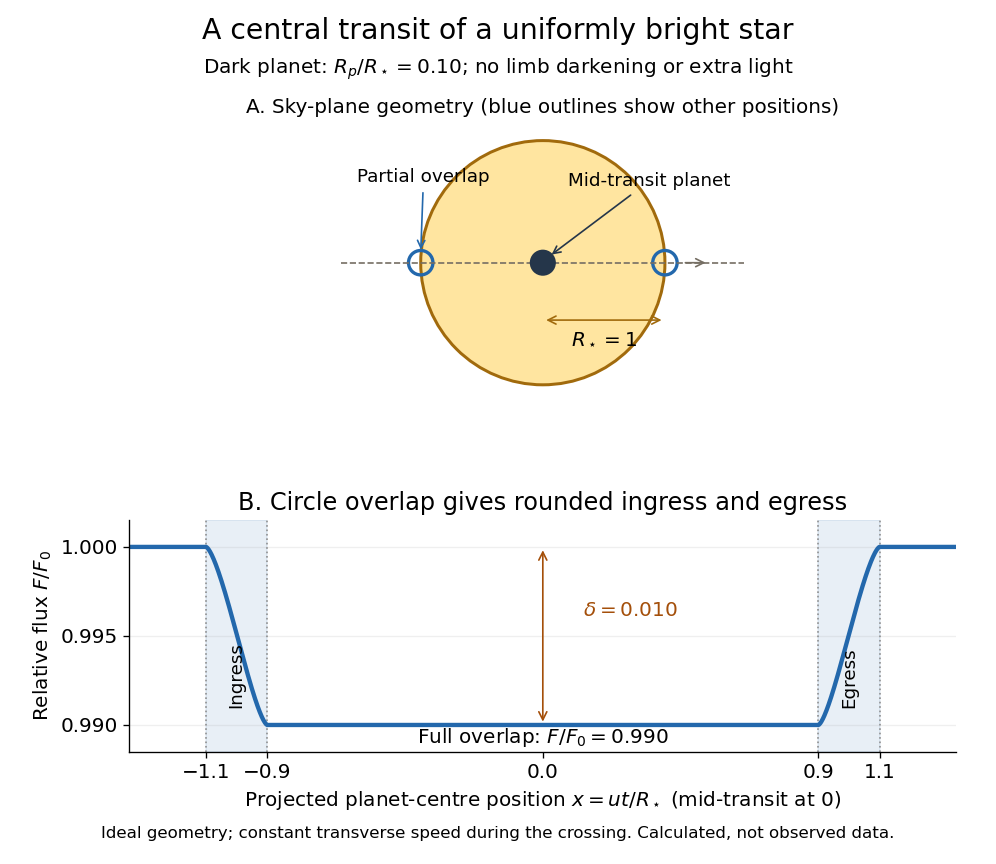
Exoplanet transit photometry measures the decrease in a star's observed radiative flux during an exoplanet transit. Define as the unobscured star's observed radiative flux and as the value at time . For a dark, opaque exoplanet crossing a uniformly bright circular stellar disc, a fully superimposed planetary disc blocks exactly the fractionHere and are the planet and star radii. This exoplanet transit depth determines a radius ratio, ; an absolute planet radius requires an independently estimated stellar radius. For , : a one-percent dip, with . Halving the radius ratio to reduces the exoplanet transit depth to , a quarter as much.
For the central exoplanet transit illustrated below, the transit impact parameter is . Write and let be the projected centre-to-centre separation in units of . The light curve is , where is the overlap area of circles of radii and . There is no overlap when ; the planetary disc is fully inside when , giving . Between those limits, the overlap area grows or shrinks continuously. Thus even a uniform star has curved ingress and egress, with a flat bottom only during full overlap. The illustration uses approximately constant transverse velocity over the short crossing, so with mid-transit at . Analytic models also handle limb darkening. [ref]
https://arxiv.org/abs/astro-ph/0210099. Mandel and Agol (2002)
.

The simple exoplanet transit depth formula assumes constant stellar brightness, no limb darkening or starspots, negligible light from the exoplanet, and no transit dilution by other light. It describes full overlap in a non-grazing exoplanet transit, requiring for a full-overlap interval. A grazing exoplanet transit never hides the whole planetary disc against the star, and limb darkening weights different blocked areas differently. Repeating dips are valuable evidence, but eclipsing binary stars and starspots can imitate parts of the signal, so confirmation and joint modelling matter.
The fractional decrease in observed radiative flux during an exoplanet transit, relative to the out-of-transit baseline. For a uniform star, a dark planet, full disc overlap, and no transit dilution, the exoplanet transit depth is . For a nonuniform star it depends on the blocked specific intensity as well as the radius ratio.
Constant extra light makes an exoplanet transit appear shallower. If the host star supplies out-of-transit observed radiative flux and an unresolved source supplies , let . Then . For , a true exoplanet transit depth of appears as ; ignoring transit dilution gives a radius ratio instead of , under the same uniform-disc assumptions.
A starspot is a relatively cool, dark region on a star's surface associated with a magnetic field. Starspots change the light curve as the star rotates. A planet crossing a starspot blocks less light than it would from an unspotted region, producing a local upward anomaly during an exoplanet transit; unocculted starspots can instead deepen the normalized exoplanet transit depth. They can also distort spectral lines and imitate a Doppler spectroscopy signal.
Articles were limited to the first 100 out of 121 total.
Articles by others on the same topic
There are currently no matching articles.