On the whole line, the homogeneous one-dimensional wave equation with constant wave speed isHere is displacement in the string interpretation; is initial displacement and is initial velocity. Its two directions of travel giveThis is D'Alembert's formula, including both Cauchy data. The countertravelling decomposition of the one-dimensional wave equation identifies as the right-moving travelling wave and as the left-moving travelling wave. Their sum is permitted by the superposition principle. For and , it is a classical solution. More generally, travelling waves with profiles and that are locally integrable functions solve the equation as distributions, with derivatives interpreted distributionally.[ref]
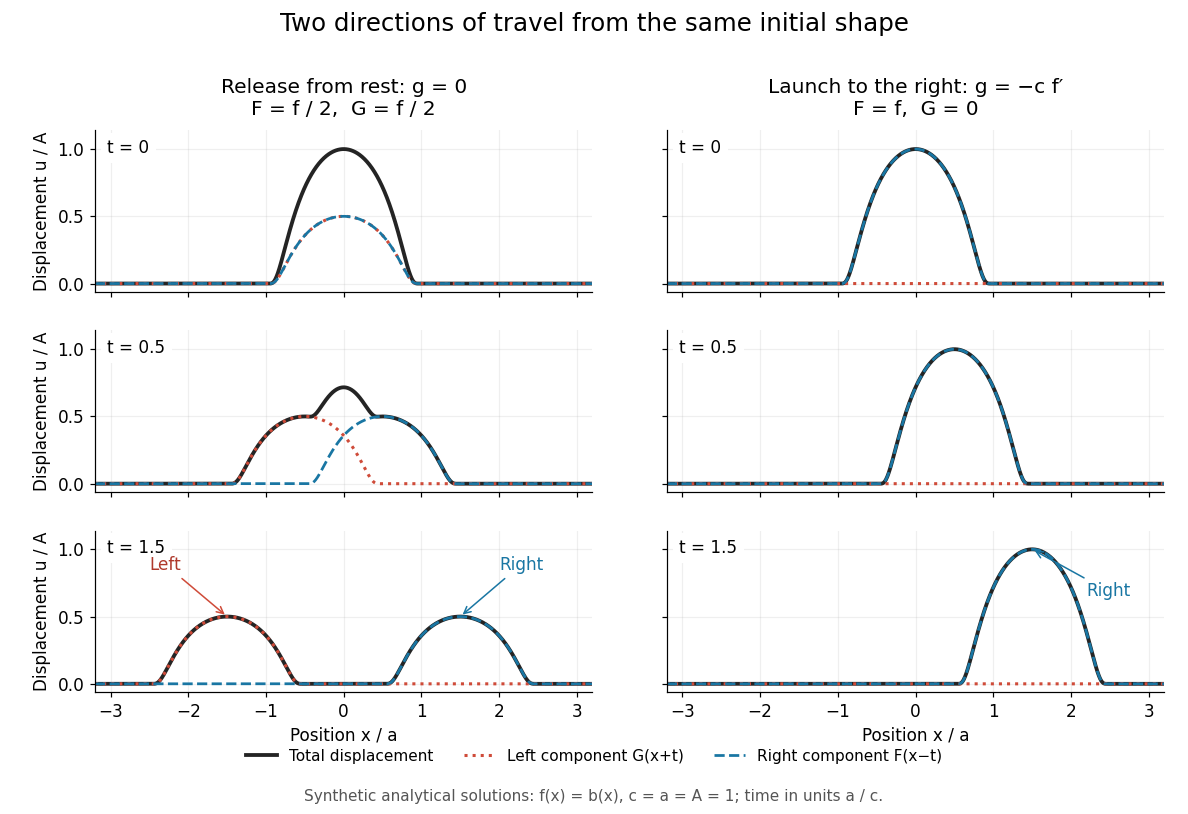
Synthetic pulse solutions: release from rest splits a profile, while matched initial velocity launches it rightward
. Details. 
The synthetic diagram uses the smooth bump function defined in D'Alembert's formula, with and . Releasing this displacement from rest, , gives . Each emerging travelling wave has half the original peak. Launching the identical initial displacement solely to the right instead requires and gives , . At , the released profiles have peaks at , while the launched profile has peak at . These are calculated model values. A purely left-moving launch requires . The initial velocity therefore selects the balance of directions; the initial shape alone does not.
For , zero response before the impulse gives the displayed retarded fundamental solution. Its initial displacement is zero and its initial velocity is . The response fills the interior of the forward causal cone for the constant-speed wave equation, rather than living only on its boundary. Changing the overall sign of the differential operator changes the Green function's sign. Equivalently, the spatial Fourier transform is , whose inverse is a rectangular profile. Values assigned exactly on the wave fronts do not change the associated distribution.
These characteristic curves are straight when wave speed is constant. A right-moving component is constant on , and a left-moving component on . The full superposition generally is not constant on either family, because the other component can vary along it. Their backwards intersections with the initial line select the endpoints used in D'Alembert's formula.
Let be any antiderivative of the initial velocity, . One choice of profiles isOpposite additive constants in and cancel, so the displacement is independent of the chosen antiderivative. Even for compact support of , these separate profiles can approach nonzero constants; cancellation in their sum is essential to support widening for the wave equation.
For a short derivation, the characteristic coordinates , give by the chain rule. Thus , and the Cauchy data imply and , giving the profiles above.
Articles by others on the same topic
There are currently no matching articles.