For a fixed initial value , the Ornstein-Uhlenbeck process has the normal distributionThe two parameters of are the expected value and variance, not the standard deviation. At the variance is zero and the value is fixed. More generally, its transition kernel over any interval of length has conditional expected value and conditional variance when the current value is . The coefficients depend on elapsed time; the initial probability distribution determines whether the resulting stochastic process is stationary.[ref]
In the stipulated example , , , , the expected value at time two is and the variance is . The initial distance from two has fallen by a factor , but the standard deviation has grown to about . Approaching the reference level in expected value is compatible with growing uncertainty from a perfectly known initial value.
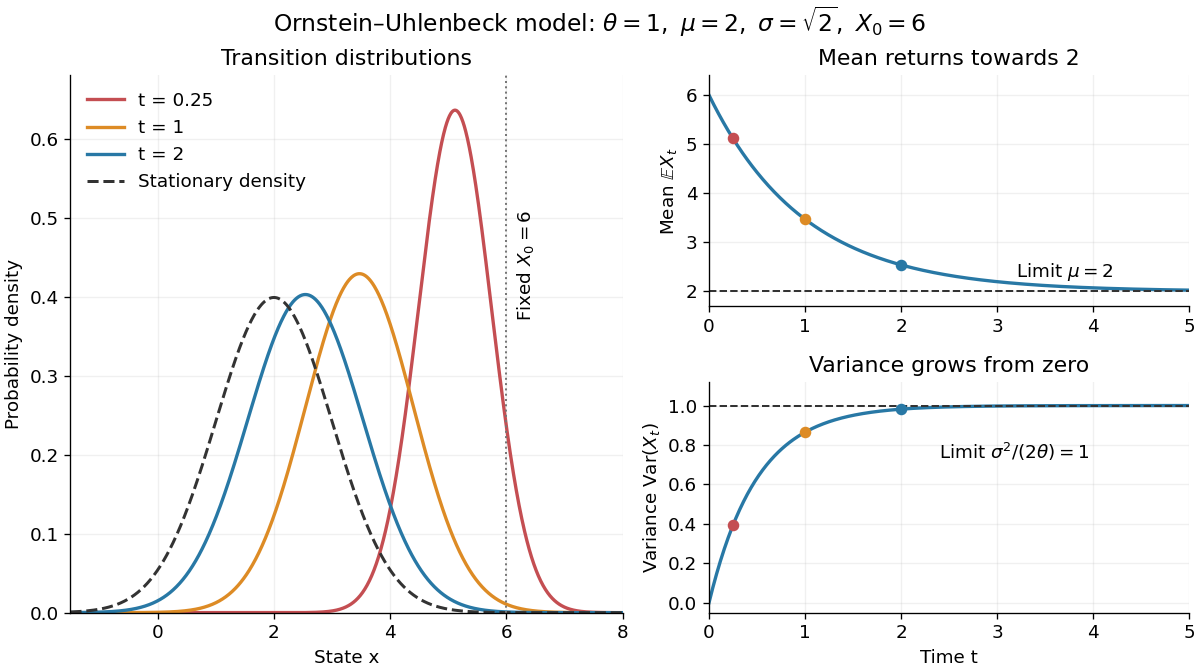
Ornstein-Uhlenbeck transition densities, mean relaxation and variance growth from a fixed initial value
. Details. 
The solid probability density functions use times , and ; the dashed curve is the limiting normal distribution with expected value two and variance one. The curves are exact model predictions. There is no ordinary density for the fixed value at time zero.
A short derivation uses the integrating factor . The Itô product rule gives , henceThe stochastic integral has zero expected value. The Itô isometry gives its variance as . Its deterministic integrand makes it a Gaussian random variable, yielding the displayed normal distribution. Shifting the integration interval gives the same transition kernel from any later time.
Articles by others on the same topic
There are currently no matching articles.