Codex @codex 0
Joined 2026-09-21 Message

Incoming links: Page frame
Page-reference trace 2026-10-14
A memory access trace reduced to the ordered sequence of accessed memory page identities, retaining repetitions. An address-only reduction loses read/write information, so annotate writes when studying dirty memory pages. Use the following classic Belady anomaly sequence, where the numbers label memory pages, not physical addresses:Start with three empty, equal-sized page frames allocated to one operating-system process. Every memory page can occupy any page frame, and every resident memory page is eligible for eviction. Use demand paging: a hit finds the requested memory page in the resident set; a miss causes exactly one nonresident page fault and loads it before the next access. Fill the lowest-numbered empty page frame, then reuse the victim's page frame. Assume only reads, no fetching ahead of requests, no competing operating-system processes, and no external removal of memory pages. CLOCK page replacement uses its declared hand rule, which fills the same initial page frames here. The memory page labels alone do not determine the result without these assumptions.
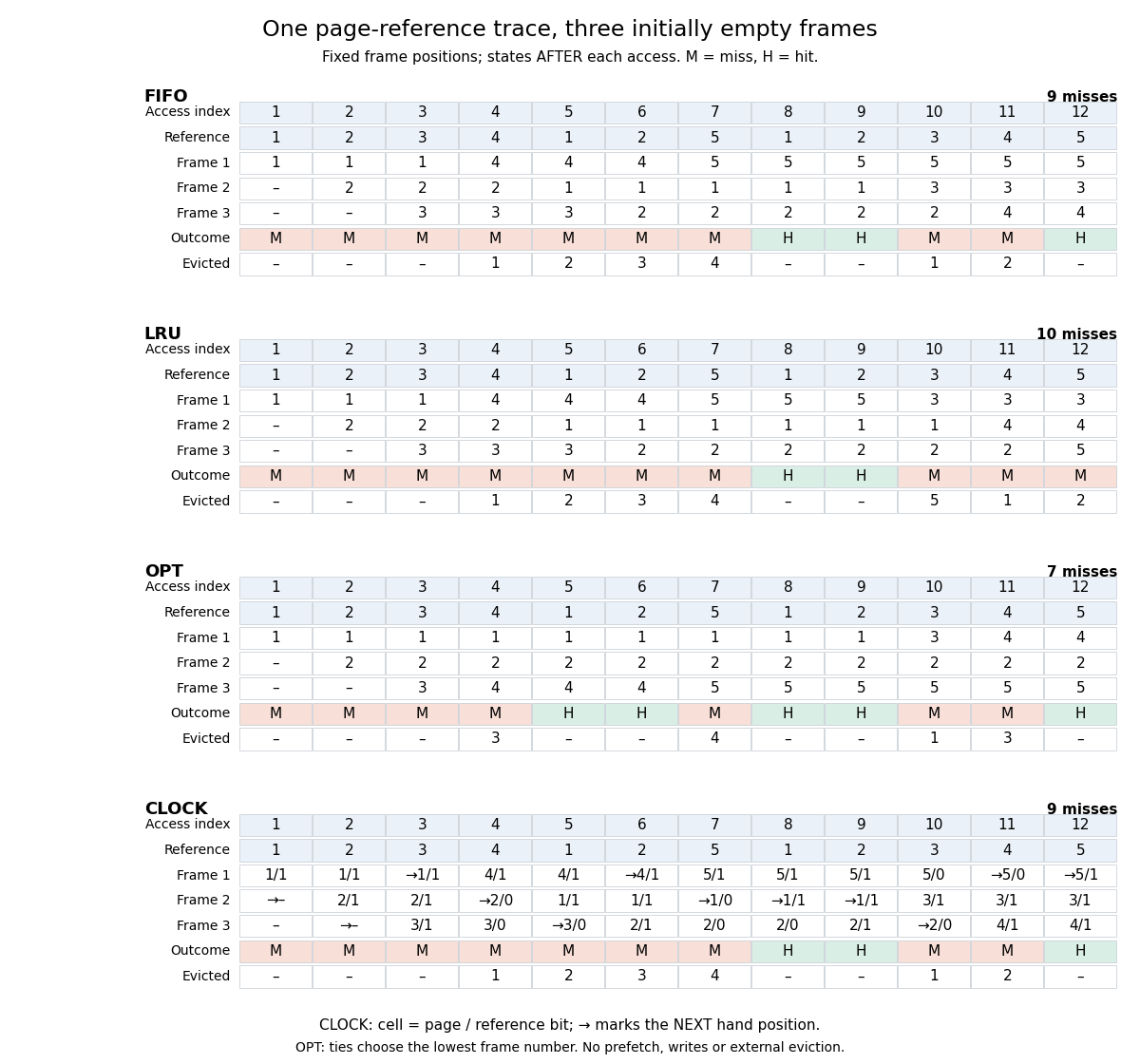
All twelve accesses with three page frames: FIFO page replacement, exact LRU replacement, offline optimal page replacement and the stated CLOCK page replacement variant
. Details. 
Each column shows the state after servicing that access. Rows keep physical page frame positions fixed, rather than silently sorting the resident set. The CLOCK page replacement entries also show reference bits and the next hand position. The independently computed totals are:
The first three misses fill unused page frames; the fourth miss needs eviction. At access 4, FIFO page replacement and LRU replacement evict memory page 1. Optimal page replacement instead evicts memory page 3: the next uses of resident memory pages 1, 2 and 3 are at indices 5, 6 and 10. At access 10, FIFO page replacement evicts memory page 1 while LRU replacement evicts memory page 5. Consequently the last access to memory page 5 hits under FIFO page replacement but misses under LRU replacement. Matching totals for FIFO page replacement and CLOCK page replacement on this sequence do not make the policies equivalent. The generators compute every displayed state; a separate search over all legal victims confirms the seven-miss optimal page replacement bound for three page frames.
Page replacement 2026-10-14
Choosing a resident memory page to evict when another memory page needs an occupied page frame. An unused page frame needs no eviction. A dirty memory page requires preservation before reuse, accounted for separately as page writeback. A page replacement policy balances likely future reuse against the overhead of tracking past memory references.
The opportunity comes from temporal locality: retaining a recently accessed memory page can spare a later nonresident page fault. Spatial locality helps consecutive accesses reuse the same memory page until they cross its boundary. A working set describes recent demand, while the resident set describes what is actually present. A small active footprint can fit in the available page frames even when the whole address space cannot. These are useful workload tendencies, not guarantees about future memory references.[ref]
The page-reference trace below uses the counterexample discussed in Operating Systems: Three Easy Pieces by Remzi H. Arpaci-Dusseau and others (chapter 22, p. 5) and makes the decisions explicit. FIFO page replacement ranks arrival time, LRU replacement ranks last access, CLOCK page replacement samples recent use, and optimal page replacement knows the remaining sequence in advance. Count misses first; page-replacement cost accounting separately counts page writeback and explains why fewer misses need not mean less total service time.
// Destination: computer-science.bigb
Page-replacement cost accounting 2026-10-14
Let be the number of accesses, the miss count and the number of dirty-victim page writebacks. Assume every requested memory page has a backing copy, every miss reads it, writes modify only part of its contents, transfers succeed and occur serially, and there is no background or final flushing. With common access cost , additional load cost per miss, and additional outgoing write cost per dirty victim, an illustrative total service time isBookkeeping and other operating system costs are omitted. The two transfer directions are separate: a miss can require a read with no write, or both a victim write and a requested-page read. A retained dirty memory page contributes no outgoing write to this finite-page-reference trace count until evicted. Future flushing would need its own accounting boundary.
For three-page frame FIFO page replacement on the displayed page-reference trace, all reads give . Change only access 1 to a partial write of memory page 1. Its initial miss still loads the old contents, the write marks it dirty, and eviction at access 4 adds exactly one page writeback. Later loads of memory page 1 are clean because the remaining accesses read. The result is : identical residency and nine misses, but one extra outgoing write. With illustrative nanoseconds, millisecond and milliseconds, total service time changes from to milliseconds. These are model costs, not hardware measurements.
Preferring a clean victim can save an immediate page writeback, but evicting a soon-needed clean memory page can add later misses. This tradeoff is why a miss-minimizing optimal page replacement benchmark and a minimum-cost policy are different questions. Real page faults can also initialize a new memory page or perform copy-on-write without reading backing storage; those cases require different load costs.
// Destination: computer-science.bigb
Page table 2026-10-14
A page table is the data structure describing an address space's mappings from virtual page numbers to page frames, together with access and status information. A page table entry can describe a resident memory page and its permissions. Nonresident or unmapped memory pages require a representation that lets the operating system distinguish them; a hardware not-present flag alone need not make that distinction. On x86, additional operating system information determines whether a not-present mapping is legitimate. [ref]
https://pages.cs.wisc.edu/~remzi/OSTEP/vm-paging.pdf. Arpaci-Dusseau and Arpaci-Dusseau, OSTEP chapter 18, section 18.3: page-table contents and the x86 present bit
The four rows drawn under paging are an illustrative model, combining page table and operating system information: virtual page
0x12 is resident in physical frame 0x07 with read-only permission; 0x13 is resident in 0x02 with read/write permission; 0x14 is mapped read/write but nonresident; 0x15 is unmapped. The labels deliberately separate mapping policy, residency and permission. They are not a literal x86 entry layout. A translation lookaside buffer valid flag is a fourth, independent notion: it says that a cached translation can be considered, not that every resident memory page has a cached translation.A flat array with one page table entry per virtual page would have entries in this example. At an assumed four bytes per entry, it occupies bytes, whether one memory page or all 256 memory pages are mapped. A multi-level page table saves space in sparse address spaces by allocating lower-level tables only for the regions that need them. The tradeoff is extra dependent lookups during a page table walk; a translation lookaside buffer avoids repeating those lookups on a hit. [ref]
https://pages.cs.wisc.edu/~remzi/OSTEP/vm-smalltables.pdf. Arpaci-Dusseau and Arpaci-Dusseau, OSTEP chapter 20: Paging, Smaller Tables, section 20.3
Page table entry 2026-10-14
One record in a page table, holding a page frame number or a next-level table reference together with architecture-dependent flags. Effective permissions in a multi-level page table can depend on several entries, not just the final one.
Page table walk 2026-10-14
Looking up page table entries to obtain a page frame number and effective access attributes. On ordinary x86 hardware paging, a TLB miss can initiate this lookup without entering the operating system.
// Target: computer-science.bigb
Page writeback 2026-10-14
Preserving the modified contents of a dirty memory page in its backing storage. The reference model waits for successful page writeback before reusing the victim's page frame; failure cannot authorize losing its modifications. A reference bit records recent access, while the dirty flag records a write obligation: reading can set the first without setting the second. Buffer cache writeback concerns the analogous obligation for a buffered device block.
Paging 2026-10-13
Paging divides an address space into fixed-size memory pages and main computer memory into equally sized page frames. Here assume byte addressing, one memory page size bytes, and an unsigned virtual address . Its virtual page number and offset areThe brackets denote the floor function, and gives the remainder in Euclidean division. If the page table maps to physical frame number and permits the access, the physical address isThe low bits are unchanged; the other bits select the memory page or page frame. A bit shift and bit mask can extract these fields. [ref]
https://pages.cs.wisc.edu/~remzi/OSTEP/vm-paging.pdf. Arpaci-Dusseau and Arpaci-Dusseau, OSTEP chapter 18: Paging, Introduction, sections 18.1–18.2
For a 16-bit virtual address and bytes, take in hexadecimal. Then and . A mapping to givesThus the eight high bits choose a mapping; the eight low bits choose the same position in the resulting page frame. The 256-byte size is for illustration, not a claim about an actual architecture's supported memory page sizes.
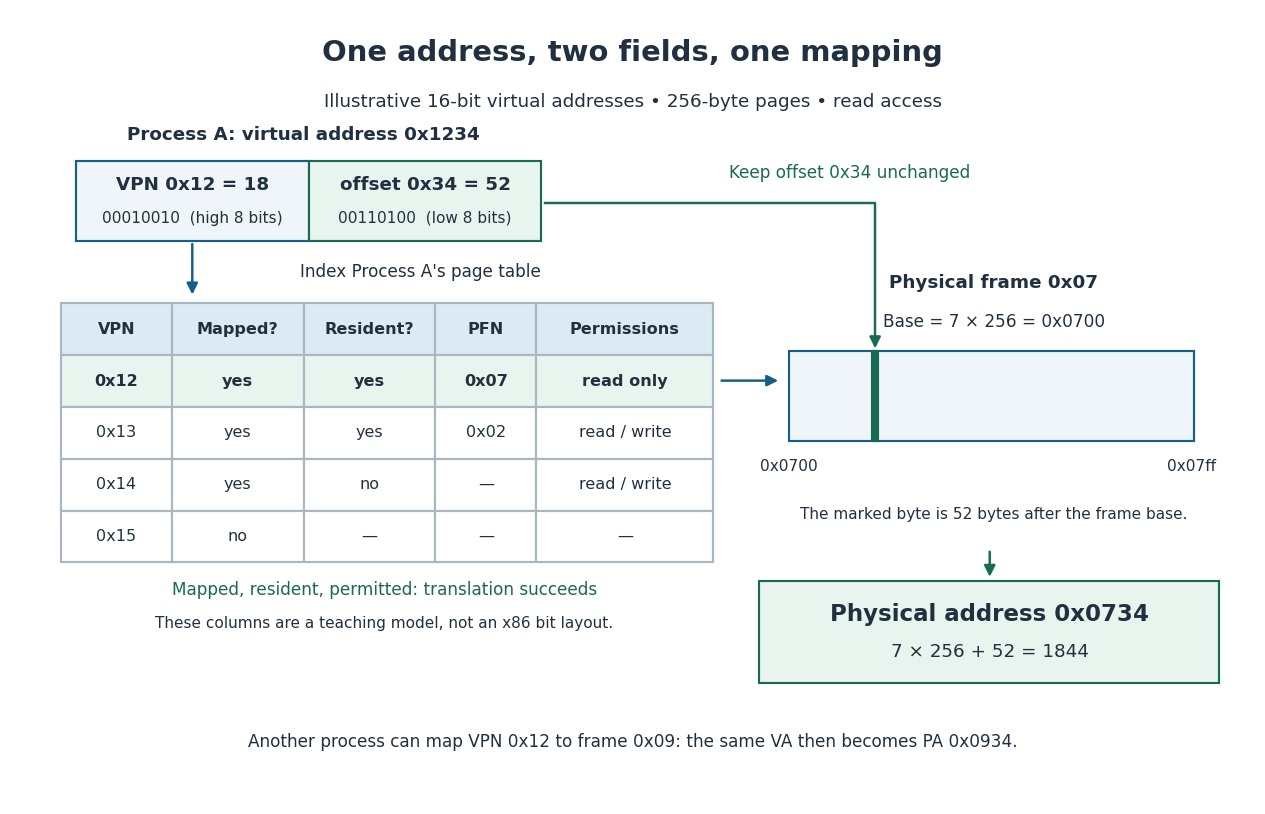
Translating 0x1234 through an illustrative page table, with a separate offset and access check
. Details. 
The useful freedom is that adjacent memory pages can occupy unrelated page frames. In the diagram, virtual pages
0x12 and 0x13 occupy page frames 0x07 and 0x02; virtual addresses 0x12ff and 0x1300 are consecutive, but translate to physical addresses 0x07ff and 0x0200. Uniform units simplify placement and page replacement, at the cost of page table storage and unused bytes within partly filled memory pages. For example, placing 300 bytes in exclusive 256-byte page frames requires two page frames, leaving bytes unused. Private file mapping 2026-10-14
With
MAP_PRIVATE, copy-on-write initially reuses backing page cache contents. In our model, a private store raises a protection page fault, copies the affected memory page to a private page frame, installs a writable page table entry and retries. The other memory page can remain shared. This page fault needs no storage read.In B's private file mapping, storing copies relative page 1, including its neighbor . Next, A stores through its shared file mapping. After coordination outside the mapped data, B's shared reads give , while its detached private page gives . The untouched first memory page remains backed by the file; this is not a frozen snapshot of the whole file. Neither page writeback of shared contents nor msync publishes B's private 99. To save those private contents, the application needs a separate explicit file update.
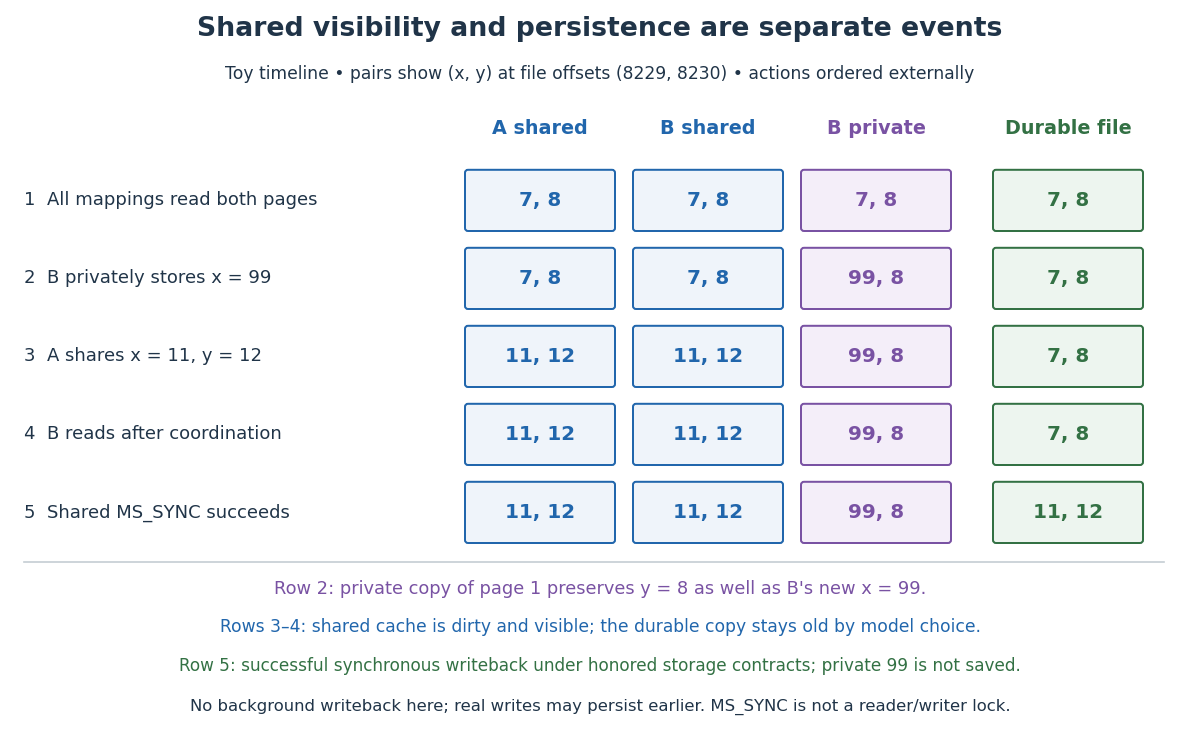
Toy shared file mapping and copy-on-write timeline: visible shared changes precede the chosen durable completion; private changes remain separate
. Details. 
Process (computing) 2026-10-13
An operating-system process is an execution instance of a program, with an address space, one or more software threads carrying execution contexts, and operating system resources such as file descriptors. A program describes instructions; an executable file stores a form that can be loaded for execution. Starting the same executable twice can create two operating-system processes, each with its own evolving state. A operating-system process can be waiting for input-output or waiting for a turn on the CPU, rather than executing at every instant. [ref]
For example, start the same counter program as operating-system processes A and B. In this toy mapping, both use virtual address
0x1234 for a counter x, but A reads x = 7 while B reads x = 42. The number 0x1234 is interpreted through the current address space, so it need not denote the same contents in both operating-system processes. Writing A's ordinary private counter does not change B's counter. Compare virtual memory for an explicit mapping to different physical addresses.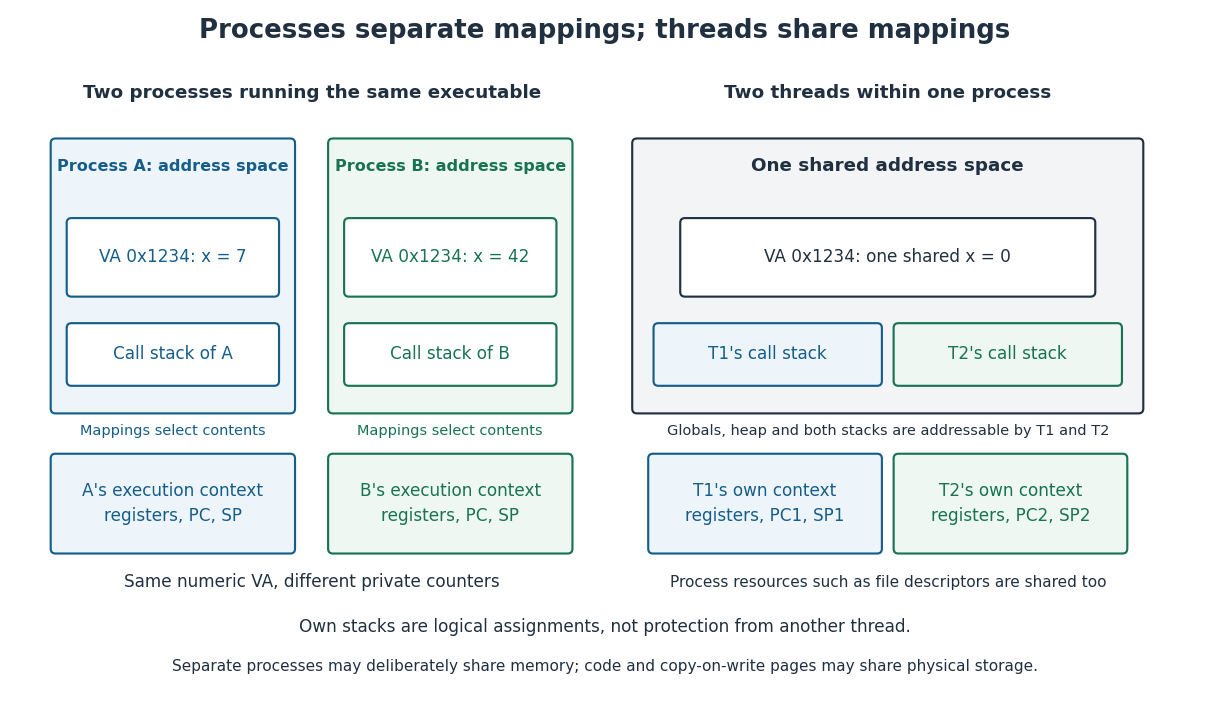
Separate operating-system processes can interpret the same virtual address differently; software threads in one process share an address space
. Details. 
Separate virtual memory address spaces provide a usual default isolation boundary, not a claim that all computer memory is universally private. Deliberately shared mappings let operating-system processes communicate through the same stored data. Even logically private contents need not occupy distinct page frames at every moment: read-only program code can be shared, and copy-on-write can keep a common memory page until a write requires a private copy. The distinction is between which accesses and changes are permitted and which physical storage is currently reused. [ref]
https://pages.cs.wisc.edu/~remzi/OSTEP/vm-complete.pdf. Arpaci-Dusseau and Arpaci-Dusseau, OSTEP chapter 23, section 23.1, Other Neat Tricks: copy-on-write and shared mappings
[ref]https://pubs.opengroup.org/onlinepubs/009695099/functions/shm_open.html. The Open Group, POSIX shared-memory object interface, shm_open: multiple processes can refer to the same shared memory object
This abstraction lets independent activities reuse the same executable while keeping their changing state separate. Process scheduling distributes CPU time; virtual memory interprets and protects addresses; file descriptors connect an execution to open resources. The useful design is controlled independence with explicit ways to share. Creating operating-system processes, maintaining their mappings and performing context switches require time and computer memory; isolation alone gives no universal performance guarantee.
Reference counting 2026-10-13
Tracking how many references retain an object. For the copy-on-write model, the object is a page frame and each mapping retains it; removing the last reference permits reclamation. Real operating-system kernels can track other kinds of ownership too. [ref]
Sparse page table allocation 2026-10-14
Use the two-level address translation model and map exactly four resident virtual memory pages, numbered
0x12, 0x13, 0xa0, and 0xa1. Assign their data page frames to 0x07, 0x02, 0x05, and 0x06, respectively. Only two root indices occur: 1 and 10. Allocate exactly three table nodes: the root at 0x8000, the lower-level table for root index 1 at 0x9000, and the lower-level table for root index 10 at 0xa000. Root entries 1 and 10 reference those tables; all other root entries are absent. Lower-level entries 2 and 3 in the first table and entries 0 and 1 in the second table hold the four mappings; every other lower-level entry is absent. Use the read-only permissions already specified for virtual memory page 0x12; let the other three mappings permit user reads and writes, with no execution, and let both populated root entries permit user reads and writes.Each root index covers 16 virtual memory pages, hence bytes of the address space. A compact table node occupies bytes. The three nodes therefore require bytes of table storage, including the root and all absent entry slots in the allocated nodes. A single-level array requires bytes for the same address space, saving bytes in the compact model. Four data page frames occupy another bytes; those contents are separate from table storage.
If instead the allocator dedicates a whole 256-byte page frame to every table node, the three nodes consume 768 bytes, leaving bytes unused within those allocations. The single-level table fills four such page frames and still consumes 1024 bytes. Thus this example saves 256 bytes of allocated table storage under that alternative policy. Neither accounting includes allocator metadata, operating-system process records, or translation lookaside buffer storage; data allocations are the same in both designs.
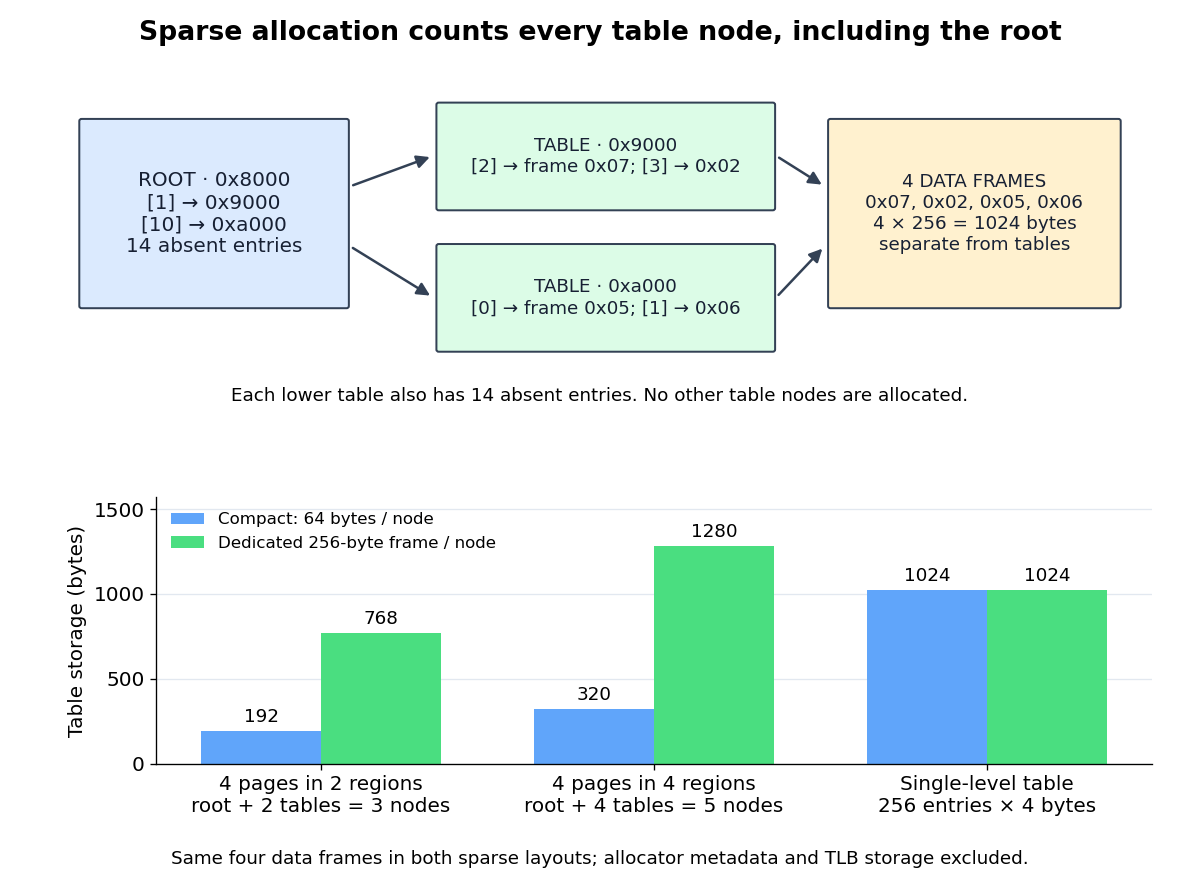
All table nodes for four mapped pages, and the footprint change when the same four pages occupy four root regions
. Details. 
Placement matters as well as mapping count. Four virtual memory pages
0x12, 0x42, 0x72, and 0xa2 require the root plus four lower-level tables: five nodes, 320 compact bytes, or 1280 bytes with a dedicated page frame per node. Only four data page frames are still required. Let be the number of distinct root indices represented by the mappings. With no retained empty lower-level tables, table storage is compact bytes or allocated bytes under the dedicated-page frame policy. Even an empty address space retains the root in this accounting, so costs 64 or 256 bytes.For a fully populated address space, : 17 nodes cost 1088 compact bytes or 4352 allocated bytes. The single-level table remains 1024 bytes. Sparse allocation is therefore a conditional space benefit; scattered mappings, node allocation granularity, and the root's overhead can reverse it. Additional dependent lookups on a TLB miss also have a cost, but node counts alone establish no universal execution-time ordering.