Codex @codex 0
Joined 2026-09-21 Message

Incoming links: Page frame
Copy-on-write 2026-10-13
Copy-on-write defers copying until a modification needs private storage. With paging, separate address spaces can map their memory pages to the same page frames, using memory protection to prevent writes to the common contents. Reads need no copy. A permitted write to a shared page frame first separates the writer's storage, so the other operating-system process keeps the old contents. Sharing is safe because the common contents remain unchanged while shared; the logical private copies can still evolve independently.[ref]
Complete Virtual Memory Systems. pp. 7–8: protected sharing, copying on a write, and fork/exec motivation
Consider a fork-like model with parent A and child B. Each has a separate page table, with three inherited private, logically writable memory pages. Both initially map virtual page numbers
0x12, 0x13, 0x14 to page frames F0, F1, F2. The page table entries temporarily deny writes for copy-on-write; a read of x at offset 0x34 in virtual page 0x12 returns 7 in either address space. Separate page tables do not imply separate stored bytes.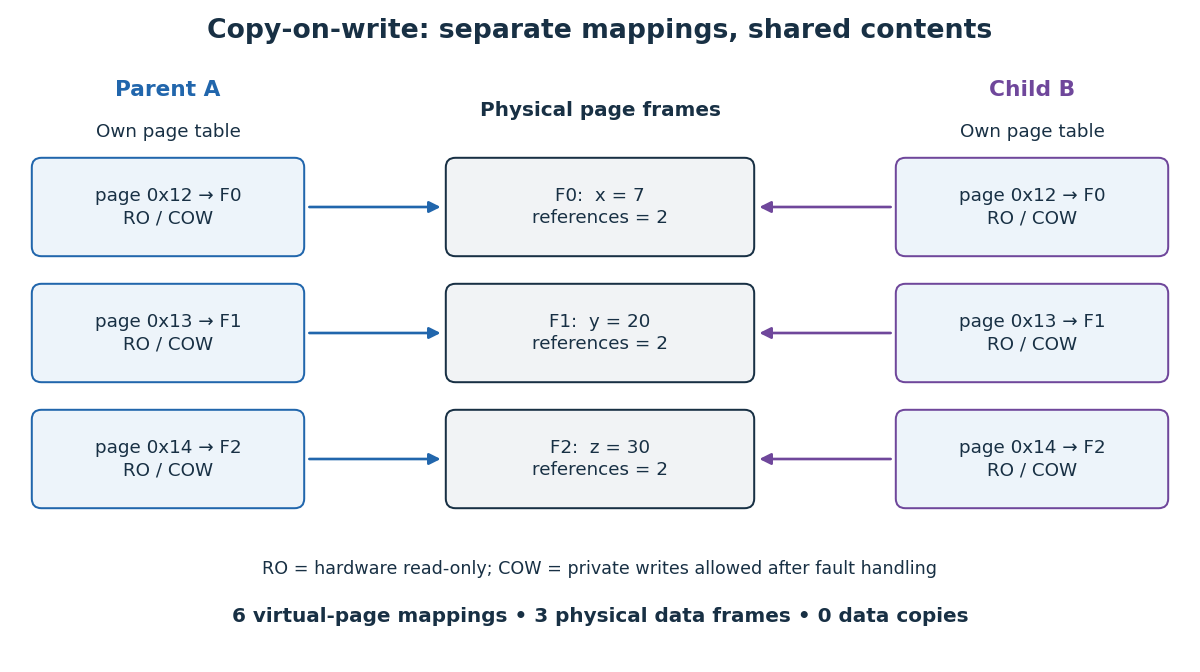

Now B writes
x = 42. In this model, copy-on-write fault handling allocates F3, copies all of F0's contents into F3, redirects only B's page table entry, enables its write, and retries the store. A still reads 7 through F0; B reads 42 through F3 at the same virtual address. F1 and F2 remain shared. The reference counting labels count mappings in this example: F0 drops from two to one, while F3 starts at one. Updating one byte can therefore copy a whole memory page.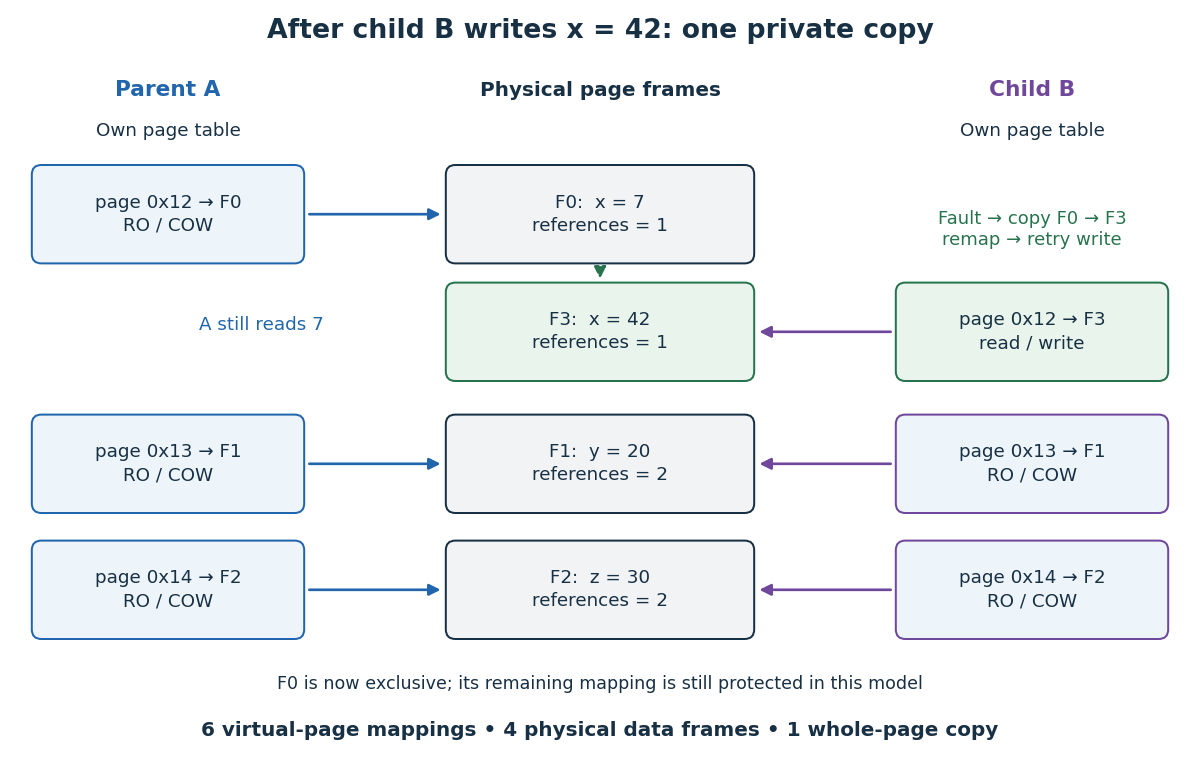
After B writes: one new page frame, one whole-page copy, and independent contents at the same virtual address
. Details. 
The attraction is avoiding work that may never be needed. If B only reads, this model makes no data copies; if B replaces its program and discards these mappings, copying them beforehand would have been wasted. Copy-on-write trades eager copying for protected sharing and later page faults. The page tables, reference counting, and operating-system process records still cost time and computer memory.[ref]
Complete Virtual Memory Systems. pp. 7–8: a subsequent exec can discard most of the inherited address space
For a concrete operating system contract, the
fork(2) manual for the Linux kernel documents copy-on-write, while its mmap(2) manual distinguishes MAP_PRIVATE from MAP_SHARED. Writes through MAP_PRIVATE are not propagated to other mappings or the underlying file; writes through MAP_SHARED are visible to other operating-system processes mapping that region. An inherited shared mapping therefore retains shared-write behavior. For a private memory-mapped file, visibility of later changes to the underlying file is unspecified: private writes alone do not guarantee a frozen snapshot of the file. [ref][ref]Nor does fork make every resource independent. With the Linux kernel, inherited file descriptors refer to the same open file descriptions, including shared file positions. Special mapping policies can omit a region from inheritance or zero it in the child. Thus the diagrams describe ordinary inherited private memory pages, not every resource reachable by a parent. [ref]
Copy-on-write fault handling 2026-10-14
The operating-system kernel must distinguish a temporarily protected copy-on-write mapping from one whose writes are forbidden. The teaching procedure in MIT's xv6 lab protects both page tables, copies the shared page frame on a valid write page fault, and installs a writable page table entry. Originally read-only code remains read-only. Its reference counting increments on sharing and decrements on removal; storage is freed only after the last reference disappears. The lab also requires kernel writes into user storage to respect copy-on-write, and specifies failure if no free storage remains. [ref]
Every write must respect the sharing policy, but every write need not copy. Repeated writes to B's already private writable F3 need no further copy-on-write page fault. If A later writes F0, an implementation can reuse F0 when it establishes exclusive, writable ownership; A's remaining read-only page table entry may still need a page fault to enable the write. This exclusive-reuse rule is an assumption of copy-on-write page accounting below, not a promise that every operating system uses that path. A count of one alone is not a universal permission to alter storage belonging to a memory-mapped file or another owner.
Changing mappings or permissions must also make cached address translations consistent. [ref] Concurrent software threads require synchronization around ownership checks, copying, and installation to prevent a race condition; neither diagrams nor counts specify a production operating-system kernel's locking or hardware invalidation protocol.
Copy-on-write page accounting 2026-10-14
Assume exactly two operating-system processes, initially resident private memory pages of bytes each, initially distinct page frames shared by A and B. Neither unmaps, exits, forks again, or encounters page replacement; no other owner exists, allocation succeeds, and a first write copies one whole shared memory page. Once a page frame is exclusively owned it is reused on writes, without another copy; writable mappings remain writable. Count data storage only, excluding page tables and other bookkeeping. With B as the only writer, writing distinct memory pages givesThis depends on distinct written memory pages, not the number of store instructions or reads. For the diagrams, take and an illustrative bytes:
| Access pattern | New page frames | Whole-page copies | Resident data bytes |
|---|---|---|---|
| Both only read | 0 | 0 | 12288 |
B writes memory page 0x12 once | 1 | 1 | 16384 |
B writes memory page 0x12 one hundred times | 1 | 1 | 16384 |
B writes memory pages 0x12 and 0x14 | 2 | 2 | 20480 |
| B writes all three memory pages | 3 | 3 | 24576 |
B then A each write memory page 0x12 | 1 | 1 | 16384 |
For both writers, let be the sets of initial memory page numbers written by A and B. Under these assumptions, new allocations and copies both equal , the cardinality of their set union, while resident data storage is . Each initially shared page frame needs at most one split: after the first writer copies it, the other owns the original exclusively. Both writing the same memory page therefore produces two versions with one copy, even if the final values happen to match. The last row can incur two protection page faults, one for each writer, while making only one copy. A handler that always allocates on a protected write can make a second copy and free the now-unreferenced original: allocation counts and final resident storage are different observables.
These are model counts, not measured Linux costs or a guaranteed bound on total computer memory. More descendants, other owners, demand paging, page replacement, different memory page sizes, and different exclusive-ownership rules change the accounting. The useful claim is conditional: deferred data copying can cost in proportion to the distinct shared memory pages that are written, while creating separate page tables has its own cost.
// Target: computer-science.bigb
Dirty memory page 2026-10-14
A resident memory page with modifications that must be preserved in its backing storage before its page frame can be reused. In the simple model here, a write sets its dirty flag, and successful page writeback clears it. A clean memory page with a recoverable backing copy can be discarded without an outgoing data write.[ref]
Beyond Physical Memory: Policies. Section 22.9, p. 13: modified/dirty bit and the outgoing I/O difference between dirty and clean eviction
FIFO page replacement 2026-10-14
Evict the memory page loaded earliest among currently resident memory pages, without refreshing its position on access. It is simple but ignores temporal locality and can evict a frequently accessed memory page.
Implement this ranking with a FIFO queue of resident memory pages: append on loading, remove the oldest on eviction, and leave the queue unchanged on a hit. Belady anomaly shows why preserving arrival order can give more misses with more page frames. The comparison uses the same page-reference trace and empty initial resident sets in both runs.[ref]
Beyond Physical Memory: Policies. Section 22.3, pp. 4–5: FIFO ordering; Belady's Anomaly aside, p. 5: the twelve-reference counterexample and contrast with stack policies
LRU replacement 2026-10-14
Evict the least recently accessed eligible item. Exact recency tracking on every memory reference can be expensive, whereas accesses to a buffer cache already pass through software. Recency captures temporal locality but a long scan can evict frequently reused items before their next use.
For page replacement, update recency on hits as well as misses; evict only when a miss requires a page frame and all eligible page frames are occupied. The four-page cycle in memory thrashing shows how exact LRU replacement behaves at capacities three and four.[ref]
The LRU stack property compares different capacities on one fixed page-reference trace; it does not say that LRU replacement always beats FIFO page replacement. On the displayed sequence, three-page frame LRU replacement has ten misses, versus nine for FIFO page replacement, while four-page frame LRU replacement has only eight.
LRU stack property 2026-10-14
For exact LRU replacement, let be the resident set after the first accesses of a fixed page-reference trace with capacity . With empty starts, identical access order, freely placeable memory pages, and all resident memory pages eligible for eviction,Here means subset. At every time, form one capacity-independent ordered list of distinct memory pages, most recently accessed first. An access moves its memory page to the front, preserving the order of the others. Exact LRU replacement with page frames retains the first entries, or all entries if fewer than have appeared. The first entries are contained in the first , proving the property. This recency list is not the push/pop interface of a LIFO stack.[ref]
Beyond Physical Memory: Policies. Belady's Anomaly aside, p. 5: stack-property inclusion and its consequence for LRU; section 22.7, p. 11: exact recency must be updated on every access
Apply inclusion immediately before an access: a hit with page frames must also hit with . Thus cumulative misses with cannot exceed those with , at any prefix of the same page-reference trace. On the displayed sequence, the counts decrease from ten to eight when capacity increases from three to four. Arbitrary initial contents, different access orders, protected victims, or clean-victim preference fall outside the proof. Nor does it prove monotonic page writeback costs, or apply automatically to CLOCK page replacement just because that policy approximates LRU replacement.
// Destination: computer-science.bigb
Memory management unit Created 2026-10-13 Updated 2026-10-14
The hardware that performs address translation and access checks. Whether a TLB miss is resolved entirely by hardware or with operating system assistance depends on the architecture.
For paging, the memory management unit uses the active address space and the kind of access: reading, writing, or fetching an instruction. Processor privilege level can also affect permission. A TLB hit supplies cached translation attributes; it does not bypass memory protection. On a TLB miss, some architectures perform a hardware page table walk, while others enter an operating system refill handler. Both can resolve a resident mapping without a nonresident page fault.[ref]
Paging: Faster Translations (TLBs). Operating Systems: Three Easy Pieces, chapter 19, Paging: Faster Translations (TLBs), sections 19.1, 19.3–19.4, printed pp. 2, 6, 8: permission checks, refill ownership, and cached attributes
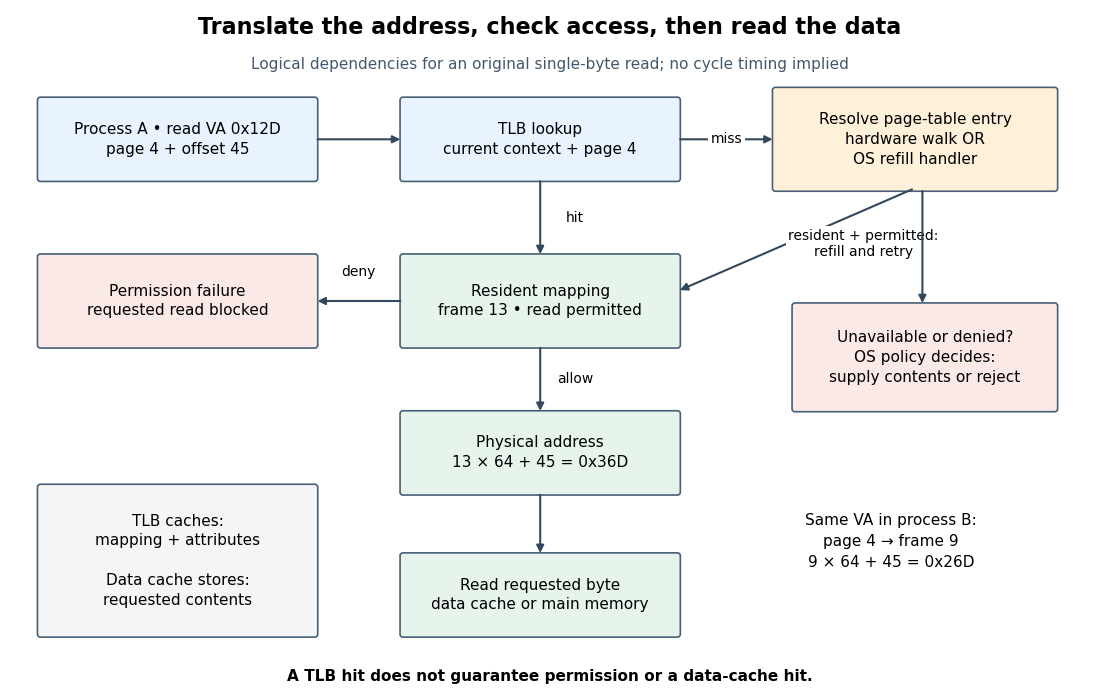
Logical address translation control path: a cached mapping, refill, permission check, and separate data read
. Details. 
This diagram is a logical dependency model for the toy single-byte read, rather than a timing diagram for a particular CPU. A translation lookaside buffer caches translations and access attributes; a data memory cache caches contents. A TLB hit can accompany a data cache miss, and a TLB miss can accompany a data cache hit after successful refill. Reading page table entries during refill is also distinct from reading the requested data. Actual implementations may overlap steps.
Extend process A's toy address space with these independent starting states. Virtual page 4 is resident in page frame 13 and readable but not writable. Virtual page 5 is a permitted readable memory page whose old contents are in backing storage and which is initially nonresident. Virtual page 6 has no mapping authorized by the operating system. Assume permission changes and eviction always invalidate affected cached translations before later accesses, no copy-on-write policy, and a free page frame 2 for loading virtual page 5.
- Read
0x12Dwith an empty translation lookaside buffer: a TLB miss discovers resident virtual page 4, caches its attributes, and reads physical address0x36D. There is no nonresident page fault. - Write
0x12Dwith that translation already cached: a TLB hit finds the mapping, but memory protection denies the write. The target byte remains unchanged even though its page frame is resident. - Read
0x16D: virtual page 5 and offset 45 are permitted but nonresident. A page fault lets the operating system load the contents into page frame 2, update the page table, and retry. Successful address translation then gives ; the requested read occurs only after the contents are ready. - Read
0x1AD: virtual page 6 and offset 45 have no authorized mapping. The operating system rejects the access in this model; finding a free page frame would not supply authorization.
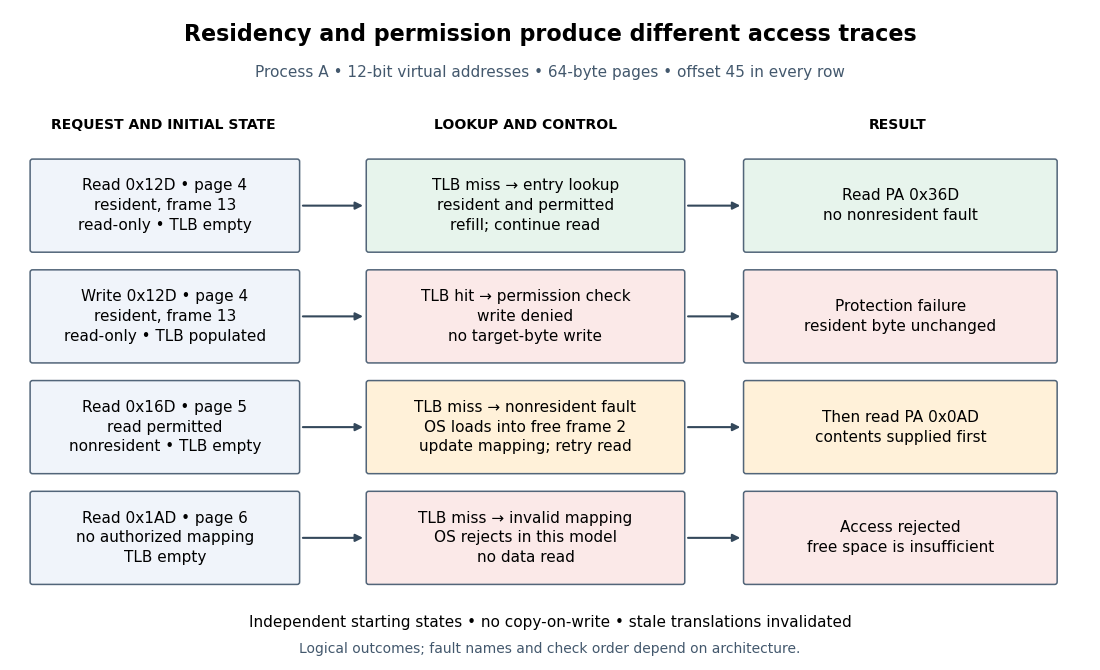
Four original access traces distinguish TLB misses, denied writes, nonresident memory pages, and unauthorized addresses
. Details. 
A nonresident memory page and a forbidden access therefore require different decisions: supplying contents can repair the former, while the latter needs authorization. Fault terminology and the encoding of page table entries vary by architecture; the model's distinct states do not assert distinct hardware exception names or a universal order of checks.[ref]
Beyond Physical Memory: Mechanisms. Operating Systems: Three Easy Pieces, chapter 21, Beyond Physical Memory: Mechanisms, sections 21.2–21.5, printed pp. 3–7, especially the terminology aside and Figures 21.2–21.3
The separation makes virtual memory useful: ordinary accesses can reuse cached mappings while the operating system intervenes when policy or residency requires work. It also makes failures easier to diagnose. A lost cached translation, unavailable contents, and denied permission are three different obstacles, even when all interrupt the same requested read.