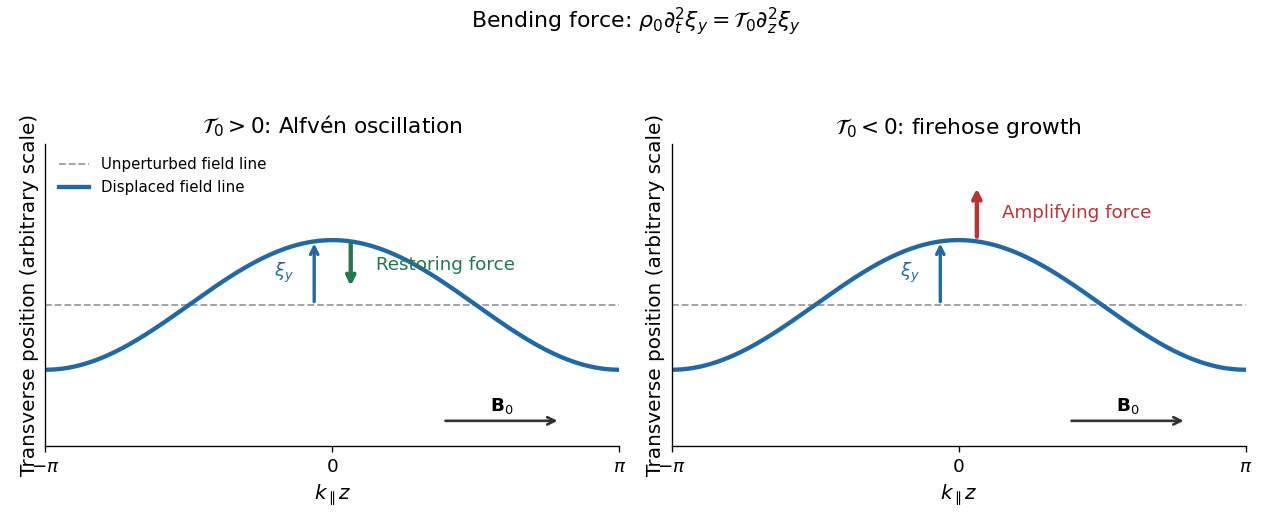
Set and . Distinguish the scalar magnetic field strength perturbation from the vector perturbation . To first order,where the last identity is the solenoidal magnetic-field constraint. For a Fourier mode with the stated time convention, putThe linear momentum conservation equation, after division by , isUse the solenoidal magnetic-field constraint in its component. The coefficient of reduces to . ThusBoth scalar pressure perturbations act within the plane. The component therefore decouples, independently of their closure. The ideal magnetohydrodynamic equations giveEliminating the amplitudes gives the Alfvén wave dispersion relationFor this Shear Alfvén wave, the velocity and fluid displacement are along , perpendicular to both and the equilibrium magnetic field. Let ; thenA real snapshot bends the magnetic field lines sideways, with . There is no first-order compression or change of magnetic field strength: , and . Scalar pressure perturbations are unnecessary in this transverse subsystem. For a traveling stable branch, , so the velocity and transverse magnetic field perturbations are in phase or opposite phase according to the branch. At the bending force and this angular frequency vanish.

Articles by others on the same topic
There are currently no matching articles.