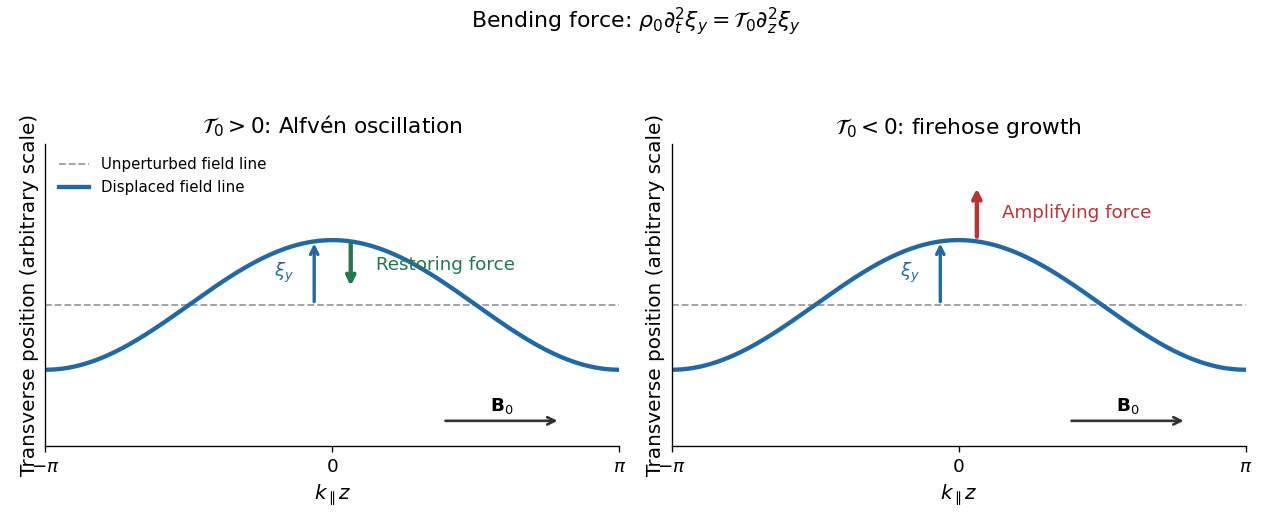
Use the source's Gaussian units and neglect the displacement current, as in nonrelativistic magnetohydrodynamics. Write for the pressure anisotropy. The pressure tensor is , so its force density isAmpère's law and the solenoidal magnetic-field constraint give the Lorentz force decompositionAdding these two force densities and using yieldsThe first term is the gradient of the modified magnetohydrodynamic total pressure; the second is the anisotropic Maxwell stress tensor contribution together with the directional pressure force. Their effective coefficient is the pressure-anisotropy-modified magnetic tension, . At fixed magnetic field, positive pressure anisotropy increases resistance to bending, while negative pressure anisotropy reduces it. When becomes negative, bending experiences an amplifying force rather than a restoring force. Gradients of can also drive motion, so the curvature interpretation refers specifically to the bending contribution.
Set and . Distinguish the scalar magnetic field strength perturbation from the vector perturbation . To first order,where the last identity is the solenoidal magnetic-field constraint. For a Fourier mode with the stated time convention, putThe linear momentum conservation equation, after division by , isUse the solenoidal magnetic-field constraint in its component. The coefficient of reduces to . ThusBoth scalar pressure perturbations act within the plane. The component therefore decouples, independently of their closure. The ideal magnetohydrodynamic equations giveEliminating the amplitudes gives the Alfvén wave dispersion relationFor this Shear Alfvén wave, the velocity and fluid displacement are along , perpendicular to both and the equilibrium magnetic field. Let ; thenA real snapshot bends the magnetic field lines sideways, with . There is no first-order compression or change of magnetic field strength: , and . Scalar pressure perturbations are unnecessary in this transverse subsystem. For a traveling stable branch, , so the velocity and transverse magnetic field perturbations are in phase or opposite phase according to the branch. At the bending force and this angular frequency vanish.

For the Alfvén wave becomes a firehose instability when its squared angular frequency is negative:Equality is marginal, rather than exponential growth. The pressure anisotropy must have negative sign; its absolute magnitude alone is insufficient.
For the intergalactic plasma, a negative relative pressure anisotropy of reaches this fluid threshold only for . In particular, the literal pair and relative pressure anisotropy is stable because the threshold is . Since the quoted numbers are approximate and allow larger plasma beta, this weakly magnetized plasma is susceptible, rather than necessarily unstable at every quoted value. For example, and relative pressure anisotropy are unstable. Positive pressure anisotropy does not excite this branch.
For the fusion-device plasma, requires a negative relative pressure anisotropy below roughly , whereas its magnitude is only about . The stabilizing magnetic tension dominates, so it is not susceptible to this fluid firehose instability under the stated conditions. Indeed, nonnegative perpendicular pressure requires the relative pressure anisotropy to be no smaller than ; at such a small plasma beta even this extreme cannot satisfy the threshold.
Magnetic flux freezing ties a transverse fluid displacement to a bend in the magnetic field lines. For the uniform background, the transverse displacement equation isFor a sinusoidal bend, . Positive pressure-anisotropy-modified magnetic tension therefore gives a restoring force, and inertia produces oscillation. In an isotropic plasma, this is precisely the positive magnetic tension .
Particles moving predominantly along bent magnetic field lines contribute a transverse momentum flux. Their larger parallel pressure opposes the restoring curvature force supplied by the magnetic field and perpendicular pressure. Once , the net force points along the original displacement: a larger bend produces a larger outward force, giving positive feedback. Equivalently, the bending contribution to the quadratic potential energy is and has become negative.
In this static, homogeneous fluid model the unstable roots areWith the root grows. Its real angular frequency is zero, so the unstable pattern grows without propagation in the equilibrium rest frame; its partner decays. Advection by a background flow would change that frame-dependent statement. The growth increasing without bound as increases is a limitation of this long-wavelength model: finite gyroradius and other kinetic corrections cannot be neglected at sufficiently short scales.
Articles by others on the same topic
There are currently no matching articles.