Average the equations in part b and make exactly the prescribed scale-separation approximation: the retained perturbations vary on lengths much greater than , and perturbations at the tangle scale are omitted. Products of two retained perturbations can then be neglected. Writing , and , the linearized equations areNo unmodelled small-scale response has been inserted into this closure.
Introduce the fluid displacement by and choose . Integrating the magnetic second-moment tensor equation giveswhere is a time-independent integration tensor set by the initial stress. For a pure oscillatory normal mode, . Its restoring force is therefore : the isotropic magnetic tangle has the same transverse response as an incompressible elastic medium with shear modulus .
For a plane wave proportional to , with , incompressibility gives . The tensor equation and magnetohydrodynamic momentum equation becomeDotting the second equation with yields for , since . Substitution then givesThere are two independent transverse polarizations. The phase speed is in every direction, and the two signs of give group velocities . These magnetoelastic waves in an isotropic magnetic tangle exist because a shear deformation distorts the second moment of the tangled magnetic field, producing a restoring magnetic tension even though its mean is zero.
For comparison, a uniform magnetic field with Alfvén velocity gives the incompressible Alfvén wave relation . Its frequency depends on the direction of , and energy propagates along . Here the averaged restoring response is isotropic: there is no preferred mean-field direction. Both systems resist transverse deformation through magnetic tension, rather than through compressive sound.
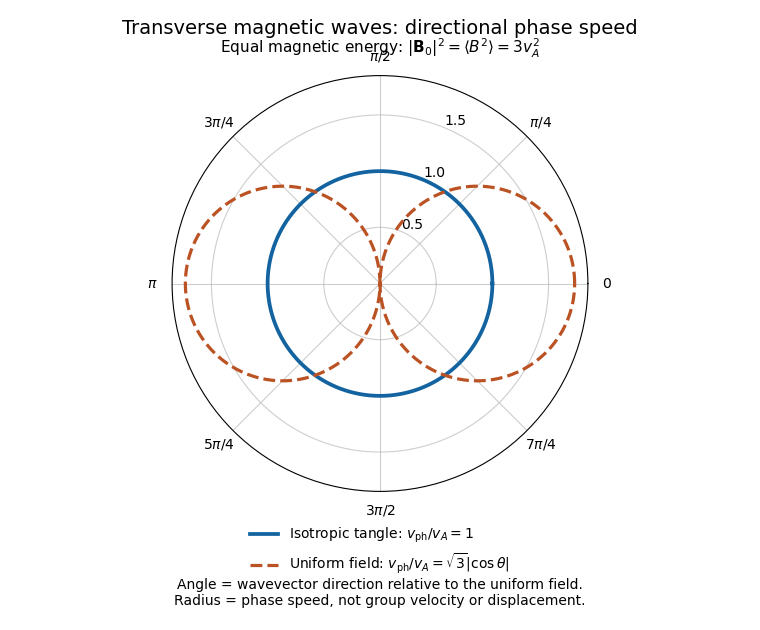
Directional phase speeds for a magnetic tangle and a uniform magnetic field with the same mean-square strength
. The radial coordinate is phase speed divided by the tangle wave speed. The circular tangle curve is direction independent; the uniform-field curve is proportional to the absolute cosine of the propagation angle. These are phase-speed curves, not group-velocity trajectories. Details.
The propagating branch is not the entire perturbation space. For example, , and solve the linearized equations without propagation, for any small, slowly varying . Such a static stress perturbation in magnetoelastic wave equations balances a pressure gradient. Thus the requested wave conclusion applies to the oscillatory branch; it must not exclude stationary initial stress perturbations.
Articles by others on the same topic
There are currently no matching articles.