Write the physical magnetic field as and use the constant mass density to introduce Alfvén velocity units, . If is the fluid's mechanical pressure, the magnetohydrodynamic total pressure per unit mass density is . The ideal magnetohydrodynamic equations then reduce toThe first equation is momentum conservation: the magnetic pressure has been included in , leaving magnetic tension explicitly. The second is the ideal magnetohydrodynamic induction equation, expressing magnetic flux freezing. The last two equations impose incompressibility and the solenoidal magnetic-field constraint.
The model assumes a smooth conducting-fluid continuum with constant mass density and constant magnetic permeability, nonrelativistic velocity, and scales on which a single-fluid description is appropriate. Negligible electrical resistivity removes magnetic diffusion; negligible viscosity removes viscous momentum diffusion. Equivalently, the magnetic Reynolds number and the Reynolds number are large on the scales being retained. The low-frequency approximation neglects the displacement current; Hall and other kinetic corrections to Ohm's law are absent. Incompressibility is an imposed approximation, commonly justified when the Mach number is small. There is no independently evolved thermodynamic pressure: enforces the incompressibility condition. We omit external body forces; a conservative one could instead be absorbed into .
The magnetic second-moment tensor is . This is the magnetic dyadic called the Maxwell tensor in the paper; the isotropic part of the usual Maxwell stress tensor is already contained in the magnetohydrodynamic total pressure. The solenoidal magnetic-field constraint givesConsequently the magnetohydrodynamic momentum equation in part a becomes , where is the material derivative. Applying its product rule and the ideal magnetohydrodynamic induction equation givesThus the evolution uses only , together with . To determine , take the divergence of the magnetohydrodynamic momentum equation. Since and ,This is the pressure Poisson equation for incompressible flow, with boundary conditions supplied by the imposed normal acceleration and normal stress, or by periodicity or decay at infinity as appropriate. For example, the normal component of the magnetohydrodynamic momentum equation requires at a prescribed boundary. The pressure is determined up to a spatially constant function of time.
For equivalence to one resolved magnetic field, the initial must actually be for a divergence-free vector field. In particular it is a symmetric positive semidefinite matrix of matrix rank at most one. The tensor equations also admit more general stresses; the averaged in part d need not have matrix rank one.
With zero velocity and no time dependence, the magnetic second-moment tensor equation holds automatically, but the magnetohydrodynamic momentum equation still requiresThe magnetic tension must therefore be a pressure gradient. Locally, its necessary integrability condition ison a simply connected region this is also sufficient for a scalar , subject to the global boundary conditions. In physical units the same balance is : the Lorentz force density is balanced by mechanical pressure, rather than necessarily vanishing. A zero mean magnetic field does not make the local magnetic tension zero, so an arbitrary tangle is not automatically a static equilibrium.
Take the trace of the statistically isotropic magnetic second-moment tensor. There are three spatial directions, soChoosing the nonnegative speed,Thus is the root-mean-square value of any one Cartesian magnetic field component in Alfvén velocity units. It is not the magnitude of the mean Alfvén velocity, which is zero here. Statistical isotropy fixes a second moment even when the first moment vanishes.
Average the equations in part b and make exactly the prescribed scale-separation approximation: the retained perturbations vary on lengths much greater than , and perturbations at the tangle scale are omitted. Products of two retained perturbations can then be neglected. Writing , and , the linearized equations areNo unmodelled small-scale response has been inserted into this closure.
Introduce the fluid displacement by and choose . Integrating the magnetic second-moment tensor equation giveswhere is a time-independent integration tensor set by the initial stress. For a pure oscillatory normal mode, . Its restoring force is therefore : the isotropic magnetic tangle has the same transverse response as an incompressible elastic medium with shear modulus .
For a plane wave proportional to , with , incompressibility gives . The tensor equation and magnetohydrodynamic momentum equation becomeDotting the second equation with yields for , since . Substitution then givesThere are two independent transverse polarizations. The phase speed is in every direction, and the two signs of give group velocities . These magnetoelastic waves in an isotropic magnetic tangle exist because a shear deformation distorts the second moment of the tangled magnetic field, producing a restoring magnetic tension even though its mean is zero.
For comparison, a uniform magnetic field with Alfvén velocity gives the incompressible Alfvén wave relation . Its frequency depends on the direction of , and energy propagates along . Here the averaged restoring response is isotropic: there is no preferred mean-field direction. Both systems resist transverse deformation through magnetic tension, rather than through compressive sound.
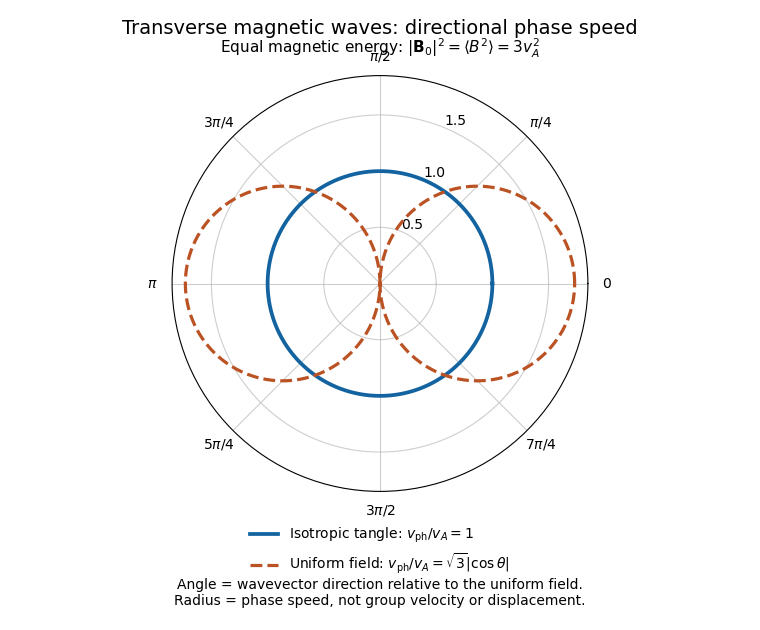
Directional phase speeds for a magnetic tangle and a uniform magnetic field with the same mean-square strength
. The radial coordinate is phase speed divided by the tangle wave speed. The circular tangle curve is direction independent; the uniform-field curve is proportional to the absolute cosine of the propagation angle. These are phase-speed curves, not group-velocity trajectories. Details.
The propagating branch is not the entire perturbation space. For example, , and solve the linearized equations without propagation, for any small, slowly varying . Such a static stress perturbation in magnetoelastic wave equations balances a pressure gradient. Thus the requested wave conclusion applies to the oscillatory branch; it must not exclude stationary initial stress perturbations.
The common part of the magnetohydrodynamic-viscoelastic analogy is stretching and advection of a line element. With the component-first velocity gradient , the ideal tensor equation isIts left side is an upper-convected derivative, the same deformation law that appears for a polymer conformation tensor when its relaxation is neglected.
There are two important physical differences. First, the solenoidal magnetic-field constraint prevents a magnetic field line from having an isolated source or sink inside the fluid. A polymer strand can have molecular endpoints, so there is no corresponding no-endpoint constraint on the strands. Second, a stretched polymer has a preferred relaxed distribution of configurations and a finite polymer relaxation time; it can recoil relative to the solvent through molecular drag and thermal motion. An ideal magnetic field has no analogous local tendency to return to a prescribed coil size. Real polymers also have a finite contour length, a limitation absent from the ideal field-stretching law.
For example, a normalized Hookean dumbbell conformation equation has the dissipative extensionThis is local relaxation toward an isotropic thermal configuration. It remains nonzero for a spatially uniform stretched . By contrast, constant magnetic diffusivity adds to the resistive induction equation. The product rule gives the resistive evolution of the magnetic second-moment tensor:The magnetic correction involves spatial gradients, vanishes for a uniform magnetic field, and does not create field-line endpoints: . It permits slippage and magnetic reconnection while preserving the no-monopole constraint. After averaging, its gradient-product term generally needs additional information beyond the averaged . One cannot replace it indiscriminately by the local polymer relaxation term, or even by alone.
Articles by others on the same topic
There are currently no matching articles.