Expand the given translating-sphere Stokes flow into its Stokeslet and potential dipole parts:The second parenthesis is and has zero curl outside the sphere. For the first,Thus the vorticity of translating-sphere Stokes flow isThe result is independent of the irrotational finite-size dipole correction. It holds in the exterior ; the singular solid harmonics are used only outside their source.
Use the force flux at infinity in Stokes flow. With an outward normal from a large sphere, the force on the body is . Let . The leading far-field velocity and pressure areTheir rate-of-strain tensor isIn the Newtonian fluid stress tensor , the isotropic pieces cancel. Consequently,The second spherical moment integral follows from rotational symmetry and . Since , taking gives the Stokes drag law:The omitted dipole contributes a surface integral of order and vanishes in this limit. The sign refers to the fluid's drag on the moving sphere.
At the terminal velocity, buoyancy-corrected weight balances the Stokes drag law:HenceA denser sphere falls in the direction of ; a lighter one rises. Equal densities give no sedimentation. The calculation assumes negligible fluid Reynolds number, an unbounded fluid, and negligible transient body acceleration after terminal settling. The fluid mass density enters through buoyancy and through the small-Reynolds number condition.
Take positive upward, let sphere A's centre be , and write its downward velocity as , with . At B's centre the displacement from A is . The vorticity of translating-sphere Stokes flow therefore givesB is held in translation but has zero applied torque. By Faxén's rotational law, it rotates with half the incident vorticity:Integrating the rotation induced by a passing Stokes sphere along the complete path cancels :Its magnitude is radians, with direction about the negative axis by the right-hand rule. All instantaneous rotations have this same axis, so the integrated angular velocity gives the net angle without a noncommuting-rotation correction. The result is independent of B's radius in the prescribed incident-flow calculation.
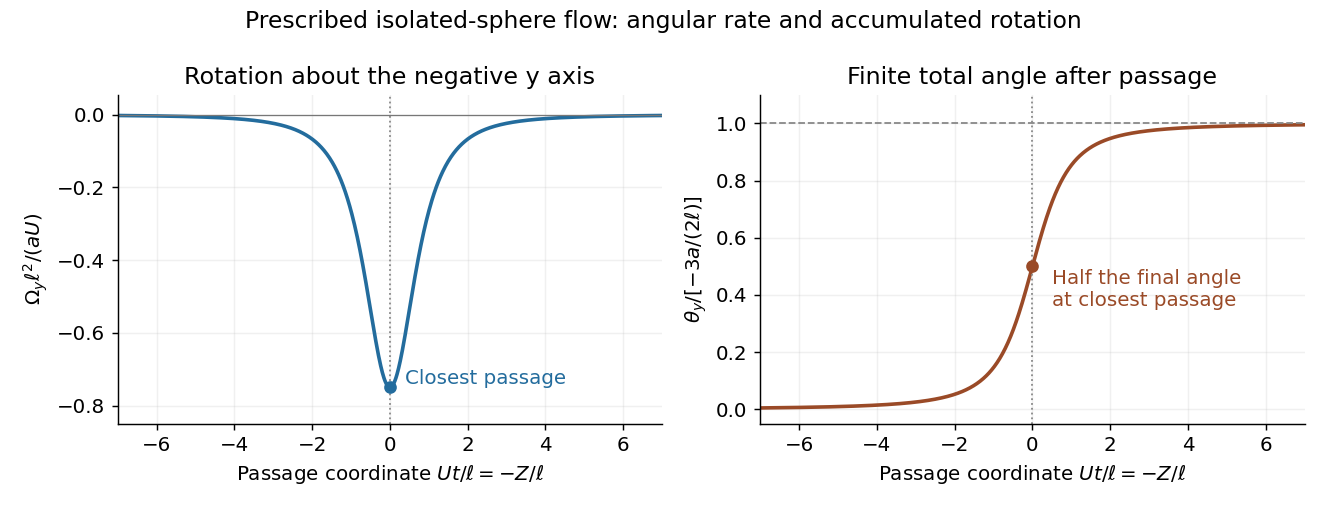

The inequality ensures no overlap. It does not by itself make mutual hydrodynamic interactions negligible: the stated flow is the isolated-A solution, and a held finite B also disturbs A's flow. Thus the displayed angle is the result for that supplied incident flow, or the leading one-way approximation to separated bodies. A fully coupled two-sphere calculation uses the method of reflections for Stokes flow or an exact pair resistance solution.
Articles by others on the same topic
There are currently no matching articles.