Gauge invariance and power counting permit the same local operators as in the original renormalizable action. With renormalized fields, a convenient counterterm parametrization isHere . Expanding the first term supplies kinetic, scalar-scalar-photon, and seagull counterterms with the relative coefficients required by the Ward identity. Equivalently introduce separate vertex constants first and then impose that identity. For , , and , it gives . Thus charge renormalization can be represented through the photon field factor, rather than adding an independent gauge-noninvariant interaction.
The mass coefficient defined here is ; it must be distinguished from . Gauge fixing may require the corresponding gauge-parameter redefinition, and vacuum diagrams can require an additive vacuum-energy counterterm. No photon mass counterterm is allowed by the unbroken gauge symmetry. The quartic scalar counterterm remains necessary for the full theory even at a scale where the renormalized is zero, because gauge interactions generate scalar four-point divergences.
The one-particle-irreducible scalar two-point function has three one-loop topologies: a scalar-photon exchange loop built from two cubic vertices; a photon tadpole at one seagull vertex; and a scalar tadpole at one quartic vertex. The last is absent when . Reducible chains of self-energy insertions belong to the Dyson expansion and are not additional one-loop self-energy graphs. The scalar-QED photon-tadpole symmetry factor is because its two identical photon legs are joined; the oriented complex-scalar tadpole has no such identical-real-line factor.
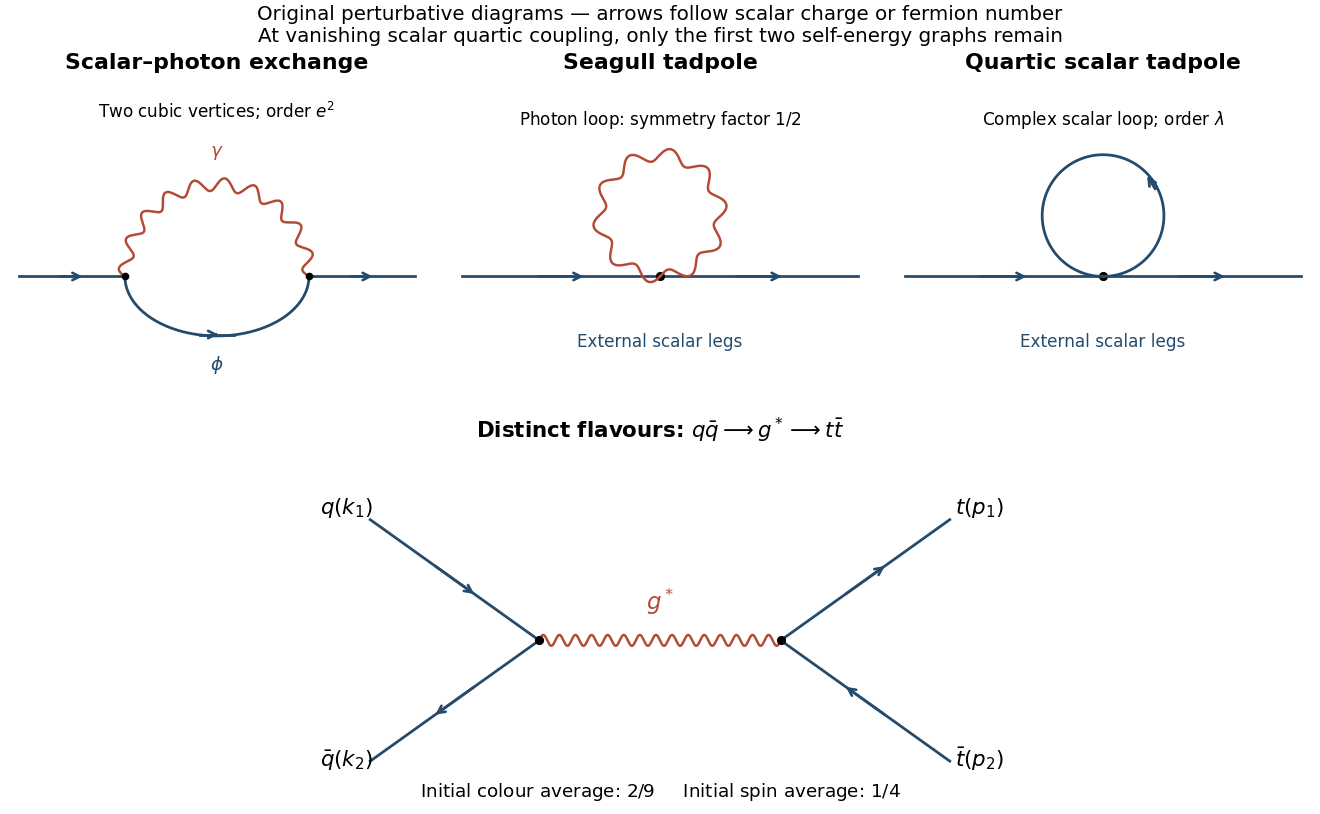

Route the photon momentum as and the internal scalar momentum as . The transverse projector obeys , so the two cubic vertices giveMultiplying the two vertices and propagators therefore givesFor the seagull, . Including the photon-loop symmetry factor gives insteadThe printed seagull coefficient is twice this result. The vertex's factor two differentiates the two photon fields; closing them into one line requires the compensating symmetry factor. Direct expansion of the action gives the same check: the interaction density has one photon contraction, yielding coefficient , not . The identical-photon origin of the vertex factor is also explicit in the standard scalar-electrodynamics rules.[ref]
Quantum Field Theory by David Tong. §6.5.1, charged scalars: the seagull vertex factor two comes from the two identical photon fields
This discrepancy does not affect the massless-photon limit in part d or the ultraviolet pole in part f.Apply the dimensionally regulated tadpole integral before removing the infrared regulator:At fixed regulator away from gamma-function poles, the power of has positive real part. ConsequentlyBoth the correctly weighted tadpole and the source's doubled version vanish. This is the near-four-dimensional limit appropriate to the question; the order of limits is important. Equivalently the exactly massless tadpole is a scaleless integral and is zero in dimensional regularization. The statement is not valid for every arbitrary fixed dimension: for example, gives a nonzero prefactor and growth as . One must keep the regulator in its stated near-four-dimensional domain.
First remove the projector denominator explicitly:Let and . The Feynman parameter for a simple and a squared propagator follows by differentiating the elementary two-denominator Feynman formula with respect to givesShift . Then , with . The numerator is unchanged by this parallel shift:Therefore the correctly combined integral isThe printed weight is not compatible with this denominator and prefactor. Exchanging with changes the mass term in as well and cannot supply the missing normalization. A concrete counterexample is with nonzero spacelike external momentum and : after Wick rotation, the remaining integral is nonzero and symmetric under . The source's expression is then exactly one quarter of the correct expression. Thus the claimed equality cannot be imposed when computing the pole.
Lorentz-covariant tensor integration replaces by . The numerator consequently contributes . The supplied master integral with powers givesInserting the corrected parameter integral givesThe pole uses , and . ThusThere is no momentum-independent pole at in this transverse gauge after removing the photon tadpole. The two-point counterterm insertion is , so minimal subtraction requiresThese coefficients cancel the actual one-loop insertion derived from the action. Applying the misprinted weight in part e would give a wave-function pole four times too small. In a convention the same answer is . Finally, does not mean that the bare mass parameter is unchanged: gives . Photon, charge and quartic counterterms require their respective Green functions and cannot be determined from this scalar two-point function alone.
Articles by others on the same topic
There are currently no matching articles.