Source paper: www.whatdotheyknow.com/request/oxford_physics_past_papers_2/response/2340696/attach/5/Physics%20Papers%202016.pdf?cookie_passthrough=1. The held cover dates this paper to 19 April 2017; the bundle filename does not determine the year. We use the stated mostly-plus spacetime metric, , and the source's loop-insertion convention . Several printed formulas need corrections, justified where they occur below.
Gauge invariance and power counting permit the same local operators as in the original renormalizable action. With renormalized fields, a convenient counterterm parametrization isHere . Expanding the first term supplies kinetic, scalar-scalar-photon, and seagull counterterms with the relative coefficients required by the Ward identity. Equivalently introduce separate vertex constants first and then impose that identity. For , , and , it gives . Thus charge renormalization can be represented through the photon field factor, rather than adding an independent gauge-noninvariant interaction.
The mass coefficient defined here is ; it must be distinguished from . Gauge fixing may require the corresponding gauge-parameter redefinition, and vacuum diagrams can require an additive vacuum-energy counterterm. No photon mass counterterm is allowed by the unbroken gauge symmetry. The quartic scalar counterterm remains necessary for the full theory even at a scale where the renormalized is zero, because gauge interactions generate scalar four-point divergences.
The one-particle-irreducible scalar two-point function has three one-loop topologies: a scalar-photon exchange loop built from two cubic vertices; a photon tadpole at one seagull vertex; and a scalar tadpole at one quartic vertex. The last is absent when . Reducible chains of self-energy insertions belong to the Dyson expansion and are not additional one-loop self-energy graphs. The scalar-QED photon-tadpole symmetry factor is because its two identical photon legs are joined; the oriented complex-scalar tadpole has no such identical-real-line factor.
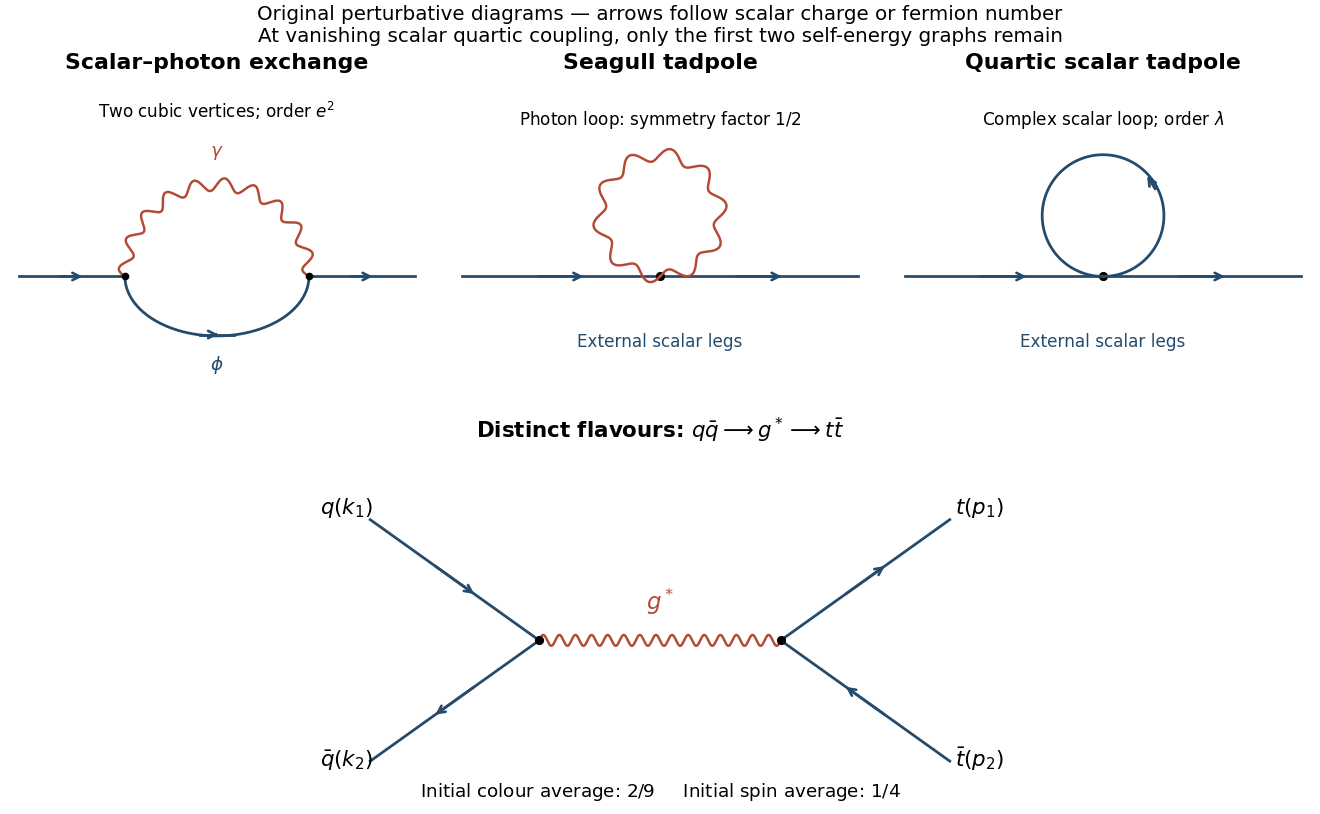

Route the photon momentum as and the internal scalar momentum as . The transverse projector obeys , so the two cubic vertices giveMultiplying the two vertices and propagators therefore givesFor the seagull, . Including the photon-loop symmetry factor gives insteadThe printed seagull coefficient is twice this result. The vertex's factor two differentiates the two photon fields; closing them into one line requires the compensating symmetry factor. Direct expansion of the action gives the same check: the interaction density has one photon contraction, yielding coefficient , not . The identical-photon origin of the vertex factor is also explicit in the standard scalar-electrodynamics rules.[ref]
Quantum Field Theory by David Tong. §6.5.1, charged scalars: the seagull vertex factor two comes from the two identical photon fields
This discrepancy does not affect the massless-photon limit in part d or the ultraviolet pole in part f.Apply the dimensionally regulated tadpole integral before removing the infrared regulator:At fixed regulator away from gamma-function poles, the power of has positive real part. ConsequentlyBoth the correctly weighted tadpole and the source's doubled version vanish. This is the near-four-dimensional limit appropriate to the question; the order of limits is important. Equivalently the exactly massless tadpole is a scaleless integral and is zero in dimensional regularization. The statement is not valid for every arbitrary fixed dimension: for example, gives a nonzero prefactor and growth as . One must keep the regulator in its stated near-four-dimensional domain.
First remove the projector denominator explicitly:Let and . The Feynman parameter for a simple and a squared propagator follows by differentiating the elementary two-denominator Feynman formula with respect to givesShift . Then , with . The numerator is unchanged by this parallel shift:Therefore the correctly combined integral isThe printed weight is not compatible with this denominator and prefactor. Exchanging with changes the mass term in as well and cannot supply the missing normalization. A concrete counterexample is with nonzero spacelike external momentum and : after Wick rotation, the remaining integral is nonzero and symmetric under . The source's expression is then exactly one quarter of the correct expression. Thus the claimed equality cannot be imposed when computing the pole.
Lorentz-covariant tensor integration replaces by . The numerator consequently contributes . The supplied master integral with powers givesInserting the corrected parameter integral givesThe pole uses , and . ThusThere is no momentum-independent pole at in this transverse gauge after removing the photon tadpole. The two-point counterterm insertion is , so minimal subtraction requiresThese coefficients cancel the actual one-loop insertion derived from the action. Applying the misprinted weight in part e would give a wave-function pole four times too small. In a convention the same answer is . Finally, does not mean that the bare mass parameter is unchanged: gives . Photon, charge and quartic counterterms require their respective Green functions and cannot be determined from this scalar two-point function alone.
Use the source term and left Grassmann functional derivatives. Differentiating its exponential inserts fields according toThe sign for follows because a left derivative with respect to must cross . Keep the order when replacing these fields. Expand in the original path integral; each field monomial can now be generated by these ordered derivatives acting on the free functional. Resumming givesThe arguments refer respectively to at . The free functional arises by performing the free Gaussian field integrals, and may be chosen so that .
No additional field-integration measure remains in this differential-operator formula. Such a measure is printed outside the operator in the source even though has already integrated out those fields. At , that literal expression would contain rather than simply , which is not the free generating functional. Also, when denotes a density, the spacetime integral in the exponent is required.
At first order the Dyson expansion inserts . Contract the scalar field at the vertex with the external scalar. The four remaining fermion fields have two admissible pairings: both external fermions attach to the vertex, or the two vertex fermions contract with each other while the external pair contracts freely. Wick's theorem givesThe minus sign in the second term is the fermion sign of the closed contraction: . The first term is connected; the second is a scalar-attached fermion tadpole multiplied by a disconnected free external fermion propagator. The full time-ordered expectation includes both topologies, whereas the connected generating functional retains only the first. There is no order- contribution in this pure Yukawa expansion because the total number of scalar fields would be odd.
For a parity-preserving free propagator, the tadpole coefficient is , whose integrand contains only and . Both vanish. Thus the second term is a legitimate formal Wick contraction but is zero with a compatible regulator; normal ordering the interaction removes it from the outset.
The different-flavour quark annihilation into a massive pair has only an -channel gluon graph at tree level when the two quark flavours differ. Its amplitude contains one incoming and one outgoing colour current, with common magnitude factor . On-shell current conservation removes the gauge-parameter-dependent longitudinal part of the gluon propagator. To display the Dirac signs transparently, evaluate spin traces with the auxiliary mostly-minus metric and ; the invariants are then the usual positive-energy Mandelstam invariants, numerically identical to those defined in the paper.
The incoming colour average and outgoing colour sum giveAveraging over the two spins of each incident particle supplies an additional . The physical spin sums are and . ThereforeThe coefficient is equivalently , with .
The two top projectors cannot both contain . The printed expression has that error. It is not repaired by changing the metric convention consistently: a particle and antiparticle still require the appropriate distinct projectors. In the auxiliary convention, its outgoing tensor would obey , rather than zero for . At threshold it gives a zero contracted trace, while the correctly averaged vector-current production amplitude squared has a nonzero limit . The phase-space cross section still vanishes at threshold because the final velocity tends to zero. The colour and spin prefactor above is consequently the prefactor for the corrected trace; no overall constant can make the misprinted massive trace the physical answer for all kinematics.
Continue with and dot products in that auxiliary metric. Odd gamma traces vanish. The two current tensors areContracting givesLet . The on-shell products are , , and . Substitution yieldsThe result is already averaged over incoming colours and spins and summed over outgoing ones. For , it becomes .
An additional check uses the centre-of-mass angle and velocity :It tends to at threshold and is positive throughout the physical region. Keeping both printed minus signs would instead give , displaying the incorrect mass contribution explicitly.
The gauge-invariant functional integral counts every gauge orbit repeatedly. Insert a gauge-orbit identityDividing by the gauge-group volume and averaging with a Gaussian weight produces the term . The determinant is represented by a pair of independent anticommuting scalar fields , giving the prescribed ghost density , where . The Grassmann integral gives a determinant rather than the inverse determinant of a commuting Gaussian integral; field-independent constants and overall determinant signs are absorbed in normalization.
Although the gauge group is Abelian, the determinant here is field dependent because the gauge condition contains the scalar fluctuation . Thus Abelian ghosts need not decouple in a broken-phase gauge. The fields implement gauge-orbit counting and are not physical external particles.
For the ghost coupling in a linear Cartesian Abelian Higgs gauge, the common factor in the scalar parametrization cancels from the gauge transformation. Separating real and imaginary parts givesConsequentlyFor the variables and gauge function actually printed, the ghost mass and Higgs-ghost vertex are thereforeFor the usual nonnegative gauge parameter, . The momentum-space ghost propagator is in this kinetic convention. There is no direct ghost-photon vertex or ghost- vertex. At the ghost becomes massless and decouples.
The scalar prefactor is incompatible with the stated canonical broken-vacuum interpretation. At it gives , whereas the potential is minimized at . In fact the printed parametrization givesIts kinetic terms have coefficient , not , and its vector mass parameter is . The given gauge function consequently does not cancel the vector-scalar mixing in those literal variables. The ghost operator computed above nevertheless follows algebraically from that gauge function without changing the printed fields.
With a canonical Abelian Higgs shift , the expansion is about a true minimum, the vector mass is , the gauge fixing cancels the mixing, and the same ghost formulas acquire the usual interpretation . For the literal parametrization, a canonical fluctuation is , so its ghost vertex would instead be ; the non-vacuum background problem still remains. These two interpretations must not be silently mixed.
Gauge invariance of the scalar potential implies the infinitesimal identityThe irrelevant common factor from the real representation's infinitesimal rotation has been divided out. Differentiate with respect to and evaluate at the stationary vacuum :The second term vanishes by stationarity, leavingWhenever , this is a nonzero vector in the kernel of the scalar mass-squared matrix, so it is a zero-eigenvalue direction. It is tangent to the degenerate vacuum orbit. In a global theory it is a Goldstone direction; in the gauged theory the corresponding would-be Goldstone field supplies a longitudinal polarization of a massive vector.
For the specific potential, stationarity at a nonzero vacuum gives , assuming and . Its Hessian isThe antisymmetry of the triplet generators gives , verifying the claimed kernel directly.
Since the hypercharge is zero, electric neutrality means . Choose the real-triplet vacuum , with . With canonical real-scalar kinetic density , insert this vacuum into the covariant derivative. The hypercharge field has no coupling to this scalar, while only are nonzero. ThusThe charged combinations haveBoth and the independent hypercharge generator annihilate the vacuum. The connected unbroken subgroup is thereforeThe electromagnetic generator belongs to it, but it is only one linear combination of two surviving neutral generators. This model has two massless neutral gauge fields, rather than the single massless photon and massive neutral vector of the usual scalar-doublet electroweak model. A neutral-field rotation does not create a massive eigenvalue from this zero block.
The two transverse triplet components are eaten, leaving one real, electrically neutral radial scalar . The radial eigenvalue of the Hessian found in part i isIndeed the radial potential is a constant plus , fixing the factor of two between its quadratic coefficient and its mass squared. The physical degree-of-freedom count is preserved: three real scalars plus four massless vectors give , while one scalar, two massive vectors and two massless vectors give .
Articles by others on the same topic
There are currently no matching articles.