The WKB approximation, also called JWKB, describes a short local de Broglie wavelength in a slowly varying potential energy. For in a classically allowed region, its two local waves areThe phase follows the classical momentum; its amplitude varies to conserve probability current. In a forbidden region, putting gives , with boundary conditions selecting the physical combination.
The WKB validity condition is , with the analogous condition on . It fails at a turning point where . For a simple turning point, locally linearizing V yields an Airy function; matching fixes the relative amplitudes and a phase. Two such turning points give the two-turning-point WKB quantization conditionFor an opaque barrier, the WKB tunnelling exponent instead givesThe factor two distinguishes probability from amplitude. Matching determines the prefactor; the exponential alone is not accurate near the barrier top. These formulas connect bound state energy eigenvalues and quantum tunnelling to classical actions. [ref]
Topics in Quantum Mechanics by David Tong. §2.2, printed pp.37–49, semiclassical expansion, Airy matching and tunnelling
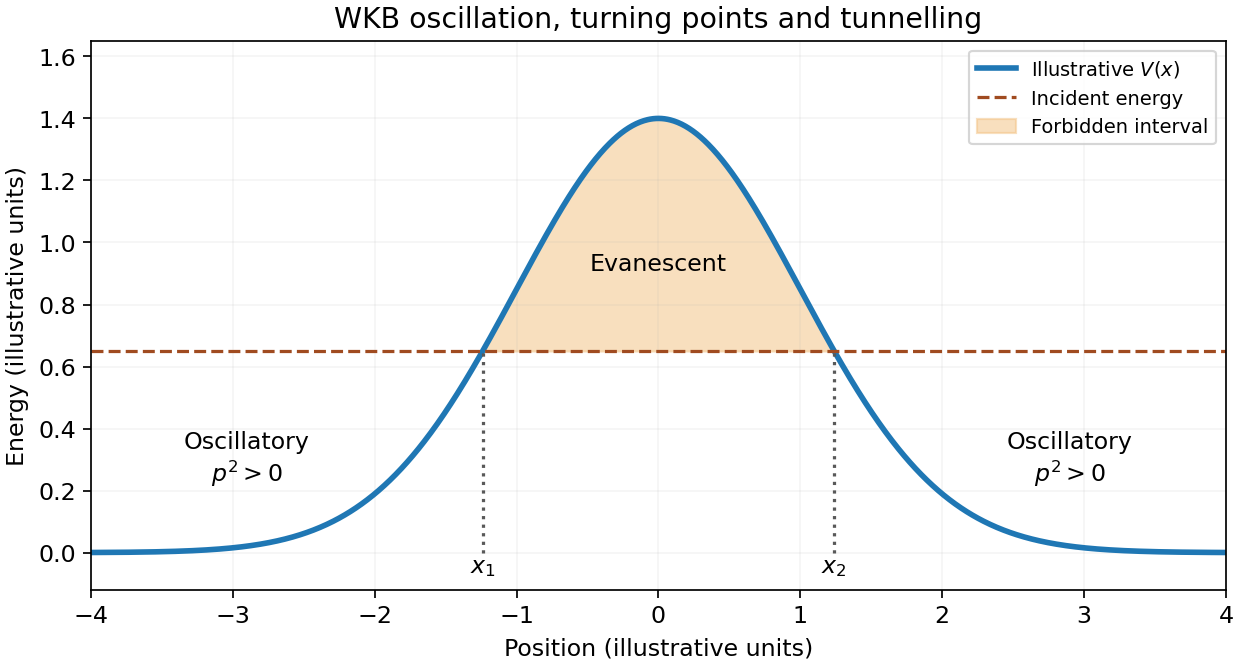
An illustrative smooth barrier separates two oscillatory WKB regions by an evanescent interval
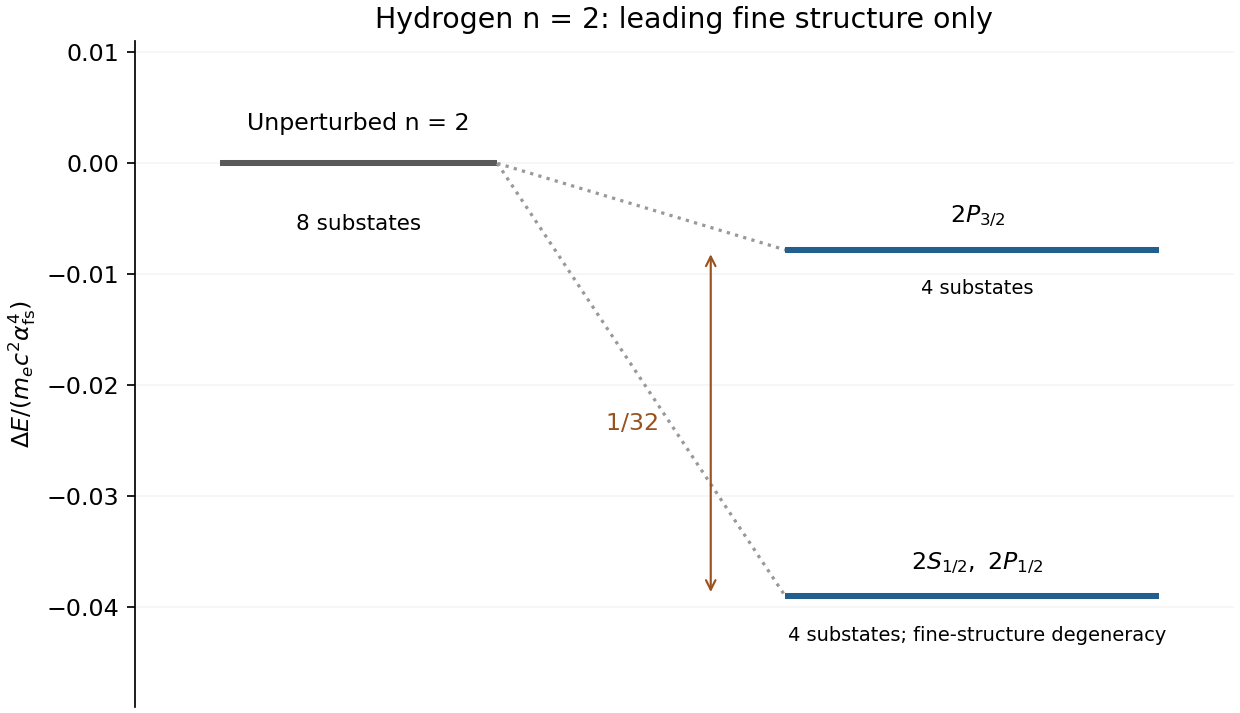
. Source. Details. For a point, stationary proton, the leading hydrogen fine structure comes from three order- contributions to the nonrelativistic electron Hamiltonian:These are the relativistic kinetic-energy correction, spin-orbit interaction and Darwin term. The spin-orbit coefficient includes the Thomas precession factor of one half; . The Coulomb Darwin contribution is a positive contact term, relevant for S states. These corrections distinguish total angular momentum , while leaving magnetic substates degenerate without an external field.
Writing , the combined hydrogen fine-structure correction isThus the splitting is of order times the principal binding energy. In the shell, and remain degenerate in this approximation, while is higher by . The Lamb shift lifts the remaining S–P degeneracy; hyperfine structure is a separate nuclear-spin effect. Neither is part of the displayed correction. Nuclear recoil and finite nuclear size have also been neglected. [ref]
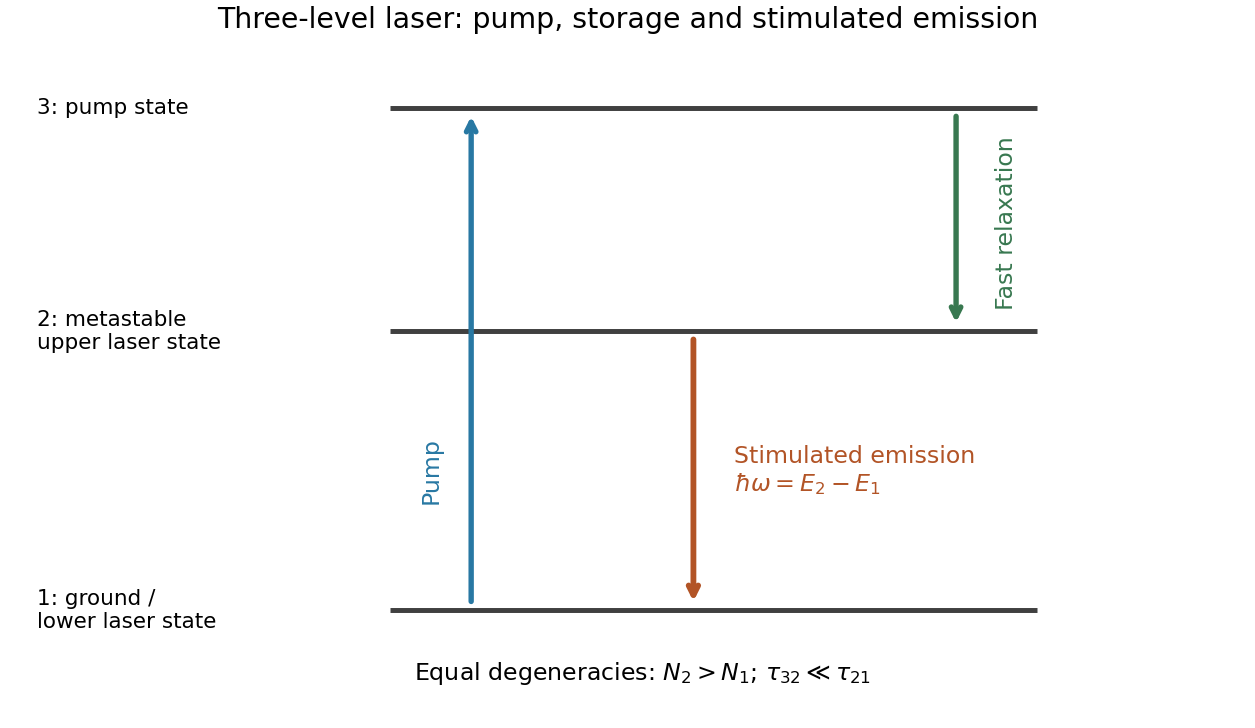
A three-level laser uses a pump transition from ground level1 to a higher level3, rapid relaxation , and a long-lived upper lasing level2. The laser transition is , so its lower level is the ground state. Fast feeding and slow upper-state decay allow excitation to accumulate, unlike steady resonant pumping of a simple two-level transition.
Stimulated emission adds photons to the stimulating optical mode, but ground-state photon absorption competes with it. The population inversion condition is when the relevant transition strengths obey the usual Einstein relations. For equal degeneracies and negligible , it reduces to , requiring more than half the active population in level2.
For a simple pump rate R per ground-state emitter, fast relaxation and negligible laser intensity, the three-level laser rate equation reduces toThis three-level ground-state inversion threshold is only transparency; positive gain must also overcome optical losses. For an illustrative uniformly filled cavity of length , equal absorption/emission cross-section , internal intensity-loss coefficient and mirror power reflectivities , the threshold condition isHere are number densities, unlike the total populations . The optical resonator supplies feedback and selects modes; a partially transmitting mirror couples out light. Spontaneous emission seeds the field, and stimulated transitions deplete the inversion until saturated gain balances loss. A ruby laser is the standard example. Real level degeneracies, branching losses and pump saturation modify the simple equations. [ref]
Fundamentals of Photonics and Quantum Electronics lecture notes by Franz X. Kärtner. Chapter7§§7.1–7.2.1, printed pp.293–298, optical feedback and three-/four-level media; original reduced ground-state model specified above


Articles by others on the same topic
There are currently no matching articles.