A three-level laser pumps emitters out of their ground state into a higher pump state, which rapidly relaxes into the upper lasing state. The lower lasing state is the ground state itself. Photon absorption on the lasing transition therefore competes with stimulated emission until enough emitters have been removed from the ground state. This is the ground state depletion problem implicit in population inversion.
The model below treats nondegenerate lasing energy levels with equal absorption and emission cross-sections. Its inversion condition is . Real materials require the relevant sublevel populations, degeneracies and transition strengths; the simple half-population condition should not be imposed on every optical transition. Extra levels let the pump and the emitted light act on different transitions, avoiding the steady two-level saturation limit discussed in population inversion.
A ruby laser uses chromium ions in ruby as its amplifying medium. Maiman's report identifies a metastable state fed by optical excitation and red emission near .[ref]
Stimulated Optical Radiation in Ruby by Theodore Harold Maiman. Stimulated Optical Radiation in Ruby, opening and level-scheme paragraphs
The pump stores excitation in the medium; stimulated emission transfers it into the optical field. The simplified three-level laser rate equation explains why the stored population and the output pulse evolve together.Theodore Harold Maiman and Irnee J. D'Haenens obtained laser action in May 1960. Their arrangement put a ruby rod inside a helical xenon flashlamp. Increasing excitation produced a marked intensity threshold, with subsequent measurements showing narrowing of the ruby emission line.[ref]
Theodore Harold Maiman by Irnee J. D'Haenens. Participant recollection: apparatus opening; paragraphs beginning In early 1960 and Subsequent measurements
The 1960 letter describes silvered parallel crystal faces and compares low- and high-excitation spectra.[ref]Stimulated Optical Radiation in Ruby by Theodore Harold Maiman. Apparatus paragraph and Fig. 2, low- and high-power spectra
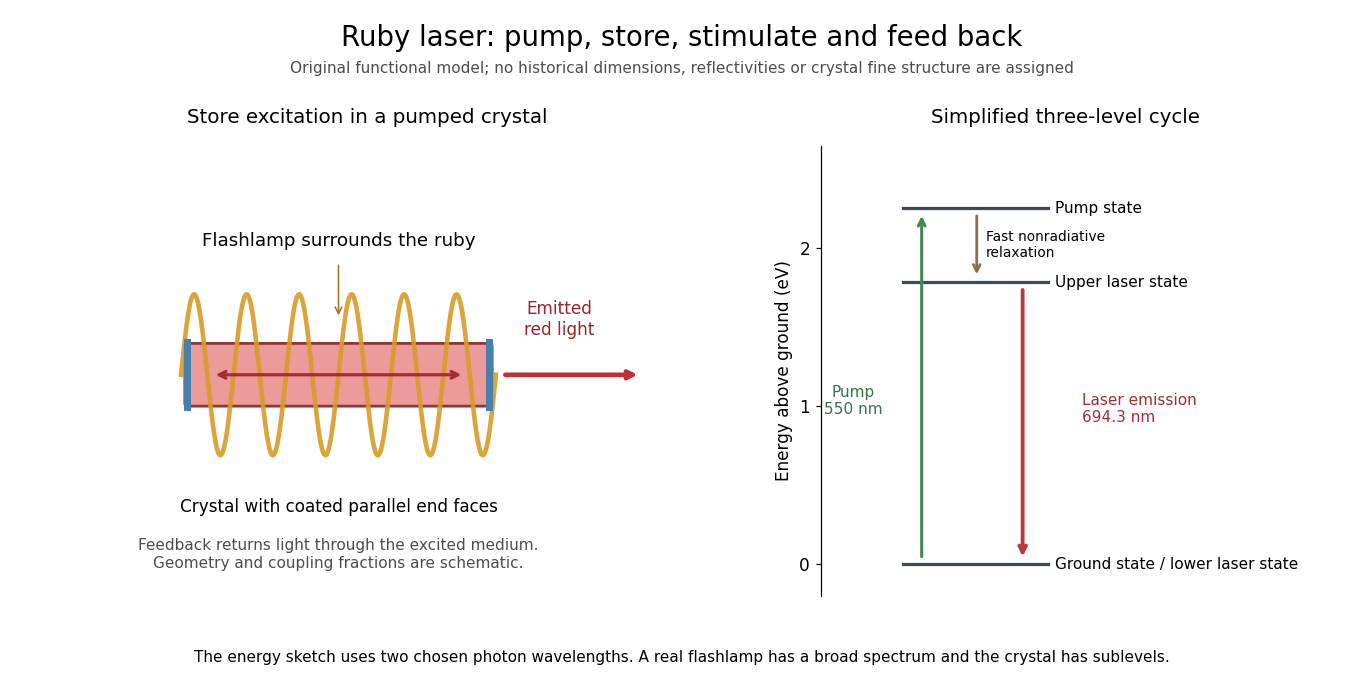
The controls answer different questions. Increased brightness establishes neither optical feedback nor narrow-band emission by itself: ordinary fluorescence can also brighten with pumping. Comparing spectra at lower and higher excitation, retaining the same optical collection geometry, tests a change in the emission process. Spectrometer resolution, response saturation and heating can alter an apparent line profile; a bright spot alone cannot distinguish those effects. These are interpretation requirements, rather than additional measurements attributed to the short original letter.
Several experimental models were made. The Smithsonian's surviving head has uncertain priority, and its installed crystal came from a later experiment.[ref]
Head Piece from Maiman Laser by Smithsonian Institution. Description: multiple experimental models, uncertain first-unit identification and replacement crystal
The functional diagram therefore describes the optical mechanism rather than claiming to reconstruct the first surviving unit.Consider an original reduced model with a fixed number of active emitters. Let be the upper lasing-state fraction, the ground-state fraction, and the number of cavity photons per emitter. Assume the pump state empties rapidly, so its population can be neglected. Measure time by , where is the upper state's spontaneous lifetime. Let be the effective pump rate, the dimensionless stimulated-coupling coefficient, the photon-loss rate in these units, and the fraction of spontaneous decays feeding this optical normal mode. The rate equations areEach term has a physical role. Pumping transfers emitters out of the ground state; spontaneous emission removes upper-state population. The net stimulated term includes emission from fraction and absorption by fraction , giving their difference . A stimulated transition removes one stored excitation and creates one cavity photon, or does the reverse. The factor accounts for spontaneous emission into the selected mode without pretending that all spontaneous emission enters it.
For negligible cavity light, the upper-state equation is linear. A constant pump applied to givesThus this model first permits population inversion at . Positive optical gain is still insufficient for an oscillator: the gain must exceed the complete laser threshold, including photon loss. The small-signal photon growth coefficient changes sign whenIf , even complete inversion cannot exceed the assumed loss in this model. For chosen and , the threshold population is and the pump threshold is . At , the unsaturated population first reaches at . These numbers are stipulated examples, not ruby material parameters.
In the steady limit with nonzero cavity light and negligible spontaneous seeding, the photon equation requires . The upper-state fraction is therefore fixed near while increased pumping principally increases the photon population. Substituting into the population equation givesFor , and , this predicts and . The inversion does not rise indefinitely above threshold. A finite supplies seed photons and smooths the ideal onset; with and exactly , the deterministic equations remain on the zero-photon solution even when that solution is unstable. This distinguishes instability of an unseeded state from actual startup of a noisy optical field.
A short optical pulse can draw on previously stored excitation. In the original calculation below, , , , , and for , followed by . The cavity field initially remains small while pumping fills the upper state. Once sufficient gain develops, the photon population grows and depletes the stored inversion. Continuing pump action can refill it, giving relaxation oscillations in this simple model. This is not a fit to Maiman's recorded output.
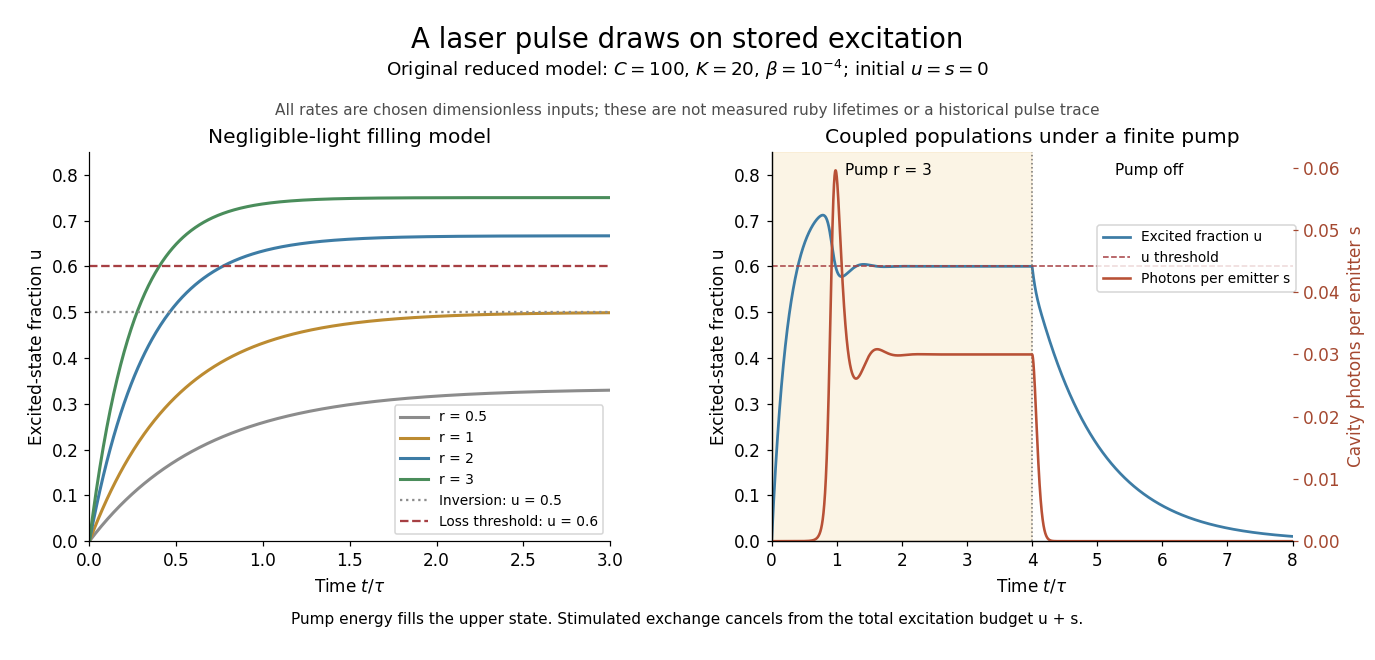
Ground-state depletion delays startup, and cavity light then drains stored excitation
. Original three-level laser rate equation calculations. Left: negligible-light upper-state fractions for several constant pumps, compared with the chosen . Right: coupled upper-state and cavity-photon populations for , , and a pump of switched off at . The rates and times are dimensionless teaching inputs, not measured ruby lifetimes or a historical pulse trace. Details.The equations expose the excitation budget underlying conservation of energy. Adding them cancels the stimulated exchange:Pumping supplies excitations; nonlasing decay and cavity loss remove them. Integrating gives the boundOnly part of the cavity loss may be useful output; passive absorption is also a loss. The pulse's instantaneous power can draw on stored excitation, while its total extracted energy still obeys the integrated budget. The model also preserves and : at each boundary its derivatives point inward or along the boundary.
There is a further energy cost in the pump cycle. For one absorbed pump photon producing at most one emitted laser photon, the ideal energy-conversion bound isChosen wavelengths and give about before other losses. The missing energy can leave through nonradiative relaxation and heating. Actual efficiency also depends on how much pump light is absorbed, unwanted decays and optical losses; a population model alone cannot predict it.
Articles by others on the same topic



The type of laser described at: Video "How Lasers Work by Scientized (2017)", notably youtu.be/_JOchLyNO_w?t=581. Mentioned at: youtu.be/_JOchLyNO_w?t=759 That point also mentions that 4-level lasers also exist and are more efficient. TODO dominance? Alternatives?
Three-level laser system by Dr. Nissar Ahmad (2021)
Source. Bibliography: