The closed shells have , so only the two equivalent p electrons matter. Their addition of angular momentum allows and , subject to the Pauli exclusion principle. Interchanging two orbital states has sign : even L is spatially symmetric and needs the antisymmetric spin singlet; odd L is spatially antisymmetric and needs the symmetric spin triplet. Thus the allowed LS terms of a p-squared configuration are , and .
In LS coupling, . The complete list of term symbols is thereforeThey contain magnetic substates, exhausting the antisymmetric two-electron space. All have even spatial parity, since each p orbital is odd.
For the linear rigid rotor, and the electric electric dipole moment interaction is . The isotropic state has no first-order shift. Its only coupled rotational state is , at gap , giving the quadratic Stark shift of a polar linear rotorUsing and the supplied I and d givesThe negative sign is the expected second-order Stark effect of a nondegenerate ground state. The mixing parameter is small, supporting the weak-field estimate. The constants h and use their defined SI values; no molecular input beyond the supplied data is needed.
The coherent state satisfies , and . The canonical commutation relation adds the vacuum term . Thereforeand the coherent-state electric-field variance isHere is taken positive as the field-amplitude scale. The coherent state displaces the mean field without changing this vacuum optical quadrature noise.
The WKB approximation, also called JWKB, describes a short local de Broglie wavelength in a slowly varying potential energy. For in a classically allowed region, its two local waves areThe phase follows the classical momentum; its amplitude varies to conserve probability current. In a forbidden region, putting gives , with boundary conditions selecting the physical combination.
The WKB validity condition is , with the analogous condition on . It fails at a turning point where . For a simple turning point, locally linearizing V yields an Airy function; matching fixes the relative amplitudes and a phase. Two such turning points give the two-turning-point WKB quantization conditionFor an opaque barrier, the WKB tunnelling exponent instead givesThe factor two distinguishes probability from amplitude. Matching determines the prefactor; the exponential alone is not accurate near the barrier top. These formulas connect bound state energy eigenvalues and quantum tunnelling to classical actions. [ref]
Topics in Quantum Mechanics by David Tong. §2.2, printed pp.37–49, semiclassical expansion, Airy matching and tunnelling
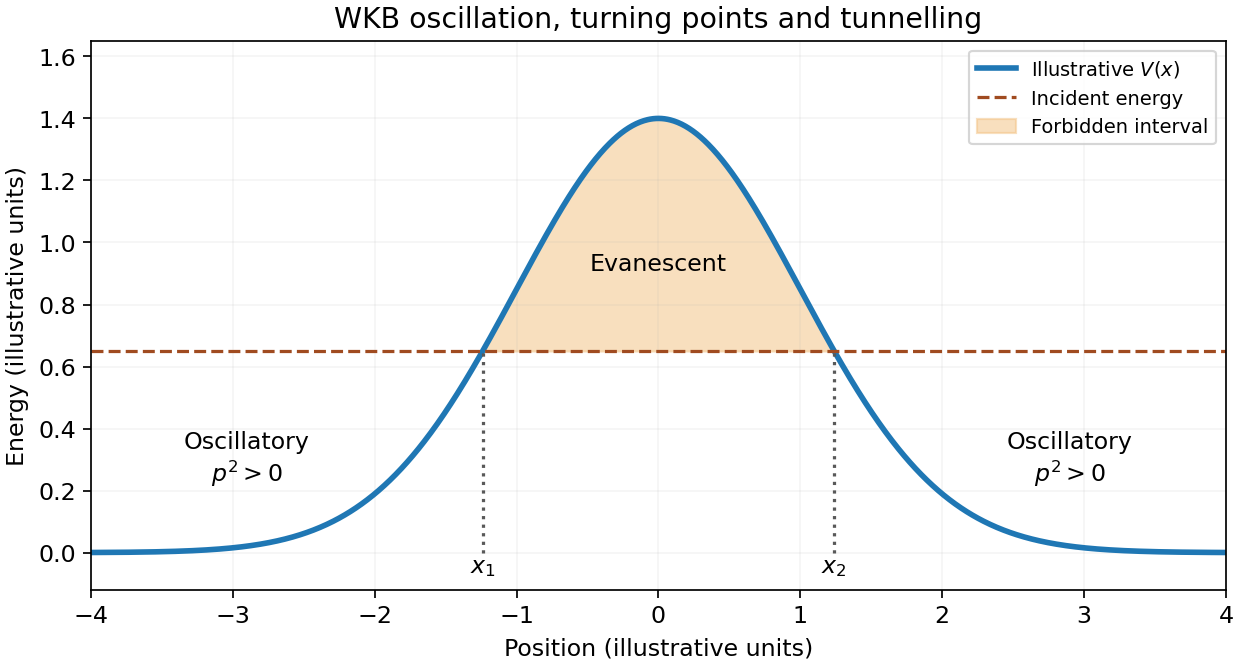
An illustrative smooth barrier separates two oscillatory WKB regions by an evanescent interval
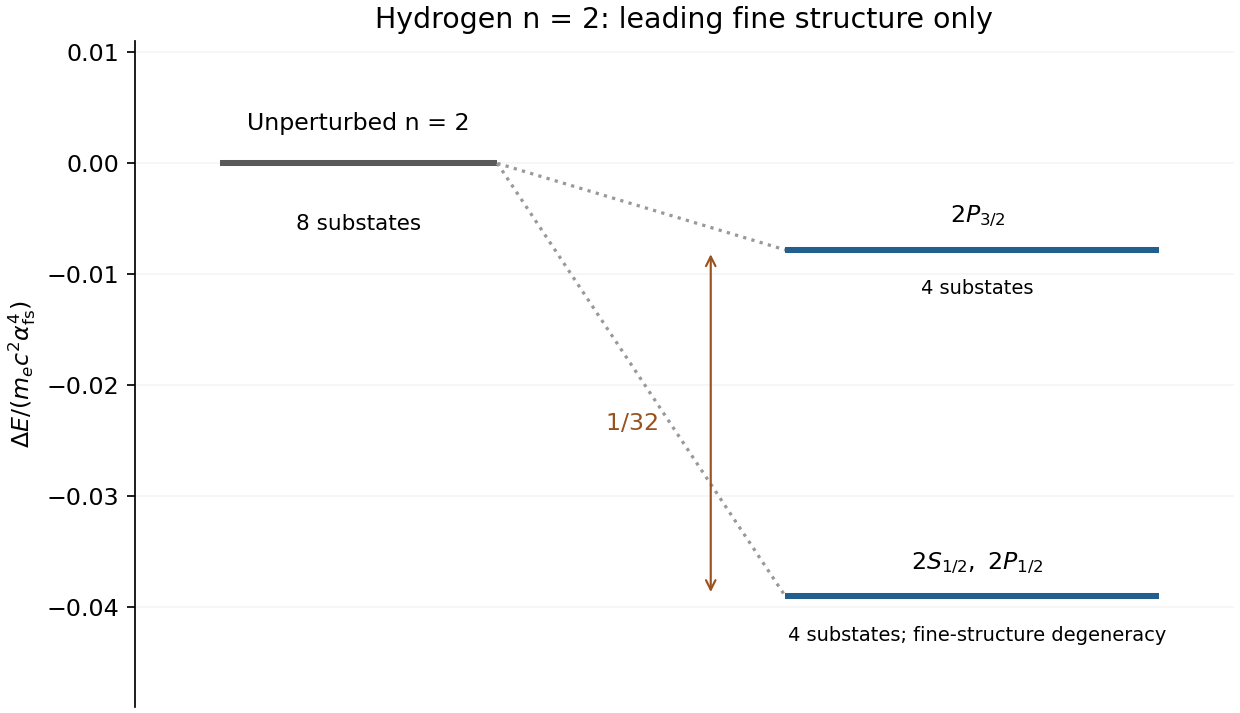
. Source. Details. For a point, stationary proton, the leading hydrogen fine structure comes from three order- contributions to the nonrelativistic electron Hamiltonian:These are the relativistic kinetic-energy correction, spin-orbit interaction and Darwin term. The spin-orbit coefficient includes the Thomas precession factor of one half; . The Coulomb Darwin contribution is a positive contact term, relevant for S states. These corrections distinguish total angular momentum , while leaving magnetic substates degenerate without an external field.
Writing , the combined hydrogen fine-structure correction isThus the splitting is of order times the principal binding energy. In the shell, and remain degenerate in this approximation, while is higher by . The Lamb shift lifts the remaining S–P degeneracy; hyperfine structure is a separate nuclear-spin effect. Neither is part of the displayed correction. Nuclear recoil and finite nuclear size have also been neglected. [ref]
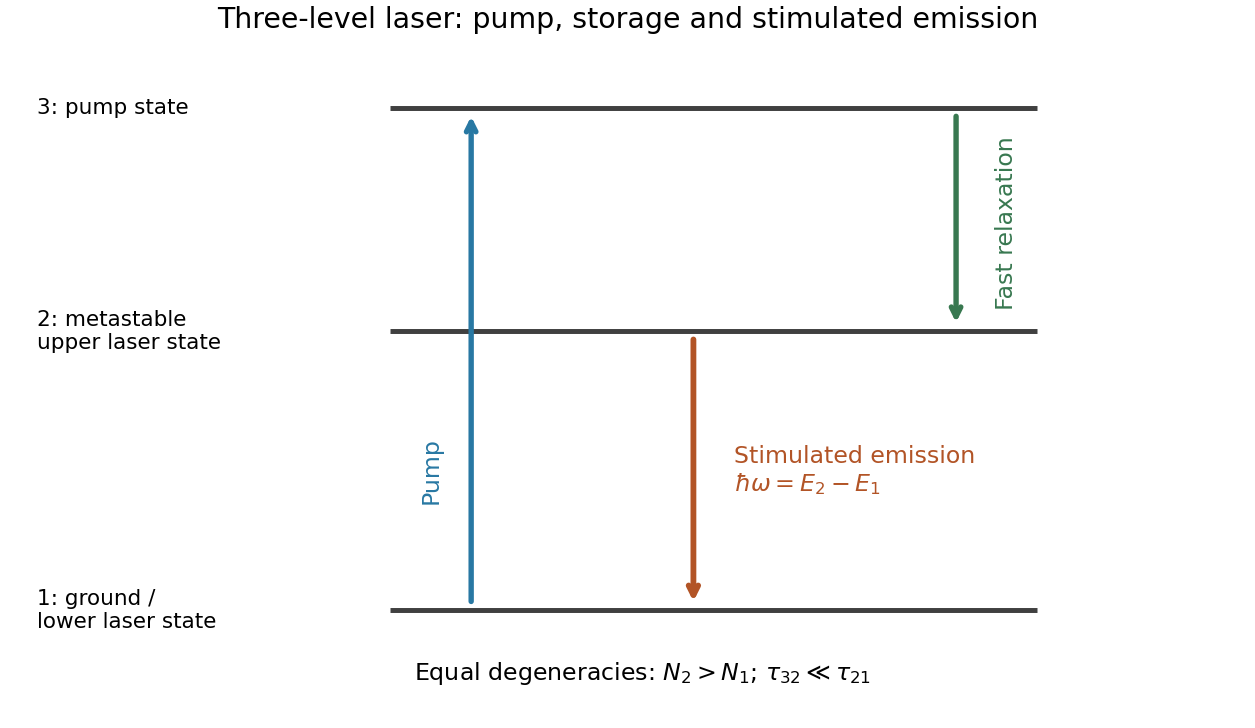
A three-level laser uses a pump transition from ground level1 to a higher level3, rapid relaxation , and a long-lived upper lasing level2. The laser transition is , so its lower level is the ground state. Fast feeding and slow upper-state decay allow excitation to accumulate, unlike steady resonant pumping of a simple two-level transition.
Stimulated emission adds photons to the stimulating optical mode, but ground-state photon absorption competes with it. The population inversion condition is when the relevant transition strengths obey the usual Einstein relations. For equal degeneracies and negligible , it reduces to , requiring more than half the active population in level2.
For a simple pump rate R per ground-state emitter, fast relaxation and negligible laser intensity, the three-level laser rate equation reduces toThis three-level ground-state inversion threshold is only transparency; positive gain must also overcome optical losses. For an illustrative uniformly filled cavity of length , equal absorption/emission cross-section , internal intensity-loss coefficient and mirror power reflectivities , the threshold condition isHere are number densities, unlike the total populations . The optical resonator supplies feedback and selects modes; a partially transmitting mirror couples out light. Spontaneous emission seeds the field, and stimulated transitions deplete the inversion until saturated gain balances loss. A ruby laser is the standard example. Real level degeneracies, branching losses and pump saturation modify the simple equations. [ref]
Fundamentals of Photonics and Quantum Electronics lecture notes by Franz X. Kärtner. Chapter7§§7.1–7.2.1, printed pp.293–298, optical feedback and three-/four-level media; original reduced ground-state model specified above


For a spinless particle, minimal coupling gives . Choose the vector potential and . Its curl is and , soThe translation separation in a magnetic field gradient follows from : a simultaneous energy eigenstate can be written . The periodic boundary condition requires , hence , . The remaining Schrödinger equation isThis magnetic-gradient quartic confinement has a positive quartic coefficient for . If , it is a single well at zero, with . Its harmonic curvature givesThus the two lowest states are respectively even and odd, with one central peak or two opposite-sign lobes, and approximately . They are not a nearly degenerate pair.
If , the two minima are , , with zero potential there and a central barrier . For well-separated minima the lowest parity states of a symmetric double well areHere are the localized ground-state Gaussians. Their even combination is the lower state; the odd combination has a node at the origin. Weak quantum tunnelling gives an exponentially small double-well tunneling splitting.
To obtain their common leading energy, put . Since ,The double-well oscillator scale in a linear magnetic field therefore givesThe asymptotic condition is , so the barrier separates narrow local oscillator states. It is this scale comparison that makes the source's “large” ratio meaningful.
The signed group velocity of a magnetic-gradient doublet follows by differentiating the band energy with respect to the conserved wavevector:For the double-well branch has and moves along ; reversing both signs reverses its velocity. To this order the two parity states have the same velocity. Corrections include local anharmonicity and the exponentially small splitting. The spinless Hamiltonian specified here has no extra Zeeman effect term.
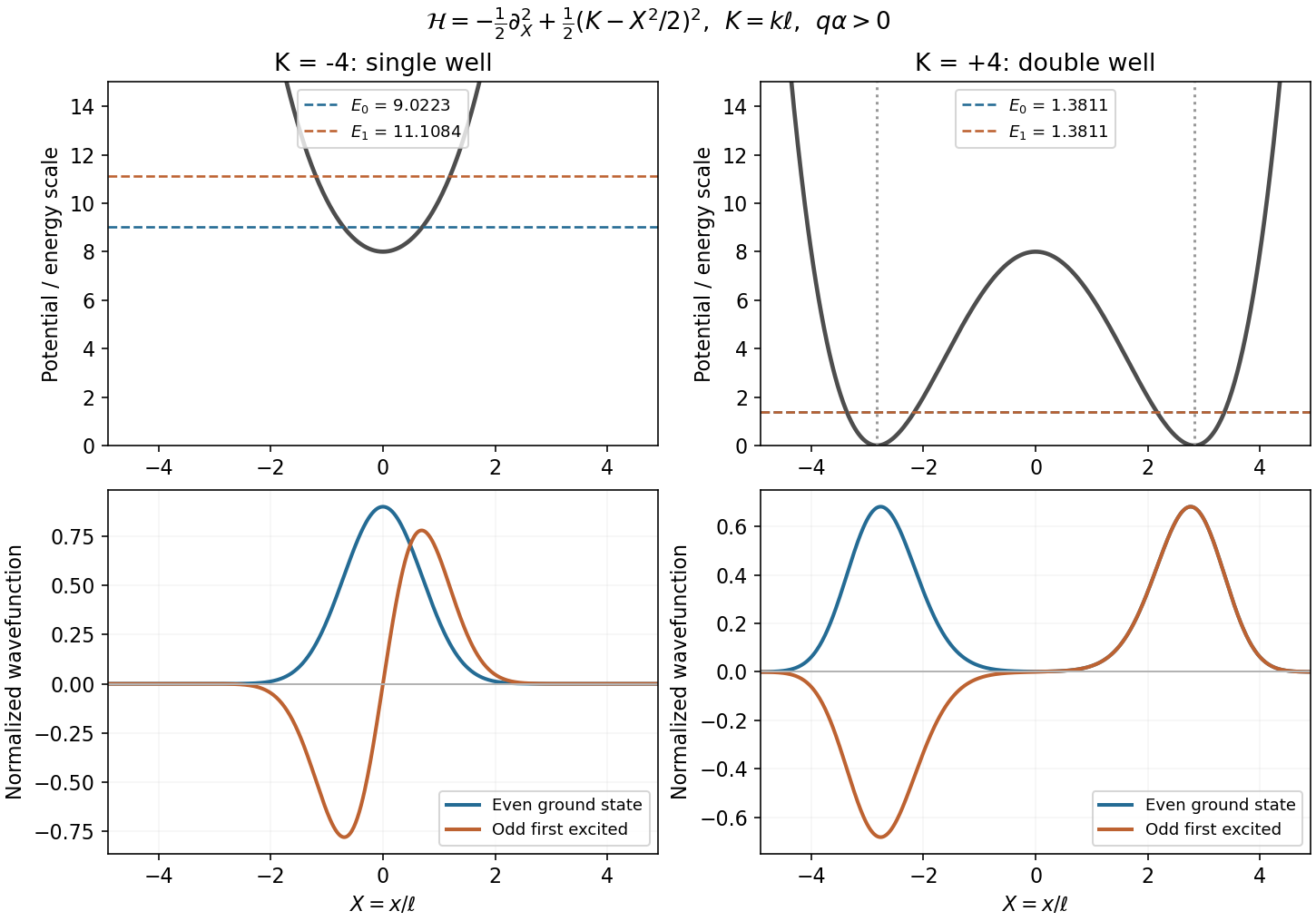
Original quartic magnetic-gradient potentials and numerical lowest even/odd wavefunctions for opposite wavevector signs
. Source. Details. 
Insert the expansion in the time-dependent Schrödinger equation, cancel the unperturbed evolution, and project onto . With ,In first-order time-dependent perturbation theory, put on the right and use for . Integration givesThe initial state must be the specified unperturbed eigenstate, the integral must exist under the switching prescription, and total transition probability must stay small. The diagonal term produces a first-order phase; setting in the off-diagonal integral changes those amplitudes only at second order. A weak peak perturbation alone is insufficient if its accumulated action invalidates this expansion.
For the infinite square well, retain the source's zero-based labels:An electron in a field along has perturbation for . About the well centre, is odd, whereas and are both even. The constant has zero off-diagonal matrix element, so the first-order parity selection in an infinite well gives . Excitation to that state is forbidden at first order, not necessarily at higher orders.
For the first excited state, direct integration or the supplied integral givesThe Fourier amplitude of the exponentially decaying electric-field pulse is . ThusThis is the leading, quadratic-in-field transition probability; the total probability of all excitations must remain small.
Starting instead in , which is odd about the centre, the pulse can transfer amplitude to the ground state and to even-labelled excited states . Other odd-labelled states have zero first-order dipole amplitude. Both downward and upward transitions are possible; their relative probabilities depend on dipole matrix elements and the pulse's spectral weight at the corresponding energy gaps. Most population remains in , with a small depletion equal to the summed leading transition probabilities. The common diagonal dipole phase in an infinite well is and has no population effect. After the pulse, the remaining coherent superposition evolves under the unperturbed Hamiltonian; no spontaneous relaxation is implied by this closed-system model.
Articles by others on the same topic
There are currently no matching articles.