Use for a product of the two individual spin-one spin eigenstates, with magnetic quantum numbers . Total requires , leaving preciselyHere these are product labels, not labels of the total angular momentum. Write their coefficients in this order as . With physical spin ladder operators , each nonzero individual step has amplitude , soBoth must vanish for a singlet state. The independent product states therefore require . Wavefunction normalization gives the spin-one singlet stateup to an overall quantum phase. Conversely, implies through , so these conditions really select total spin zero. Distinguishability imposes no additional exchange restriction. The ladder hint uses dimensionless angular momentum units; restoring its common factor does not change the coefficient ratios.
For a bound energy eigenstate with a nondegenerate energy eigenvalue of an even one-dimensional potential, the wavefunction can be chosen with definite parity. A uniform electric field gives the electric-dipole interaction , which is odd under reflection. Hencesince is odd. Second-order nondegenerate perturbation theory then gives the leading allowed Stark effect shift:Only opposite-parity intermediate states have nonzero position matrix elements. More generally, reflection maps to , so an analytic nondegenerate energy level is an even function of the field. This explains the absence of all odd orders and the usual quadratic Stark effect.
A level separation changes by the difference of the two quadratic coefficients. Symmetry alone does not guarantee a nonzero differential shift: in a displaced quantum harmonic oscillator every level moves by the same , leaving every spacing unchanged. Degenerate states would instead require degenerate perturbation theory and can split linearly; the nondegeneracy of one-dimensional bound states applies to ordinary isolated well levels.
Neglect hyperfine structure and use the electronic weak-field Zeeman splitting regime, where is small compared with the spin-orbit interaction splitting. The sodium levels are , and . The Landé g-factor formula givesFor example, inserting gives . Each sublevel with magnetic quantum number shifts by . Thus the lower level has shifts , the upper level has shifts , and the upper level has shifts and .
The electric-dipole selection rule allows except , and . Both fine structure branches are allowed. The emitted photon energy isAll the allowed components of the sodium D-line Zeeman pattern are listed below; the last column is the photon shift in units of :These are four components of D1 and six of D2. Their strengths need not be equal; the table and arrows specify allowed transitions, not intensities.
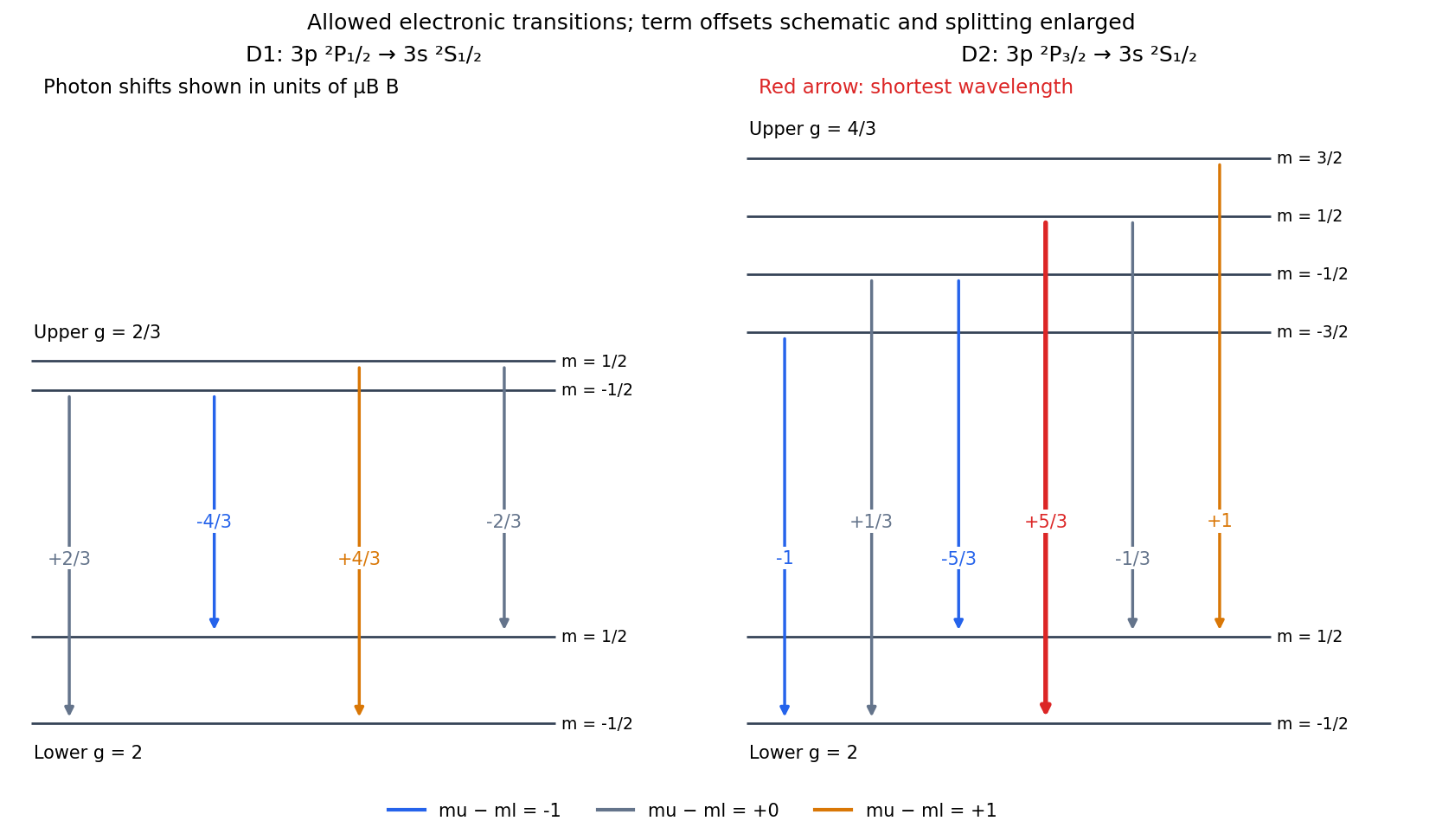

The level lies above , so D2 has the larger zero-field photon energy. [ref]
https://physics.nist.gov/PhysRefData/Handbook/Tables/sodiumtable5.htm. NIST, Energy levels of Neutral Sodium, 3p fine-structure ordering
In the stated weak-field regime its most positive shift is . Since , the shortest wavelength is therefore produced byThe tempting pair has a larger difference of level shifts but is forbidden because . Articles by others on the same topic
There are currently no matching articles.