An electric field shifts and can split the energy eigenvalues of an atom. This is the Stark effect; its hydrogen atom ground-state case is quadratic in a weak field.
The observable in Stark effect spectroscopy is a change in a spectral line, rather than a direct reading of an individual energy eigenvalue. If an upper energy eigenstate emits a photon into a lower energy eigenstate , the Planck constant relates its frequency to the difference:Here denotes the applied electric field component along a chosen axis. Both levels can move, and electric-dipole selection rules for hydrogen decide which pairs produce observable spectral lines. This makes Stark effect spectroscopy a probe of energy eigenstates and their electric dipole moments: the slope is the corresponding dipole component by the Hellmann–Feynman theorem. The comparison with Zeeman splitting is useful: there an applied magnetic field supplies the perturbation.
The energy shift produced by an oscillating electric field, often called a light shift. For a far-detuned two-level drive with coupling and , the ground-state shift is approximately . Multilevel atoms can have polarization-dependent differential shifts.
An electric-field shift or splitting of molecular rotational levels. The observed line shift is the difference of upper- and lower-level shifts, subject to polarization-dependent selection rules; shifting only one endpoint gives an incorrect spectral splitting.
The dipole coupling connects only at fixed . For , second order gives ; the ground-state result is separately . Here has energy units and is the polar angle to the field.
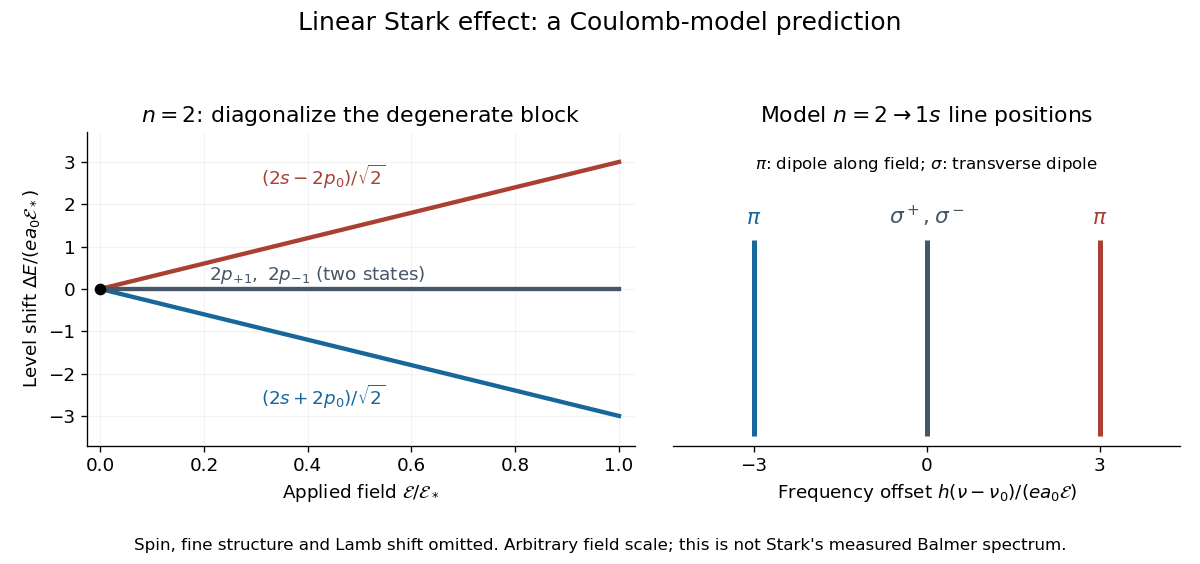
For , the and frequency shifts are and . Their difference is , so . The common lower-state shift cancels from the splitting but not from either absolute transition frequency.
Radiation polarized along the static field drives the zero-projection change, while transverse polarization supplies the two circular components with projection changes plus or minus one. The opposite signs of the excited magnetic quantum number remain degenerate in a pure static electric field; they need not be separate spectral lines.
Every state in a fixed- manifold has parity , while the dipole component is odd. Therefore its complete matrix within that degenerate manifold vanishes. One must check the whole degenerate block, not only one diagonal element, before concluding that first-order splitting is absent.
The quadratic Stark effect is an energy level shift whose leading term is quadratic in an applied electric field. For a nondegenerate energy eigenstate of definite parity, the diagonal matrix element of an odd electric-dipole perturbation vanishes. Second-order nondegenerate perturbation theory givesEvery term is negative for the ground state. If field reversal is implemented by the parity operator, an analytic nondegenerate energy branch is even in the field. This symmetry explains the absence of odd powers; it does not apply without qualification to a degeneracy split linearly by the field.
In 1913 Johannes Stark reported that an applied electric field resolved the hydrogen and spectral lines into five components at his instrument's spectral resolving power, viewed perpendicular to the electric field. Three inner components had polarization of an electromagnetic wave perpendicular to the electric field; two outer components had it parallel.[ref]
Observation of the Separation of Spectral Lines by an Electric Field by Johannes Stark. Stark, Nature 92 (1913), p. 401, two opening paragraphs; issue dated 4 December
In his lecture of 3 June 1920 for the 1919 prize, Johannes Stark describes canal rays emerging through a perforated cathode into the electric field between it and a supplementary electrode. A spectrograph recorded the emitted light. His earlier Doppler effect comparison used a collimator perpendicular to the beam and then along approaching rays. Later beam/electric field reversal changed component intensities.[ref]
Structural and Spectral Changes of Chemical Atoms by Johannes Stark. Nobel Lectures, Physics 1901–1921; Stark, Structural and spectral changes of chemical atoms, printed pp. 430, 433–435; lecture date p. 427
The historical account distinguishes observation perpendicular to the electric field, with five resolved components, from observation parallel to it, with three. These are viewing directions, distinct from the direction of the polarization of an electromagnetic wave.[ref]
The Discovery of the Stark Effect and Its Early Theoretical Explanations by A. J. Kox. Kox, The discovery of the Stark effect and its early theoretical explanations, §2 Johannes Stark, paragraph following Figure 2
The experimental distinctions matter. Changing the viewing direction tests a Doppler effect contribution; changing the applied electric field tests the Stark effect; analyzing polarization of an electromagnetic wave separates components that may overlap in an unpolarized record. A comparison with the unperturbed spectral line fixes the origin of a displacement. These are different controls, and the earlier Doppler effect comparison should not be described as a field-off control of the later discovery. A spectrograph's finite spectral resolving power can merge several components into one. In particular, a count of visible spectral lines does not by itself count all energy eigenstates.
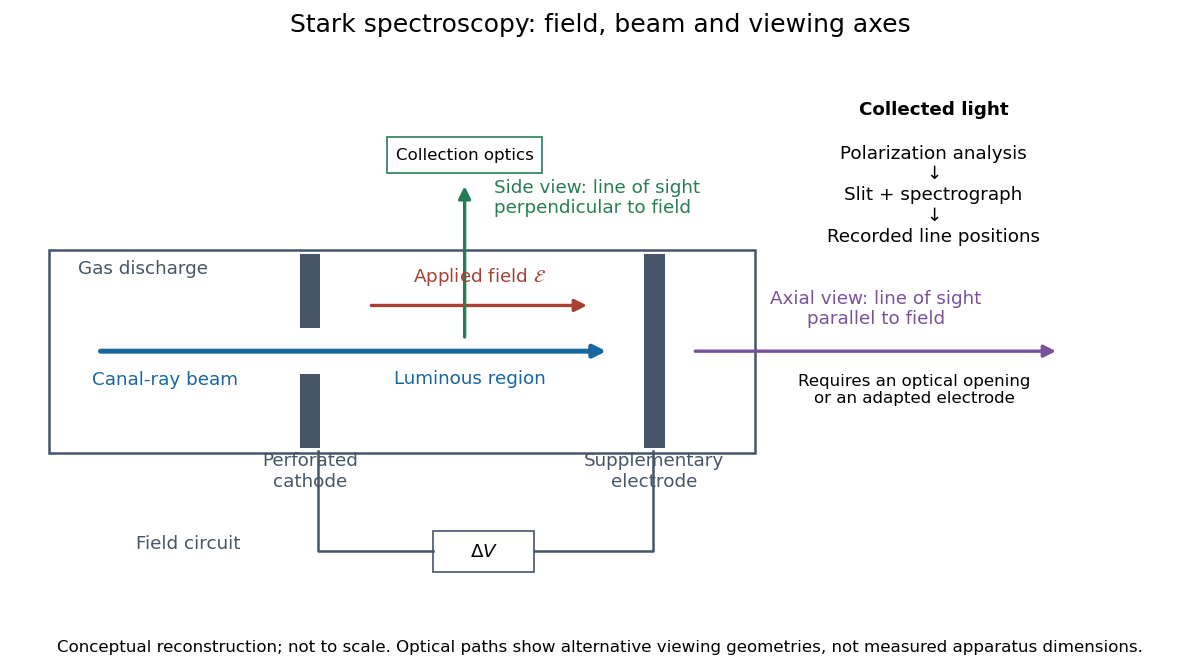
Stark spectroscopy: field, beam and viewing axes
. Original conceptual reconstruction of the canal ray source and two alternative viewing geometries. No dimensions, electric field strengths or measured wavelengths are specified. The axial optical path requires an opening or adapted electrode; it is not a ray passing through the solid electrode drawn here. Details.For a modern idealization of the gap, an electric potential difference over separation gives only if edge effects and the charge density in the gas are negligible. This is a calibration model, not a historical value assigned to Stark's apparatus. Similarly, a canal ray beam need not be a pure beam of neutral excited hydrogen atoms; the quantum mechanics model below isolates one neutral hydrogen atom from the source's preparation and collision processes.
Consider a fixed proton and one electron, omitting spin, fine structure and the Lamb shift. Let be the elementary charge, the Bohr radius in this fixed-nucleus model, and . Because the electron's electric dipole moment is , its electric-dipole interaction isThe first excited hydrogen eigenspace has a common unperturbed energy eigenvalue . Write and in the hydrogen energy eigenbasis. The electric-dipole selection rules for hydrogen leave only the coupling within this eigenspace. Each diagonal matrix element vanishes by parity, but that does not make the entire perturbation vanish. Degenerate perturbation theory requires its eigenvalues in the whole eigenspace. With the usual real wavefunction phases the off-diagonal position matrix element is .[ref]
Linear Stark Effect. Quantum Mechanics by Richard Fitzpatrick; Fitzpatrick, Linear Stark Effect, equations (7.82)–(7.86)
The factor three can be checked directly. Set and use normalized radial wavefunctions and spherical harmonics:The angular integral is . Including and the radial volume factor then givesReversing the quantum phase of reverses this sign, with no change to the predicted energy eigenvalues.
Thus the nontrivial two-dimensional block and its determinant equation areConsequently, for the displayed sign convention,The two remaining energy eigenstates have zero first-order shifts. The slopes correspond to opposite electric dipole moments, and . The electric field selects combinations of opposite parity that already have these dipole expectations at leading order. This is why applying first-order nondegenerate perturbation theory separately to and , and obtaining two zero diagonal entries, misses the splitting.
The approximation requires small compared with the separation to other principal quantum numbers. For real hydrogen atoms, it also requires the relevant electric-dipole interaction to dominate the small splittings omitted here, including the Lamb shift. At sufficiently small electric fields a pre-existing nonzero – separation must be retained before taking the limit. A simple two-state illustration with unperturbed separation has shifts relative to its meanFor , the lower branch moves by relative to its zero-field value. At the splitting is linear. This interpolation explains the importance of the hydrogen energy-level degeneracy; it is not a complete model of the fine structure multiplet.
For an illustrative emission calculation, retain only the first-order shifts above and neglect the quadratic shift of the hydrogen atom ground state. The unperturbed Lyman-alpha line frequency is . The possible offsets areThe outer pair originates in the parts of and has transition electric dipole moments along the applied electric field, conventionally called components. The central pair originates in and has transverse rotating transition electric dipole moments, conventionally called components. Because electromagnetic radiation is transverse, the components disappear when viewed along the electric field. Viewed from the side, the and components have polarization of an electromagnetic wave respectively parallel and perpendicular to the applied electric field. Line intensities additionally require the initial quantum state populations and the collection geometry.
The even, spherically symmetric hydrogen atom ground state has no permanent electric dipole, so a uniform electric field gives no first-order energy shift. The electric-dipole selection rules for hydrogen allow odd-parity excited states to mix in at second order, yielding a negative shift quadratic in the field.
Here there is a nondegenerate energy eigenvalue, so second-order nondegenerate perturbation theory applies. With , it givesThe notation includes integration over the continuous spectrum, as well as a sum over discrete energy eigenstates. All denominators are negative because is the ground state. The positive electric polarizability therefore lowers its energy.[ref]
Quadratic Stark Effect. Quantum Mechanics by Richard Fitzpatrick; Fitzpatrick, Quadratic Stark Effect, equations (7.57) and (7.65): quadratic convention and exact polarizability
An independent way to see the coefficient avoids truncating that sum. Define and . In coordinates , the dimensionless unperturbed Hamiltonian operator and normalized wavefunction are and , with energy eigenvalue . Writing the first-order wavefunction correction as , substitution into the time-independent Schrödinger equation givesThe second equality can be checked by differentiation. Its parity makes orthogonal to . The resulting integral issince the normalized radial probability density is , giving and . Converting back to SI units gives the stated electric polarizability. The induced electric dipole moment is and tends to zero with the electric field, unlike the selected degenerate branches' leading dipoles. Both calculations describe weak-field level shifts; a spatially uniform static electric field also allows eventual quantum tunnelling and ionization, which these real energy corrections do not calculate.
Articles by others on the same topic



The Stark effect is the phenomenon in which the energy levels of atoms and molecules are shifted and split in the presence of an external electric field. This effect is named after the German physicist Johann Stark, who discovered it in 1913. When an external electric field is applied, it interacts with the electric dipole moments of the atoms or molecules.