Keep fixed and put , so as temperature tends to zero. For even , the finite-ring antiferromagnetic Ising correlation becomesBoth alternating ground states have , so their equal-weight canonical ensemble has the same two-point correlation function despite its zero one-point correlation function.
For odd , the signs instead giveDirect substitution gives an indeterminate ratio. Expanding at fixed with ,Consequently the zero-temperature correlation of an odd antiferromagnetic Ising ring isThe odd-ring factor has a direct probability interpretation. At zero temperature, the canonical ensemble gives equal weight to its ground states. The single frustrated bond in an antiferromagnetic Ising ring is uniformly located, with probability of lying on the chosen -bond path. If it is absent from that path, ; if it is present, this product is . Averaging gives .
Thus the decay with separation here comes from averaging a movable, compulsory frustrated bond in an antiferromagnetic Ising ring, even after additional thermally excited frustrated bonds in an antiferromagnetic Ising ring disappear. In particular for odd , and reproduces the ground-state energy. The formula also respects , although its factor changes sign halfway around the ring.
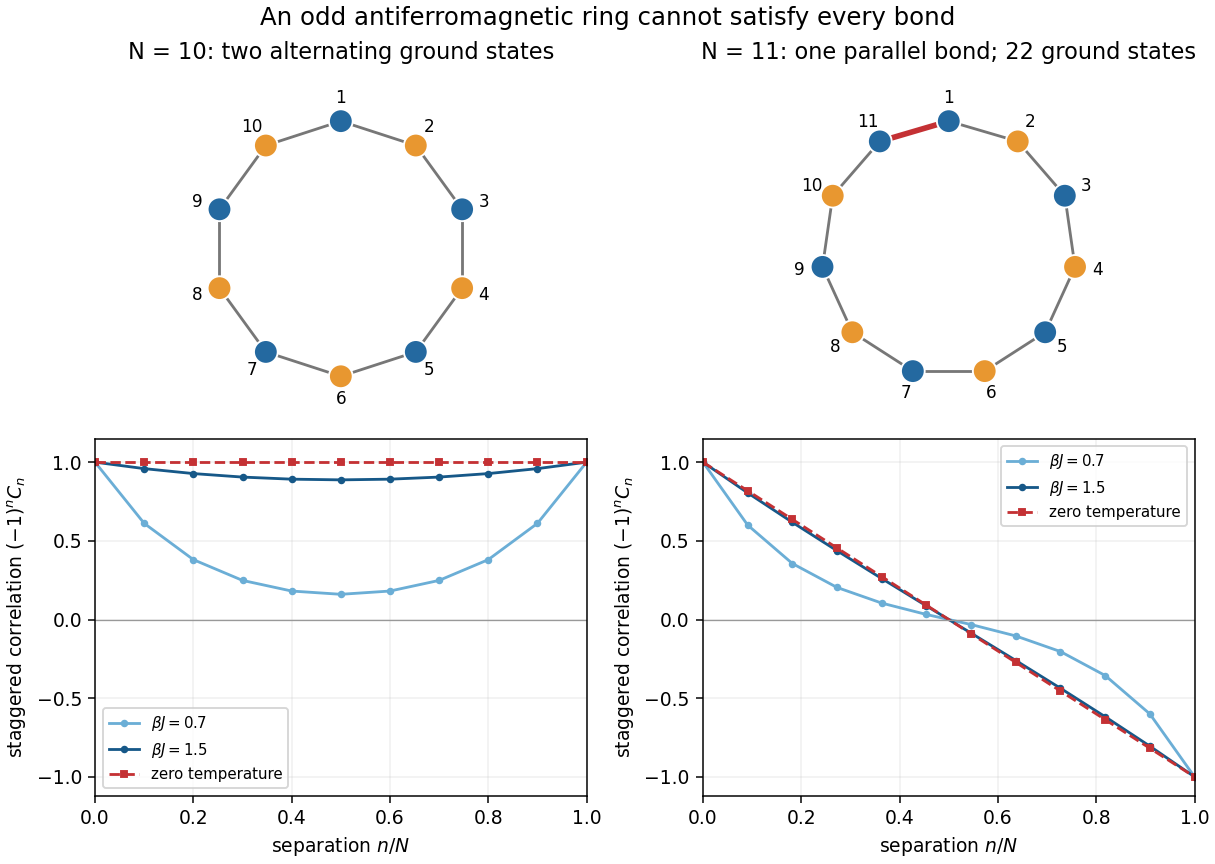

The order and scale of limits matter. Taking the thermodynamic limit first at positive temperature gives the exponential function in part (c). Cooling an odd finite ring first leaves the linear factor . Both orders subsequently give at fixed , but this agreement is not uniform in separation: when stays nonzero, the odd-ring linear factor survives in the zero-temperature expression.
Articles by others on the same topic
There are currently no matching articles.