Each neighboring pair of Ising spins contributes at least to the energy, with equality exactly when the two Ising spins are opposite. For even , alternation closes consistently under the periodic boundary conditions. The ground states are thereforeHere is the ground-state degeneracy. Choosing fixes every other Ising spin, so these are all the ground states; translations do not give additional spin configurations. The two ground states are exchanged by spin inversion symmetry.
Let count the parallel neighboring pairs, or frustrated bonds in an antiferromagnetic Ising ring. The periodic boundary conditions implyThere are antiparallel pairs, so : the number of antiparallel pairs must be even. For odd , must consequently be odd. Each frustrated bond in an antiferromagnetic Ising ring raises the energy by relative to a satisfied pair, givingThe minimum is attained at . Choose its position among the labeled bonds, choose either orientation of one Ising spin, then alternate across every other bond. This constructs exactly two spin configurations per position. ThusThis is geometric frustration: every local interaction prefers opposite Ising spins, but the closed odd ring prevents all preferences being satisfied at once. No particular location is preferred for the single frustrated bond in an antiferromagnetic Ising ring.
Write , where is the inverse temperature, is temperature and is the Boltzmann constant. In the canonical ensemble, each spin configuration has probability . The nearest-neighbor Boltzmann factors multiply, so the spin-chain transfer matrix, in the order , isMultiplying its entries around the ring and summing over every Ising spin yields the partition function:The trace implements the periodic boundary conditions; replacing it by an endpoint sum would describe a different partition function. The normalized eigenvectors and corresponding eigenvalues areThe negative eigenvalue is essential for the antiferromagnetic Ising model. Introduce their ratioThe exact finite- partition function and Helmholtz free energy areFor finite , , so for both even and odd . The last term retains the finite-ring effect of geometric frustration.
To insert an Ising spin into this trace, use the diagonal matrix . In the eigenbasis of , it exchanges and , and hence has vanishing diagonal entries. The one-point correlation function is thereforeThe same conclusion follows directly from spin inversion symmetry: reversing every Ising spin preserves the energy and the Boltzmann factor while reversing .
For the two-point correlation function, the two insertions divide the ring into paths of and bonds. ThusIn particular, the exact finite-ring antiferromagnetic Ising correlation isBecause the one-point correlation functions vanish, this is also the connected correlation function. It gives and , as required by and exchanging the two paths around the ring. At , distinct Ising spins are independent and for ; is understood separately if a power occurs in the displayed expression.
Take the thermodynamic limit at fixed separation and fixed finite . Since , the terms and in the finite-ring antiferromagnetic Ising correlation vanish, through either even or odd . ThereforeMatching the decaying exponential function gives the correlation length, in units of the site spacing:If the physical spacing is , the physical correlation length is . The alternating sign records the preferred opposite orientation of neighboring Ising spins; the finite correlation length shows that this preference does not maintain long-range Néel order at positive temperature.
For large , , so : the correlation length becomes large on cooling, but diverges only at zero temperature. At infinite temperature, and ; the separate equal-site two-point correlation function remains .
Keep fixed and put , so as temperature tends to zero. For even , the finite-ring antiferromagnetic Ising correlation becomesBoth alternating ground states have , so their equal-weight canonical ensemble has the same two-point correlation function despite its zero one-point correlation function.
For odd , the signs instead giveDirect substitution gives an indeterminate ratio. Expanding at fixed with ,Consequently the zero-temperature correlation of an odd antiferromagnetic Ising ring isThe odd-ring factor has a direct probability interpretation. At zero temperature, the canonical ensemble gives equal weight to its ground states. The single frustrated bond in an antiferromagnetic Ising ring is uniformly located, with probability of lying on the chosen -bond path. If it is absent from that path, ; if it is present, this product is . Averaging gives .
Thus the decay with separation here comes from averaging a movable, compulsory frustrated bond in an antiferromagnetic Ising ring, even after additional thermally excited frustrated bonds in an antiferromagnetic Ising ring disappear. In particular for odd , and reproduces the ground-state energy. The formula also respects , although its factor changes sign halfway around the ring.
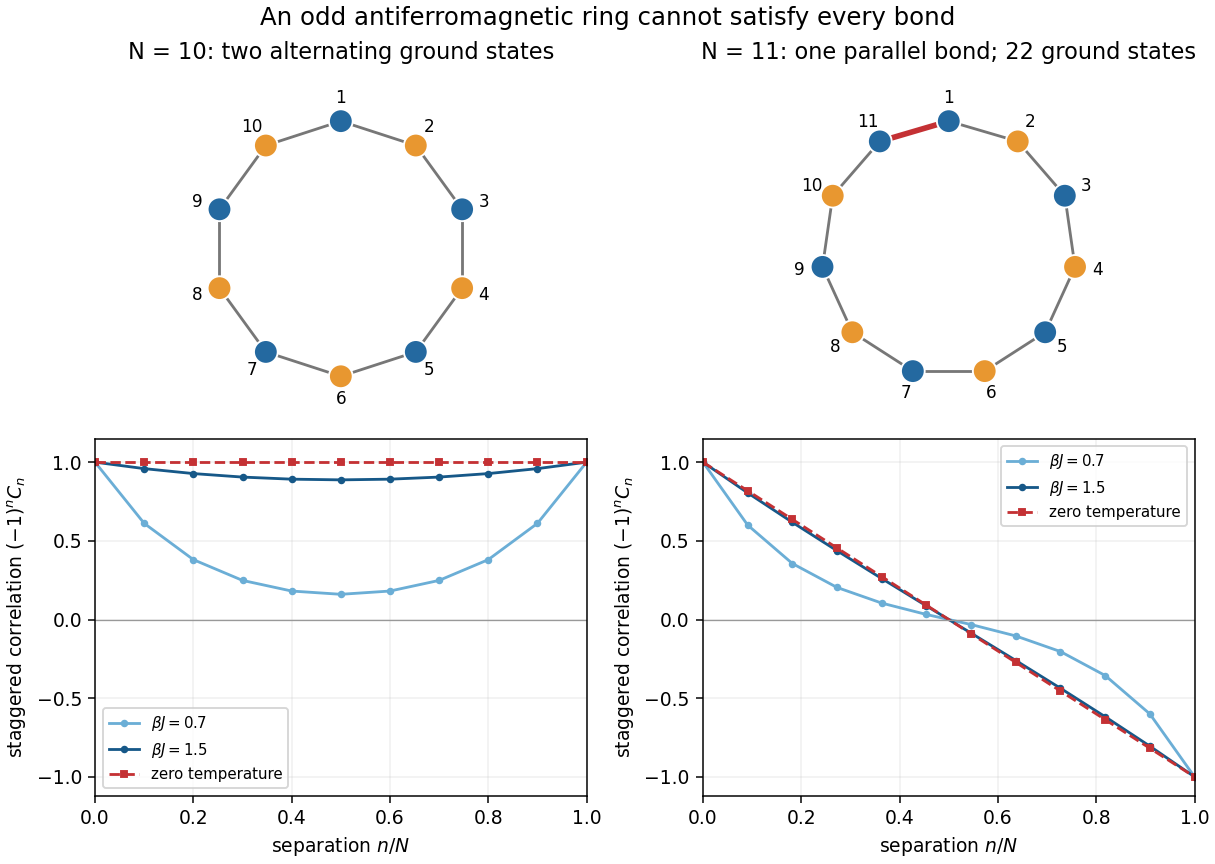

The order and scale of limits matter. Taking the thermodynamic limit first at positive temperature gives the exponential function in part (c). Cooling an odd finite ring first leaves the linear factor . Both orders subsequently give at fixed , but this agreement is not uniform in separation: when stays nonzero, the odd-ring linear factor survives in the zero-temperature expression.
Articles by others on the same topic
There are currently no matching articles.