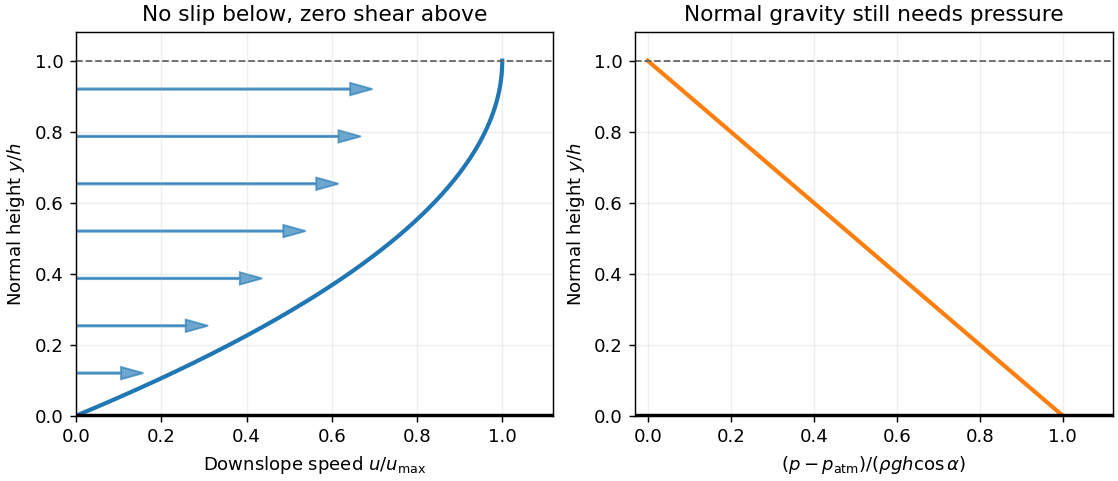
Let measure distance down the incline and distance perpendicular to it, with the wall at and the free surface at . A uniform steady falling film flow has . Its convective acceleration vanishes because and . A flat surface exposed to constant atmospheric pressure hasThus , and the downslope component of the Navier-Stokes equations reduces to . The printed pressure-free equation must be understood as this downslope projection: its full vector version would incorrectly omit the normal hydrostatic pressure gradient that balances .
The no-slip boundary condition gives . Neglecting air shear stress makes the surface shear-free, so . Two integrations give the uniform gravity-driven Newtonian film profileThe velocity increases up to the free surface, whereThis assumes a uniform laminar Newtonian fluid film, a stationary wall and negligible surface shear; a varying thickness or externally imposed downslope pressure gradient would alter the balance.

Articles by others on the same topic
There are currently no matching articles.