Original public paper: Physical PDF pages 258–261. All three optional notes and both long questions are covered.
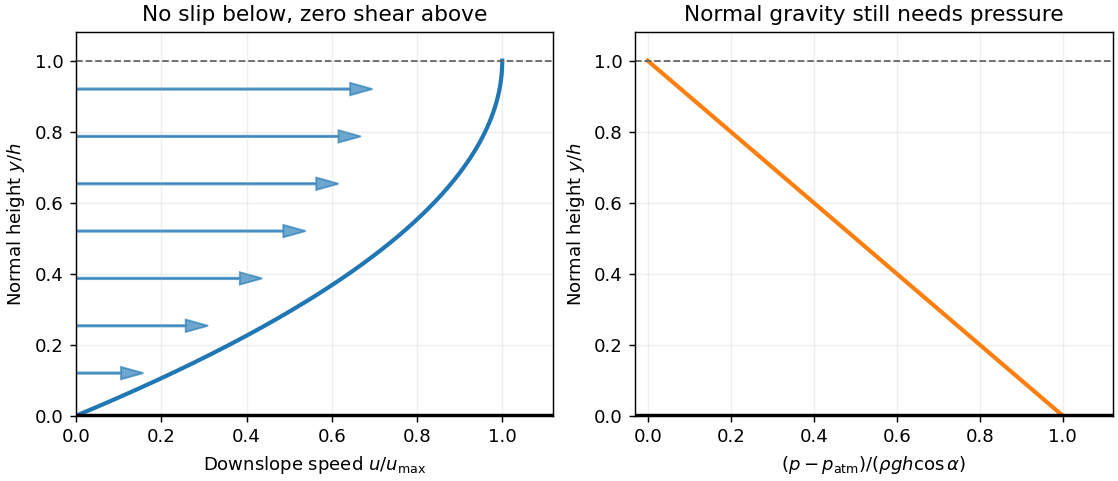
Let measure distance down the incline and distance perpendicular to it, with the wall at and the free surface at . A uniform steady falling film flow has . Its convective acceleration vanishes because and . A flat surface exposed to constant atmospheric pressure hasThus , and the downslope component of the Navier-Stokes equations reduces to . The printed pressure-free equation must be understood as this downslope projection: its full vector version would incorrectly omit the normal hydrostatic pressure gradient that balances .
The no-slip boundary condition gives . Neglecting air shear stress makes the surface shear-free, so . Two integrations give the uniform gravity-driven Newtonian film profileThe velocity increases up to the free surface, whereThis assumes a uniform laminar Newtonian fluid film, a stationary wall and negligible surface shear; a varying thickness or externally imposed downslope pressure gradient would alter the balance.
By reflection symmetry the vertical gravitational field of the self-gravitating incompressible slab vanishes at its mid-plane. Inside the slab, the gravitational Poisson equation therefore integrates to . Treat the star as a test particle, so its own mass does not alter that field. Its vertical stellar orbit in a uniform slab obeysHence with . The first mid-plane crossing occurs after one quarter of this simple harmonic motion period:Its independence of follows from the linear interior restoring force. The calculation neglects drag and changes to the slab, and it uses the infinite planar approximation rather than the field of a finite Galactic disk.
Work in the rest frame of the shock. The normal momentum flux is conserved, so . In the strong-shock limit , while mass conservation gives . The given Strong-shock Rankine-Hugoniot conditions therefore yieldUsing the downstream ideal gas law givesFor a monatomic perfect gas, and the coefficient is . This is the immediate post-shock temperature, before substantial radiative cooling; ionization, dissociation or unequal electron and ion temperatures require additional physical modeling.
An Alfvén wave is a transverse disturbance restored by magnetic tension. In a uniform conducting fluid with background , a small transverse displacement bends the magnetic field lines. Magnetic flux freezing gives , and the linear transverse Lorentz force density is . Thus the Linear Alfvén wave equations reduce toFor this shear polarization, at linear order. The disturbance transports energy along the background magnetic field; a single traveling wave has equal perturbation magnetic energy and kinetic energy, with for propagation along . These properties distinguish it from compressive magnetosonic waves.
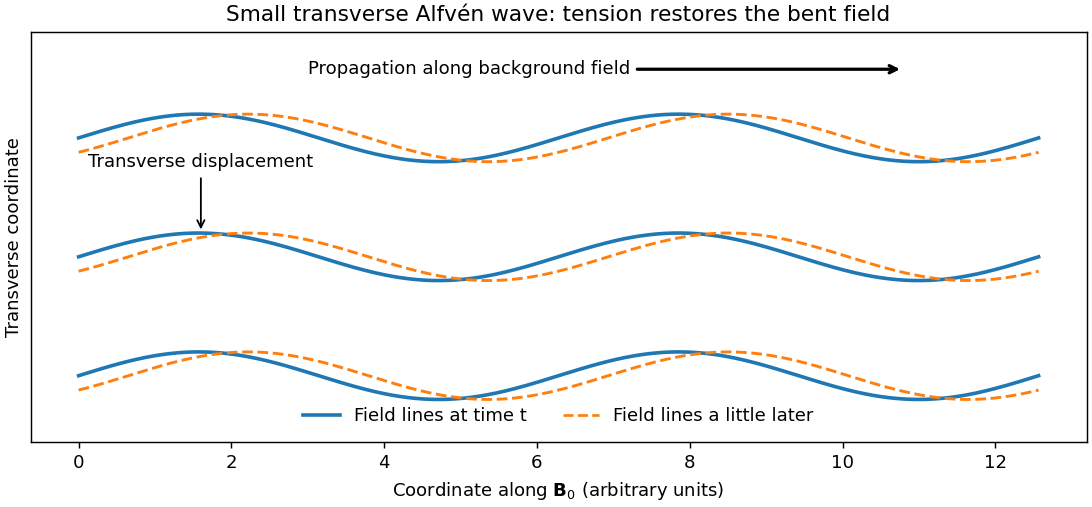
The ideal magnetohydrodynamics approximation requires strong electrical coupling and wavelengths large compared with microscopic scales. Finite electrical resistivity and viscosity dissipate the wave's energy. In stellar winds and other astrophysical plasmas, Alfvén waves carry disturbances and can contribute to heating when dissipated. The Lundquist liquid-metal Alfvén wave experiment provides a laboratory counterpart: a conducting liquid in a strong applied magnetic field transmits a transverse magnetic disturbance, making the field's mechanical restoring action measurable.
A geometrically thin accretion disk around a central mass has nearly Keplerian orbits, with . Its vertical hydrostatic equilibrium gives . The specific angular momentum decreases inward, so accreting matter must transfer angular momentum to other matter. A viscous stress couples neighboring annuli rotating at different angular velocities.
Writing for effective kinematic viscosity and for surface mass density, the outward viscous torque in an accretion disk isSteady mass conservation defines . If the inner radius has negligible applied torque, angular momentum conservation gives , henceWell outside that boundary, and the inward drift time is of order , much longer than an orbital period in a thin disk with modest effective stress. Dissipation of orbital energy heats the disk. If that heat escapes locally from two faces, the radiative flux from either face isIntegration over both faces gives in this Newtonian zero-torque model. Material can lose angular momentum while the disk's outer parts spread outward: outward transport does not imply that most of its mass moves outward. In real ionized disks, magnetorotational instability and magnetic stresses often provide the effective transport; molecular viscosity alone is generally insufficient.
In a radiative shock, a narrow dissipative jump first converts upstream kinetic energy into internal energy. The immediate strong adiabatic compression is , and the immediate temperature is the result of part 1(c). Downstream gas then radiates, loses specific enthalpy and compresses further. Its shock cooling length is of order , with the immediate downstream speed used only as an estimate because the gas slows as it cools.
For the idealization of equal far-upstream and cooled downstream temperatures, unchanged composition and negligible magnetic stress, write . Conserved mass and normal momentum flux across the whole layer giveWith , the nontrivial isothermal shock root isIt can greatly exceed the adiabatic strong-shock compression. An upstream adiabatic sound speed instead defines , so the same result is ; the two Mach numbers must not be confused. The radiated energy flux is when the two endpoint specific enthalpies agree. The gas's specific entropy rises at the initial jump and falls during cooling, while the escaping radiation carries entropy away. A transverse frozen-in magnetic field, or an imposed temperature floor, can limit the compression. Strongly cooling shocks can therefore collect thin dense shells without violating total conservation of energy.
For a barotropic fluid, define . Dotting the steady Euler equation with givesThus the Bernoulli function is constant along each streamline. Different streamlines can have different constants; steady flow alone does not imply one spatially uniform .
In a quasi-one-dimensional flow through area with negligible gravity, the axial momentum equation and giveMeanwhile the mass flow rate is constant, so . Substitution proves the nozzle area-velocity relationA subsonic flow accelerates where decreases, whereas a supersonic flow accelerates where increases. A smooth accelerating transonic branch in a de Laval nozzle therefore crosses at a minimum-area throat. Suitable reservoir and downstream pressures are also required: a converging-diverging shape by itself does not exclude a wholly subsonic solution or a downstream shock.
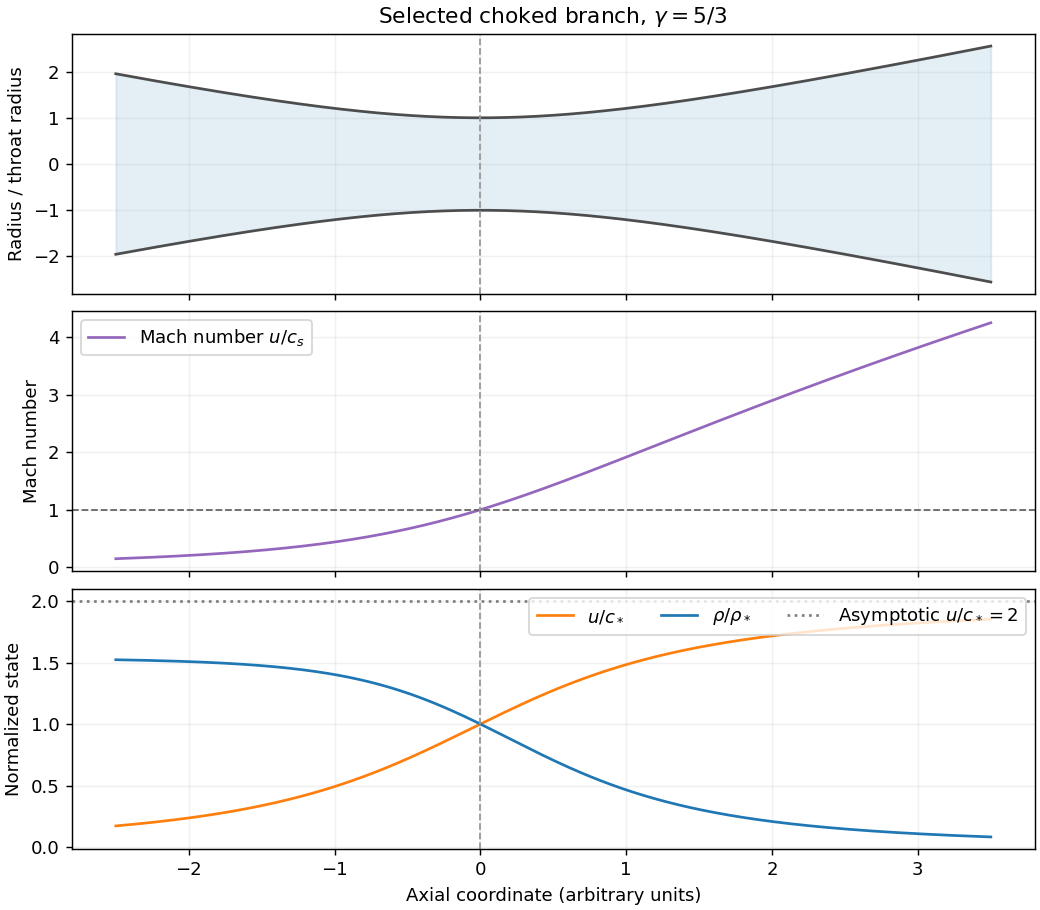


For the stipulated constant- polytropic flow, . At the throat , soThe specific enthalpy is . Evaluating at the throat and substituting elsewhere givesOn the outward supersonic branch, lets the gas expand and its specific enthalpy tend to zero for . ConsequentlyFor , . Also . These are the adiabatic nozzle terminal speed and expansion laws for a lossless escaping branch; a subsonic branch could instead approach finite pressure with . A pressure-shaped astrophysical jet is being approximated by a nozzle here: the assumed geometry does not by itself explain the confinement or account for magnetic forces or relativistic motion in an actual active galactic nucleus.
In a spherical self-gravitating equilibrium with positive mass density, away from the center. Thus can locally be replaced by , so both and can be expressed as functions of . Hydrostatic equilibrium further givesSince decreases outward wherever , eliminating gives a barotropic equation of state along this equilibrium. This is a relation describing its structure; it does not require all thermodynamic perturbations of an arbitrary material to be barotropic.
For , integrate the polytropic enthalpy balance :For a finite-radius zero-pressure boundary with and , and therefore . With the gravitational potential zero at infinity, an isolated sphere has . It is an integration constant tied to that boundary, not necessarily a zero of the gravitational potential.
Put and , with . The preceding relation gives . Substitution into the spherical gravitational Poisson equation yields the Lane-Emden equationLet be the first zero of the regular Lane-Emden function and . Then the Lane-Emden mass formula and radius areFor a common fixed polytropic index with a finite first zero, their scalings areThe usual regular zero-pressure models have a finite first zero for ; the model has infinite radius, so a finite-radius formula cannot simply be applied to it.
For an ideal gas of fixed composition, . Consequently homologous polytropes at fixed central temperature have and both , recovering . The common central temperature, composition and dimensionless structure are the relevant assumptions. Keeping fixed instead gives the different polytropic mass-radius relation, and no finite index makes its generic fixed- exponent exactly one.
For adiabatic monatomic hydrogen, and . At a common fixed specific entropy, hence common , the same relations giveHere , and the omitted constant in the last relation depends on . A population with different cloud entropies need not follow that mass sequence.
Efficient radiative cooling in molecular clouds prevents compression from forcing the temperature upward as steeply as in an adiabatic monatomic gas. Rotational transitions of molecules and radiation by dust provide low-temperature cooling channels; which dominates depends on composition, opacity and temperature. It is therefore possible to assemble dense massive cold clouds while disposing of compressional heat. This explains the direction of the idealized comparison, rather than proving a universal cloud-mass cutoff.
For a common isothermal sound speed , a spherical isothermal equilibrium has equal to times a dimensionless structural factor. Holding that factor fixed gives the homologous isothermal mass-radius relationFor example, the singular isothermal sphere has . A regular finite cloud requires a pressure-confined isothermal sphere or another outer boundary: an unconfined isothermal sphere does not end at a finite vacuum radius. Equal temperature alone, while allowing arbitrary truncation or density contrast, does not make the coefficient universal.
Articles by others on the same topic
There are currently no matching articles.