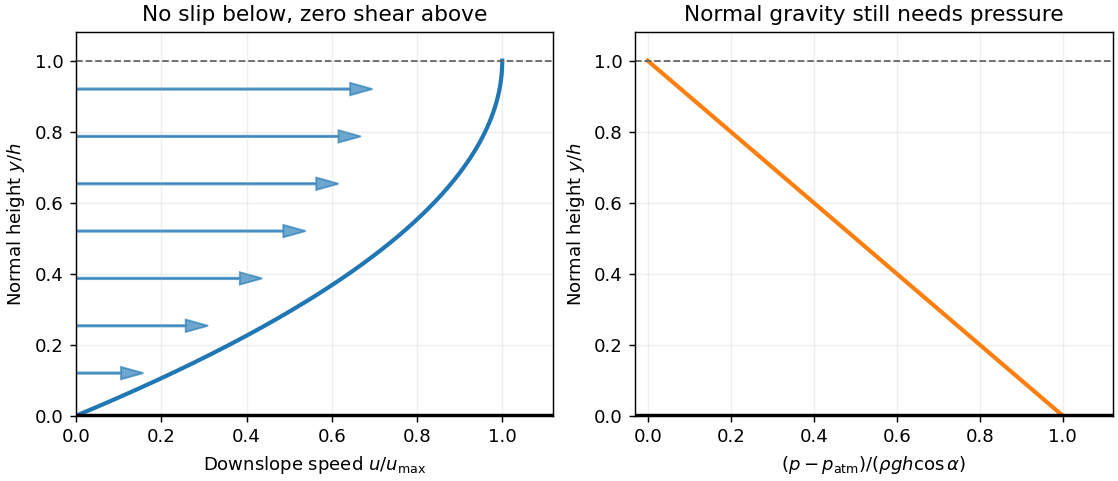
Let measure distance down the incline and distance perpendicular to it, with the wall at and the free surface at . A uniform steady falling film flow has . Its convective acceleration vanishes because and . A flat surface exposed to constant atmospheric pressure hasThus , and the downslope component of the Navier-Stokes equations reduces to . The printed pressure-free equation must be understood as this downslope projection: its full vector version would incorrectly omit the normal hydrostatic pressure gradient that balances .
The no-slip boundary condition gives . Neglecting air shear stress makes the surface shear-free, so . Two integrations give the uniform gravity-driven Newtonian film profileThe velocity increases up to the free surface, whereThis assumes a uniform laminar Newtonian fluid film, a stationary wall and negligible surface shear; a varying thickness or externally imposed downslope pressure gradient would alter the balance.

By reflection symmetry the vertical gravitational field of the self-gravitating incompressible slab vanishes at its mid-plane. Inside the slab, the gravitational Poisson equation therefore integrates to . Treat the star as a test particle, so its own mass does not alter that field. Its vertical stellar orbit in a uniform slab obeysHence with . The first mid-plane crossing occurs after one quarter of this simple harmonic motion period:Its independence of follows from the linear interior restoring force. The calculation neglects drag and changes to the slab, and it uses the infinite planar approximation rather than the field of a finite Galactic disk.
Work in the rest frame of the shock. The normal momentum flux is conserved, so . In the strong-shock limit , while mass conservation gives . The given Strong-shock Rankine-Hugoniot conditions therefore yieldUsing the downstream ideal gas law givesFor a monatomic perfect gas, and the coefficient is . This is the immediate post-shock temperature, before substantial radiative cooling; ionization, dissociation or unequal electron and ion temperatures require additional physical modeling.
Articles by others on the same topic
There are currently no matching articles.