Hydrostatic equilibrium with self-gravity. A resting fluid obeys . Spherical symmetry and the Poisson equation for Newtonian gravity giveEliminate the Newtonian gravitational potential derivative to obtainEquivalently, the shell theorem gives and , which leads to the same hydrostatic equilibrium equation.
A uniform-density liquid. With constant , . There is no central point mass, so the interior gravitational acceleration magnitude is . ThusUse at a vacuum boundary, neglecting surface tension. The uniform-density planetary pressure profile isThe central value can also be writtenIt has units pascals and decreases smoothly from its maximum at the centre to zero at the surface.
An isothermal gas. Here is the constant isothermal sound speed, with . Try , so . The two sides of the equilibrium equation becomeThus , giving the singular isothermal sphere,This does not describe a finite gaseous sphere in vacuum. Both pressure and mass density diverge at the centre, and for every finite outer radius , so it cannot meet there. Extending it to infinity removes the finite-radius pressure jump but makes the total mass infinite. It is useful as an idealized profile over an intermediate radial range, or as a truncated model with nonzero external pressure. The vacuum boundary obstruction for an isothermal sphere also applies to the regular, nonsingular isothermal solution; removing the central singularity does not produce a finite vacuum surface.
Steady outflow. In the wind calculation, take the central mass to be fixed and neglect the wind's own self-gravity. Constant mass flow rate and the isothermal equation of state giveThe steady radial Euler equation isSubstituting the density derivative givesThis is the isothermal Parker wind equation. A smooth sonic point requires both sides to vanish when , soMaintaining constant temperature during expansion generally requires heat input; it is an isothermal model, not the adiabatic blast-wave model of Question 5.
The escaping branch at large radius. Integrate the wind equation, using dimensionless logarithm arguments:Set and . ThenFor the accelerating transonic branch, , which fixes . At on its supersonic branch, and is smaller than . ConsequentlyA first correction makes the ordering explicit:This is the large-radius asymptotics of an isothermal Parker wind. The leading expression also holds for other supersonic branches with finite .
The source implicitly selects an escaping wind. Positive steady outward flow alone does not determine that branch: a subsonic isothermal breeze also satisfies the differential equation. Its limit gives , hence and . Such a breeze needs nonzero pressure at infinity. Selecting a regular outflow from a subsonic base into vanishing ambient pressure instead gives the accelerating transonic wind used above.
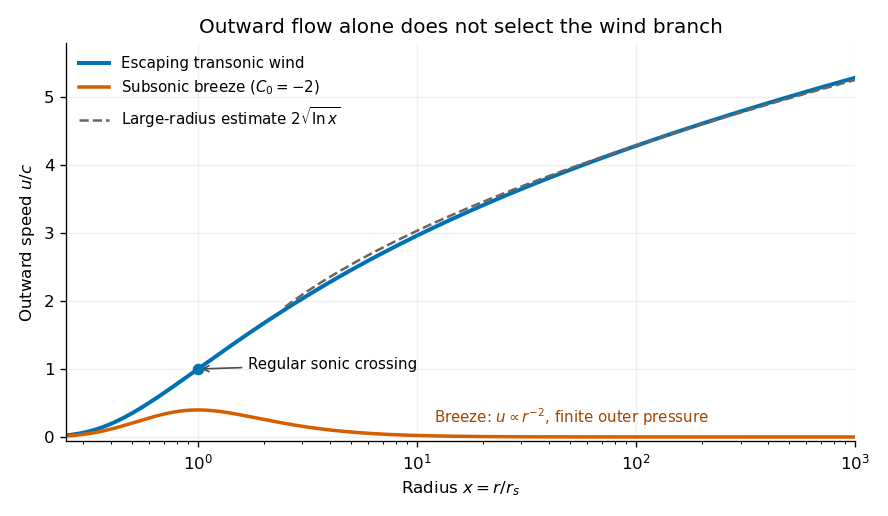
Original numerical branches of the integrated isothermal wind equation, showing the escaping wind, its logarithmic asymptote, and a pressure-confined subsonic breeze
. Details. 
The asymptotic speed has the same units as ; the logarithm is dimensionless. Its unlimited growth is a formal feature of indefinite isothermal heating and a prescribed point-mass potential. Real heating, surrounding pressure, and eventually the neglected wind mass limit that extrapolation.
Articles by others on the same topic
There are currently no matching articles.