Write the initial mass density as . The ideal gas law gives pressure , and the sphere has . Here is the Boltzmann constant and is the gravitational constant. First obtain the gravitational potential energy by adding concentric shells. The mass inside radius is , soIn a small contraction at fixed total mass, the gravitational energy released is . The positive work required against the gas pressure is . Equating these givesUse to eliminate the radius. The uniform-sphere pressure-work collapse criterion isThe units are kilograms: has units , and supplies . At fixed initial and , makes gravity stronger than the pressure-work requirement in this model, allowing contraction.
This is a Jeans mass estimate for homologous contraction of an initially uniform sphere. It is not an exact stability limit for a hydrostatic gas sphere: uniform mass density and uniform temperature would give uniform pressure, rather than the gradient required by hydrostatic equilibrium. The numerical coefficient therefore differs from conventions based on a Jeans instability wavelength or a pressure-confined isothermal sphere. Subsequent contraction also depends on heat exchange; isothermal pressure support during gravitational collapse weakens relative to gravity as the radius decreases.
The exponential factor removes the first spatial derivative. Apply the chain rule explicitly:while . Substituting into the supplied density equation, the terms proportional to cancel, leavingThis is the atmospheric acoustic cutoff transformation. There is a sign error in the target equation in the original PDF, as well as in the transcription: the last term must be for real positive . If the displayed minus sign is retained literally, coefficient matching would require , so it would not define a real characteristic oscillation period.
For the corrected equation, a plane wave has dispersion relationThus is the acoustic cutoff frequency: vertically propagating acoustic waves have . The scale height and sound speed have units metres and metres per second, respectively, so has units .
For an order-of-magnitude estimate in the lower terrestrial atmosphere, take and . These are representative atmospheric values, not additional data specified by the paper. They giveThe isothermal atmosphere approximation is local: a real atmospheric temperature profile and the thermodynamic response of the disturbance modify the precise cutoff and period.
For an inverted free surface, gravity promotes a displacement instead of restoring it. The surface tension term still resists curvature. Hence the gravity-capillary wave relation becomes, with ,For , where , . Writing the displacement as gives the Rayleigh-Taylor instability growth rateShorter wavelengths, , remain oscillatory because surface tension dominates. The marginal scale is determined by the capillary length,A sufficiently small aperture excludes the long unstable modes: this is finite-aperture stabilization of an inverted liquid surface. The estimate requested is therefore a container opening of order one centimetre, with the marginal full wavelength rather than a geometry-independent maximum diameter.
The exact largest opening cannot be fixed from the stated infinite-surface dispersion relation alone. It requires the aperture shape and contact-line boundary conditions. For example, a one-dimensional span of width whose contact line is pinned at both ends has a half-sine lowest mode with . In that simple model,Different geometries change the numerical factor. This is a small-disturbance stability estimate with negligible air inertia and no leakage or contact-line failure; a guarantee that a real inverted container retains its water needs those additional boundary details.
Following a fluid element. Let be a pathline, satisfying . The material derivative, also called the Lagrangian time derivative, is the rate observed while following that element. The multivariable chain rule givesThe partial derivative holds position fixed; the advection term accounts for motion through a spatially varying field. For a vector field, the same formula applies component by component in fixed Cartesian axes.
Momentum balance. For an inviscid flow, pressure is the only surface stress. A small material volume has net pressure force , obtained by the divergence theorem. Its mass is and its material acceleration is . Applying Newton's second law gives the Euler equations for an inviscid fluid,This is the local momentum conservation equation when viscosity and physical body forces are absent. A prescribed body force per unit mass would add on the right.
Changing to rotating coordinates. In a rotating frame with constant angular velocity , the lab acceleration is the rotating-frame material acceleration plus . ThereforeFor uniform rotation,With constant , this gives the Euler equation in a uniformly rotating frame,The term subtracted from is the equilibrium centrifugal contribution. Dividing the bracket by defines a reduced pressure , with units . The Coriolis acceleration remains a velocity-dependent term.
Linear disturbances. Linearize about rest in the rotating coordinates, with the equilibrium part of removed. The advective acceleration is quadratic in disturbance amplitude, so the linearized Euler equations and incompressible flow condition areTaking the curl removes the pressure gradient. The identitygives the inertial-wave vorticity equation,
Plane-wave frequencies. Let and use the given plane wave convention. Incompressible flow requires , and the vorticity equation givesFor a nonzero frequency, apply again, using . It follows thatThis is the inertial-wave dispersion relation. If is the angle of the wavevector to the rotation axis, the positive angular frequency is . It is largest, , for a parallel wavevector, decreases to zero for a perpendicular one, and is independent of the magnitude of the wavenumber at fixed direction. The two signs describe the two oscillatory polarization branches. When , the zero-frequency result is obtained directly from the linear equations rather than by dividing by ; it describes the nonoscillating balanced limit.
The local conservation laws. The first equation is the radial Euler equation: the material acceleration is caused by the pressure gradient force per unit mass, . It neglects gravity and viscosity. The second equation is mass conservation in spherical coordinates,The term appears because the area of a spherical surface grows as .
To obtain the third equation, let be the specific internal energy of an ideal gas with constant heat capacity ratio . The first law of thermodynamics for a smooth adiabatically moving element isDifferentiating and collecting terms givesand henceThus the entropy parameter is conserved along each smooth pathline; for fixed composition, specific entropy differs from only by a constant. This is local isentropic flow behind the shock. A physical shock wave itself generates entropy and must be treated with jump conditions, rather than by applying this smooth equation across the discontinuity.
The front-radius scaling. In the self-similar blast wave approximation there is no scale set by ambient pressure, cooling, gravity, or the initial source radius. Write . Using and , dimensional analysis givesThus , , andThe dimensionless coefficient depends on and the resolved similarity profiles; dimensions alone do not fix it. Define the length scale , so and the front is at the fixed coordinate .
Kinetic energy. Substitute and into the volume integral. Since and ,But , so the first of the spherical blast-wave similarity energy integrals isThe conclusion requires a fixed, integrable similarity profile, as in the finite-energy blast solution. Expansion increases the swept-up mass while reducing the characteristic squared speed, leaving this product constant.
Pressure and internal energy. The derivatives of the similarity variable areWriting a prime for differentiation with respect to , the material acceleration becomesThe radial momentum equation therefore requires a pressure gradient on the scale . Integrating over radius gives pressure similarity in a spherical blast wave:whereThe prefactor has units , as required for pressure. Strictly, the momentum equation alone permits an additional pressure uniform in space and arbitrary in time. In the scale-free strong-blast solution, shock matching and the remaining thermodynamic equation fix that freedom with the same similarity scaling; any allowed constant of integration is included in . An independently imposed external pressure would introduce another scale and invalidate the simple dimensional ansatz.
For constant , the internal energy is consequentlyIf is the total excess explosion energy, its normalization isThe two constant fractions need not be equal. No explicit solution for is needed to establish their time independence.
Hydrostatic equilibrium with self-gravity. A resting fluid obeys . Spherical symmetry and the Poisson equation for Newtonian gravity giveEliminate the Newtonian gravitational potential derivative to obtainEquivalently, the shell theorem gives and , which leads to the same hydrostatic equilibrium equation.
A uniform-density liquid. With constant , . There is no central point mass, so the interior gravitational acceleration magnitude is . ThusUse at a vacuum boundary, neglecting surface tension. The uniform-density planetary pressure profile isThe central value can also be writtenIt has units pascals and decreases smoothly from its maximum at the centre to zero at the surface.
An isothermal gas. Here is the constant isothermal sound speed, with . Try , so . The two sides of the equilibrium equation becomeThus , giving the singular isothermal sphere,This does not describe a finite gaseous sphere in vacuum. Both pressure and mass density diverge at the centre, and for every finite outer radius , so it cannot meet there. Extending it to infinity removes the finite-radius pressure jump but makes the total mass infinite. It is useful as an idealized profile over an intermediate radial range, or as a truncated model with nonzero external pressure. The vacuum boundary obstruction for an isothermal sphere also applies to the regular, nonsingular isothermal solution; removing the central singularity does not produce a finite vacuum surface.
Steady outflow. In the wind calculation, take the central mass to be fixed and neglect the wind's own self-gravity. Constant mass flow rate and the isothermal equation of state giveThe steady radial Euler equation isSubstituting the density derivative givesThis is the isothermal Parker wind equation. A smooth sonic point requires both sides to vanish when , soMaintaining constant temperature during expansion generally requires heat input; it is an isothermal model, not the adiabatic blast-wave model of Question 5.
The escaping branch at large radius. Integrate the wind equation, using dimensionless logarithm arguments:Set and . ThenFor the accelerating transonic branch, , which fixes . At on its supersonic branch, and is smaller than . ConsequentlyA first correction makes the ordering explicit:This is the large-radius asymptotics of an isothermal Parker wind. The leading expression also holds for other supersonic branches with finite .
The source implicitly selects an escaping wind. Positive steady outward flow alone does not determine that branch: a subsonic isothermal breeze also satisfies the differential equation. Its limit gives , hence and . Such a breeze needs nonzero pressure at infinity. Selecting a regular outflow from a subsonic base into vanishing ambient pressure instead gives the accelerating transonic wind used above.
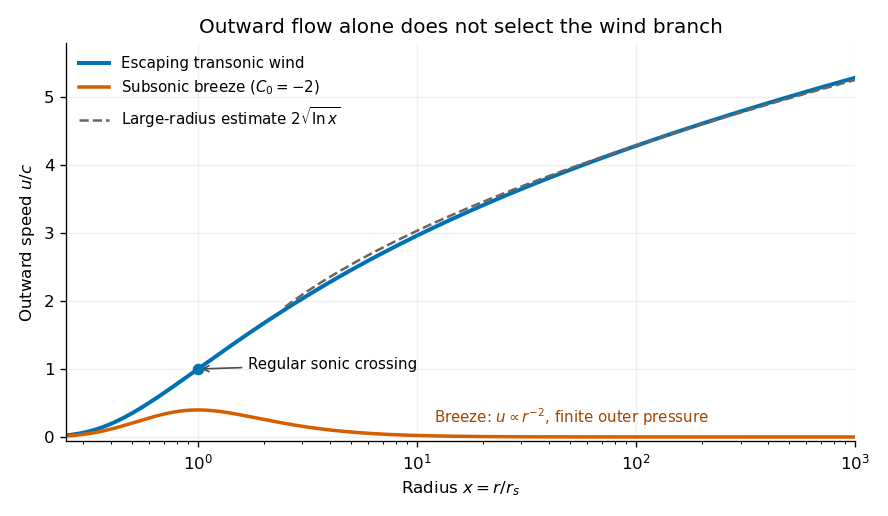
Original numerical branches of the integrated isothermal wind equation, showing the escaping wind, its logarithmic asymptote, and a pressure-confined subsonic breeze
. Details. 
The asymptotic speed has the same units as ; the logarithm is dimensionless. Its unlimited growth is a formal feature of indefinite isothermal heating and a prescribed point-mass potential. Real heating, surrounding pressure, and eventually the neglected wind mass limit that extrapolation.
Articles by others on the same topic
There are currently no matching articles.