An ultraluminous X-ray source is a compact, apparently off-nuclear source in another galaxy with an inferred isotropic X-ray luminosity typically above W, exceeding the classical Eddington luminosity of an ordinary stellar-mass accretor. Imaging X-ray surveys revealed unusually bright sources away from galactic nuclei; distance association with the host converted the observed fluxes into surprisingly high luminosities. Better angular resolution helps exclude blends and background active nuclei. The 2014 discovery of coherent pulsations established a neutron star in M82 X-2, so the class cannot be identified exclusively with black holes.[ref]
An intermediate-mass black hole can radiate approximately isotropically below its own Eddington luminosity: this avoids extreme super-Eddington emission, but the inferred mass requires dynamical or suitable spectral/timing support and is not proved by luminosity alone. A stellar-mass accretor with a supercritical accretion disk and a wind funnel can combine genuinely super-Eddington output with geometrical beaming; this is compatible with a neutron-star accretor but requires a consistent radiation/flow/torque model. Relativistic beaming from a jet is another possibility for some objects, but orientation, spectral and variability evidence must support it. These mechanisms need not apply identically to every member of the observed class.
For spherical radiation with flux , the outward acceleration is . Equating it to givesThe limit assumes the stated opacity, approximate spherical symmetry and coupling between the radiatively accelerated plasma and the accreting matter. It is not a universal ceiling on isotropic-equivalent luminosity for an anisotropic magnetized flow.
Write the available accretion power as . ThenAccretion as the energy source alone does not fix . For radiatively efficient Newtonian accretion onto a slowly rotating stellar surface, and the corresponding surface accretion Eddington rate isThis is the appropriate convention for the numerical neutron-star estimates below, rather than imposing a separate reference efficiency of .
Using , m and the stated opacity givesIf the observed X-rays represent isotropic, radiatively efficient surface accretion power, thenA bolometric correction, beaming, radiation advected into the flow or energy carried by a wind would change the mapping from the measured band luminosity to the supplied mass rate. This estimate keeps the assumptions needed for comparison with the torque calculation.
In magnetically channelled accretion, an outer accretion disk supplies nearly Keplerian material. Near the magnetospheric truncation radius, magnetic stresses disrupt the disk and guide matter along field lines onto polar accretion columns. Shocks and settling near the surface release gravitational binding energy, and an oblique magnetic geometry makes the rotating emission pattern pulsate.
The corotation radius satisfies , henceThe accretion Alfvén radius estimates where magnetic stress becomes comparable with the inflow's dynamical stress; it is the magnetic truncation scale in this application, not the Alfvén critical point of an outward stellar wind. The supplied seventh-root scaling follows from a dipole's rapidly decreasing magnetic pressure and an accretion-pressure estimate. Its coefficient depends on disk geometry. Ordinary inward surface accretion requires the magnetosphere to remain outside the star and usually inside or near corotation, . Beyond corotation, a rapidly moving magnetosphere can transfer angular momentum outward and inhibit inflow through the propeller effect.
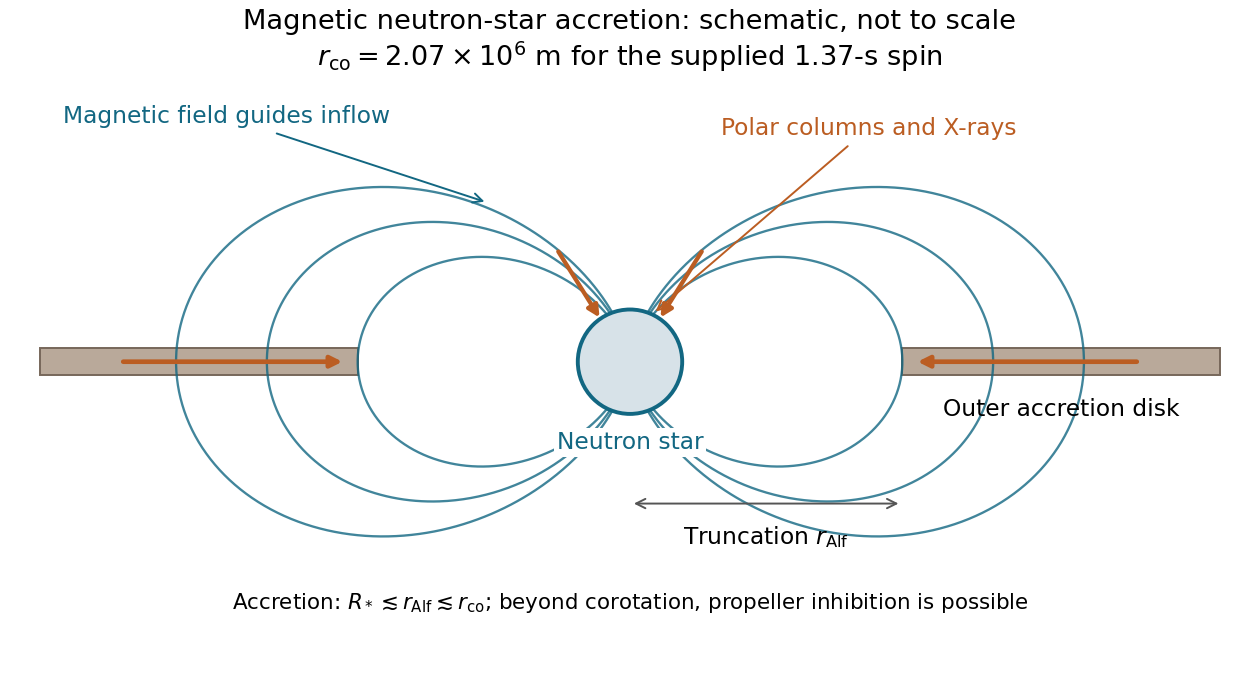
Magnetic channeling from a truncated accretion disk to neutron-star polar caps, with the corotation condition shown separately
. Details. 
Let yr. With constant moment of inertia, the observed positive spin-up torque isNearly Keplerian material at the inner disk carries specific angular momentum . Equating its inflow rate to the observed torque givesIn the surface accretion Eddington rate convention,The printed coefficient is therefore recovered at its intended approximate precision. This is a material-torque model; magnetic torques, wind angular-momentum loss and a changing stellar moment of inertia are not included.
The accreting-pulsar luminosity and material-torque consistency test shows a concrete tension between the simplest isotropic luminosity estimate and the material-torque estimate. Making their rates equal requiresAn exterior accretion Alfvén radius cannot lie inside a 10-km star. Even taking its smallest exterior value, , the observed torque permits only about in this model, below the isotropic estimate. The discrepancy is modest enough to be sensitive to the approximate radius and moment of inertia, but it prevents claiming exact simultaneous agreement under the stated central values.
Near corotation, the torque gives only . If its radiative efficiency is unchanged, beaming into a fraction about of the sky would reconcile that intrinsic luminosity with the apparent isotropic value. The given truncation formula would then require T for a magnetosphere near corotation. Other possibilities include substantial opposing magnetic torque, outflows separating the disk supply rate from the surface rate, a different radiative efficiency and magnetically altered opacity. These are changes to the elementary model that need independent evidence, rather than a license to use an unphysical truncation radius. Coherent pulsations already identify the accretor as a neutron star; they do not by themselves choose between these accretion-flow refinements.
Articles by others on the same topic
There are currently no matching articles.