Take the field along and write , with Bohr magneton . The printed Hamiltonian uses dimensionless angular-momentum operators, with eigenvalues and ; physical angular momenta carry an additional . Thus and are energies. Assume the usual positive spin-orbit interaction coefficient . Reversing its sign reverses the zero-field ordering but not the state count.
An electron has . addition of angular momentum givesThe coupled angular-momentum state count can be checked directly. The product basis contains states. The coupled basis containsCoupling therefore reorganizes the states rather than creating or losing them. There is no hyperfine multiplicity because .
Use to obtainThe two spin-orbit interaction energies are and . In a weak field, project the Zeeman effect onto a fixed multiplet:This is the first-order energy formula, not a statement that has no matrix elements between different values. For a common and a conventional choice of relative phase, its complete coupled-basis block isThe inter-multiplet Zeeman coupling terms give second-order weak-field corrections because the two spin-orbit interaction multiplets are already separated.
In the strong-field basis the Zeeman part is diagonal, . WriteIts diagonal matrix elements are . Its off-diagonal matrix elements connect to with coefficientand the reverse spin change has replaced by in the corresponding ladder coefficient. These terms preserve but mix the two product states. To first order in , the energy correction is simply .
For the P state, . Measured relative to its gross-structure centroid, the six low-field levels areThus the upper quartet starts at with slopes in a plot against ; the lower doublet starts at with slopes . Their zero-field separation is .
At high field all six product-state energies, retaining the term linear in , areThe two zero-slope levels have different and no mutual matrix element, so their first-order degeneracy does not require an additional degenerate perturbation. At finite field they split at order .
An exact interpolation makes the requested whole-field sketch unambiguous. The stretched levels areFor , use product states and . Their Hamiltonian block issoThese energies reduce to the quartet and doublet at zero field and to the six strong-field expressions above. Within a fixed , the nonzero off-diagonal element prevents a crossing of the two branches. Levels in different sectors can cross without hybridizing. For the S state, and the spin-orbit interaction term vanishes, leavingthroughout this Hamiltonian's range of validity.
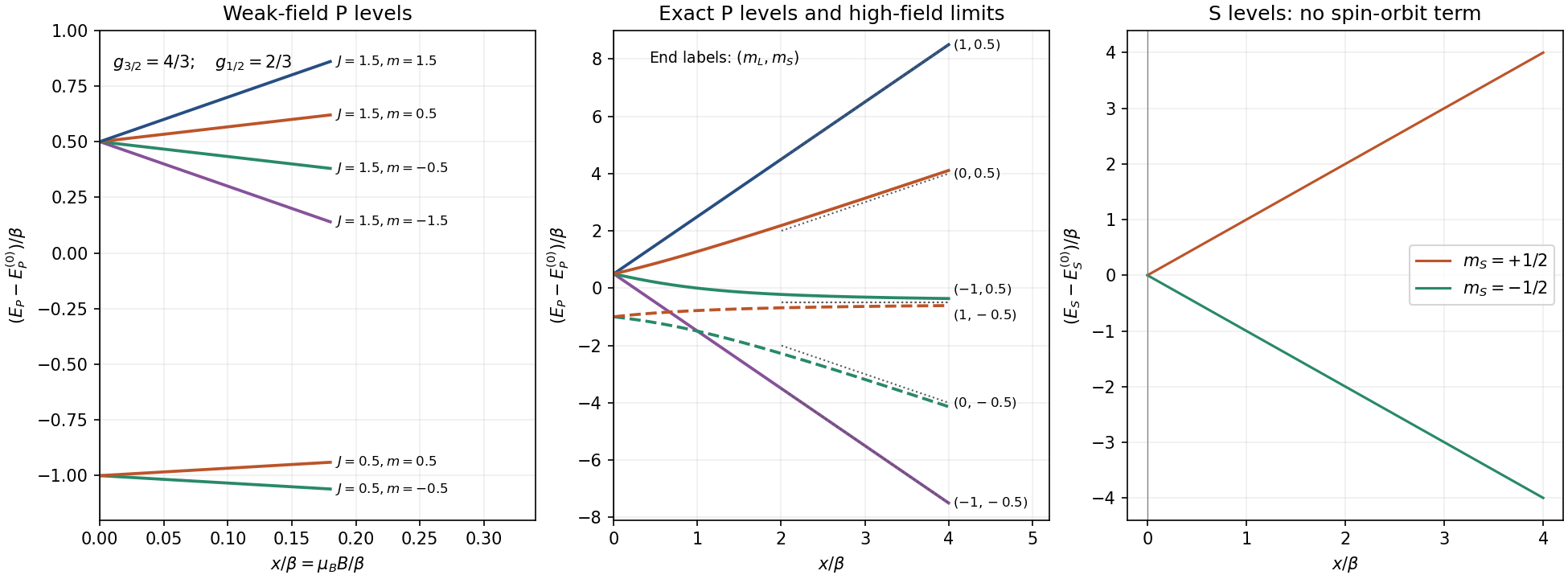

For electric dipole transitions at low field, and apply, with the usual exclusion of . Each P state has opposite parity to the S state. The transition has four allowed sublevel pairs. For , the two stretched upper states each have one destination and the other two each have two, giving six. Hence there are 10 allowed state-to-state channels at weak nonzero field. Relative to the two zero-field transition energies, their Zeeman shifts are
In the decoupled high-field limit, an electric dipole acts on orbital coordinates, so . Each of the six P product states connects to the S state with the same spin and . Thus there are 6 allowed channels in the limiting product-state description. Their photon energies areThis Paschen-Back transition-channel count is not the count of distinct frequencies: to first order in the two channels coincide, giving 5 distinct frequencies, with shifts . If the residual spin-orbit interaction splitting is unresolved there are the three usual orbital Zeeman groups.
The apparent loss of four channels is a change in eigenstate mixing, not a change in Hilbert-space dimension. At finite large field, four weak spin-forbidden Paschen-Back lines arise from small opposite-spin admixtures, with intensities vanishing as . A generic finite-field calculation therefore retains ten nonzero channels; six carry finite strength in the complete-decoupling limit. Observation direction and polarization select which of these channels a detector actually receives.
Articles by others on the same topic
There are currently no matching articles.