At equilibrium, detailed balance requires zero net probability current along each reversible link: . The equilibrium probabilities satisfy , where each state free energy includes its internal degeneracy. ThereforeIn the source sketch B is lower, and the labelled vertical drop is naturally . With that drop convention the ratio is . If instead means the conventional reaction change , the exponent has the minus sign. For example a drop of gives a forward/backward ratio , not .
Write for the probability of state B, so . Gain minus loss givesWith , the solution isIt rises monotonically from zero, initially with slope , towards on time scale . The first panel of the original figure below shows this shape for illustrative equilibrium probability .
The other equilibrium probability is , and their ratio is . Applying detailed balance from part (a) giveswhich is precisely the two-state Boltzmann distribution. It fixes the ratio but not the sum of the rates, so equilibrium measurements alone do not determine the relaxation time.
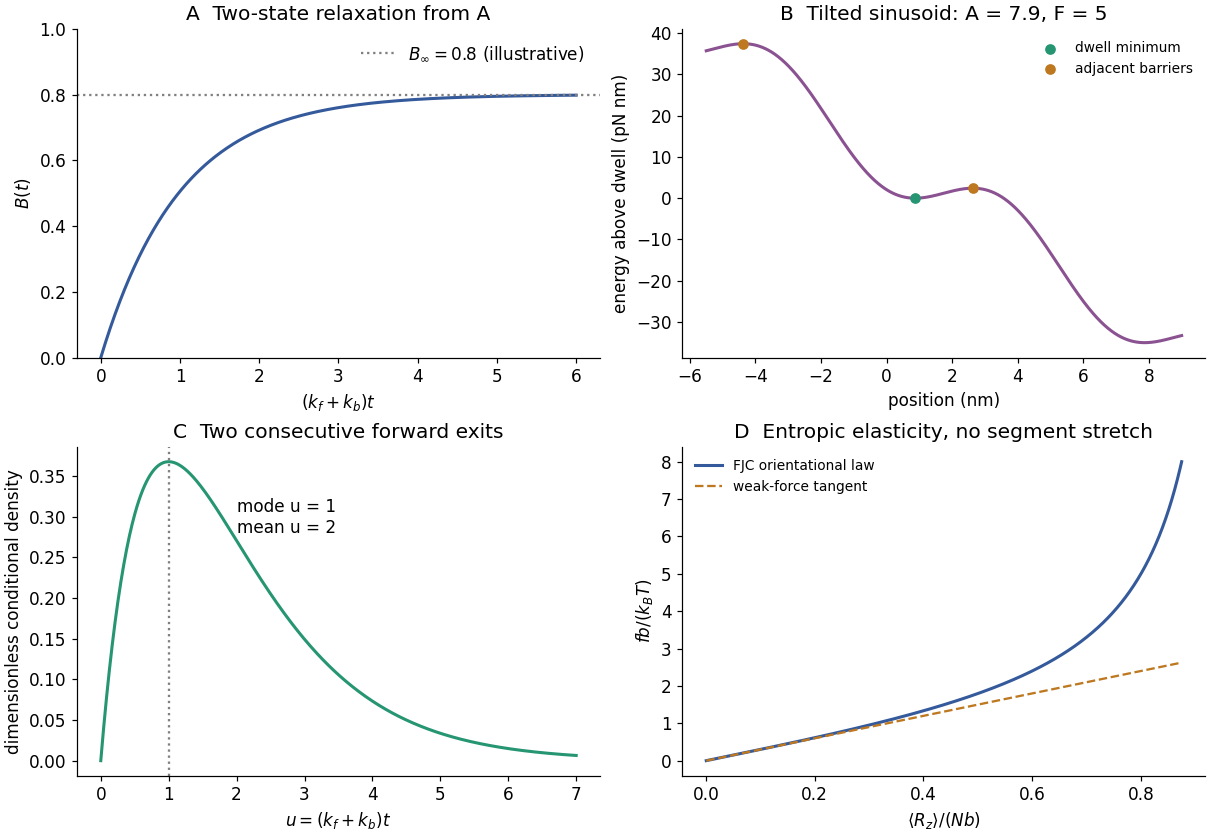
Two-state equilibration, a tilted periodic motor, sequential-step times and freely jointed chain elasticity
. Original model plots, not reconstructions of the source graphs. The motor potential uses sinusoidal coefficient and forward tilt ; other panels use dimensionless axes. Details.
Take forward as increasing , and specify the sinusoidal amplitude convention byThus the unforced barrier is , not . Let and . Stationary points exist because . A minimum is at and its forward saddle at . The distances and activation barriers areUse an Arrhenius estimate with the supplied distance-squared waiting-time scaling, . Calibrate at with and rate in each direction. At the explicit room-temperature estimate , , givingApplying the same distance rule separately backwards gives and hence the literal scaling-model estimateThermodynamic qualification: for isothermal diffusion in this translated tilted potential, adjacent wells differ by , so local detailed balance instead requires . The two separate distance prefactors introduce an extra factor , inconsistent with that requirement. Keeping the forward estimate while enforcing the proper ratio givesBoth interpretations are shown because the supplied distance heuristic is not, by itself, a thermodynamically consistent prescription for both directional prefactors. Additional hidden chemical driving would require its own affinity, not an unexplained prefactor asymmetry. A common transition-state prefactor, as in a consistent Kramers model, preserves the Boltzmann rate ratio. Moreover the forward barrier is only about , so rare-escape exponential dwell kinetics and the numerical rate should be regarded as rough estimates. If “amplitude” meant the entire unforced barrier height, the maximum restoring force would be only and no dwell wells would survive at ; the amplitude convention is therefore essential.
Assume identical dwell states and memoryless forward/backward exits with constant rates and ; put . The probability density for the first exit to be forward at is . For the very next exit also to be forward at time , multiply by and integrate over the unobserved first time:This density integrates to , the probability that both directions are forward. Conditional on that event, the normalized total-time density is the Erlang distributionIts mean is , so the most probable time is not the mean. Since both backward-rate conventions in part (c) have , neglecting backwards steps gives the usual approximation and mode . If “two forward steps” instead permits intervening backwards events, thinning independent Poisson exits gives that latter rate- distribution directly; it describes a different conditioning. The low barrier noted in part (c) limits the physical accuracy of all these memoryless dwell assumptions.
Articles by others on the same topic
There are currently no matching articles.