Write and use the orthonormal basis of the Hückel method. The four normalized one-dimensional symmetry-adapted linear combinations areFor example, the mirror plane exchanges sites , , , , without changing the sign of an individual orbital. The all-positive combination is unchanged by every vertical mirror but changes sign under , giving . The alternating combination changes sign under both sorts of vertical mirror, as required for . The two remaining sign patterns distinguish from in the printed axes. The signs refer to the upper lobes; the lower lobes have opposite quantum phases, and neither colour denotes an electric charge.
For a normalized coefficient vector , the energy isEvery site has one short-bond and one long-bond neighbour. Equivalently, apply the Hückel method matrix to any coefficient and read off its two neighbouring signs. The results areWith negative resonance integrals and , the and levels are occupied, while and are unoccupied in the closed-shell alternating-bond state.
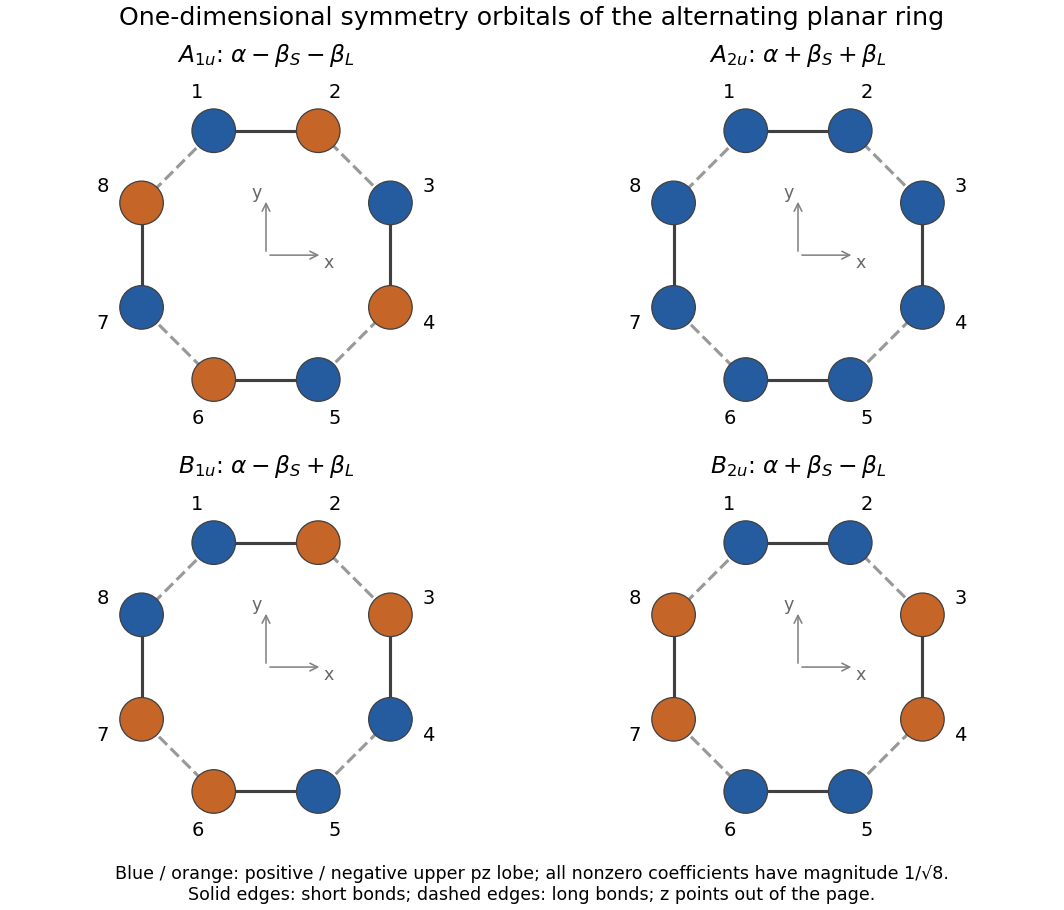
Original phase patterns for the four one-dimensional carbon-ring symmetry orbitals in the printed numbering and axes
. Details. 
Use the four supplied opposite-site combinations in the order . Their Hückel method matrix isThe negative corner is essential. For example, includes the long bonds – and –, each with opposite coefficient signs, giving .
Because the basis is orthonormal, the secular determinant isIt factors as , giving two doubly degenerate energies, .
At , the preceding matrix separates into identical and blocks. For , a normalized pair at the lower energy isA pair at the upper energy isThe four coefficient vectors are mutually orthonormal. Any orthogonal mixing within either equal-energy pair is an equally valid choice of molecular orbitals. At this limiting parameter value, additional coincidences with the one-dimensional levels occur: the full eight-orbital system is four isolated dimers, with four bonding and four antibonding levels.
Articles by others on the same topic
There are currently no matching articles.