The alternating short and long bonds preserve fourfold, but not eightfold, rotations. Including the molecular plane and inversion symmetry, the planar structure belongs to , the D4h molecular point group.
Use the printed axes: the short bonds are –, –, – and –, and the and axes pass through the midpoints of opposite short bonds. Interchanging short and long bonds is not a molecular symmetry operation of this geometry.
For the atomic orbital basis, only orbitals whose centres remain fixed contribute to a character. Each such orbital contributes if its direction is preserved and if it is reversed. In the standard D4h molecular point group class order,No nonidentity operation other than leaves any carbon site fixed. Reflection in the molecular plane fixes all eight sites but reverses every function.
Molecular character reduction givesThe dimensions sum to . The two copies of are separate equivalent irreducible representations which may mix with one another; they do not force all four functions to have a common energy.
Write and use the orthonormal basis of the Hückel method. The four normalized one-dimensional symmetry-adapted linear combinations areFor example, the mirror plane exchanges sites , , , , without changing the sign of an individual orbital. The all-positive combination is unchanged by every vertical mirror but changes sign under , giving . The alternating combination changes sign under both sorts of vertical mirror, as required for . The two remaining sign patterns distinguish from in the printed axes. The signs refer to the upper lobes; the lower lobes have opposite quantum phases, and neither colour denotes an electric charge.
For a normalized coefficient vector , the energy isEvery site has one short-bond and one long-bond neighbour. Equivalently, apply the Hückel method matrix to any coefficient and read off its two neighbouring signs. The results areWith negative resonance integrals and , the and levels are occupied, while and are unoccupied in the closed-shell alternating-bond state.
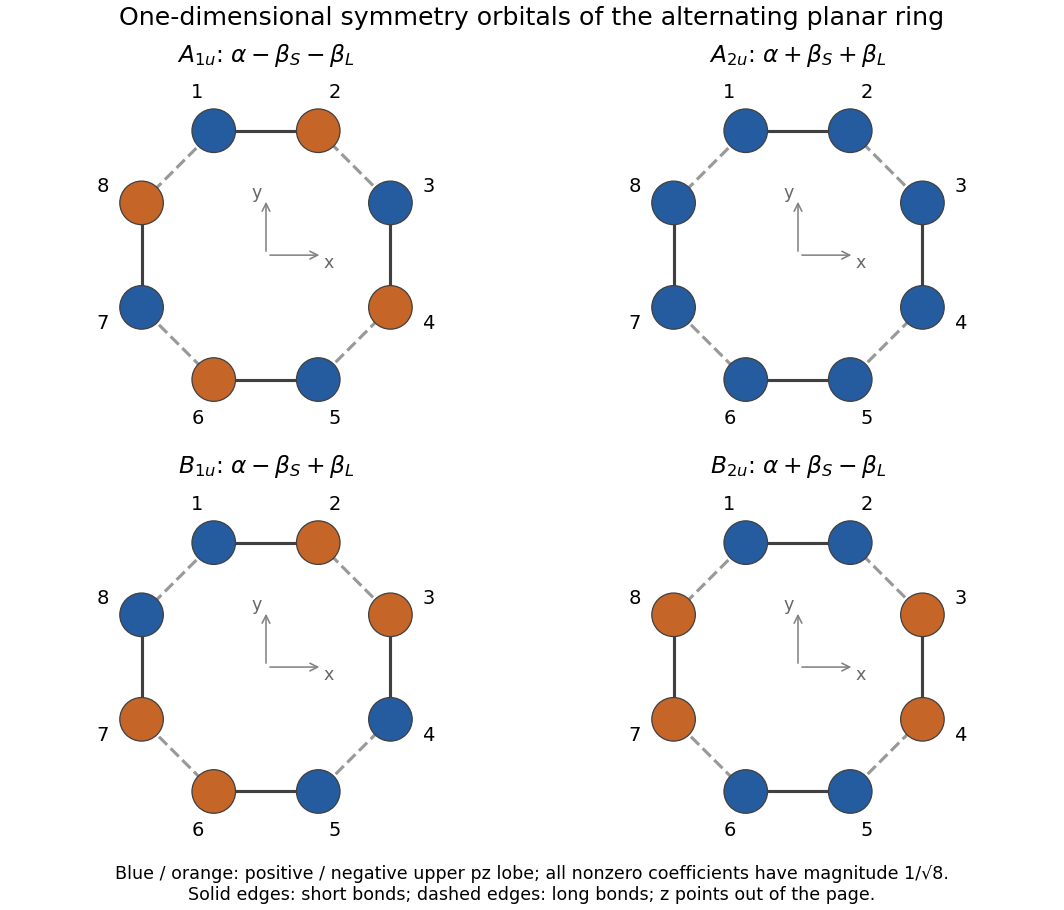
Original phase patterns for the four one-dimensional carbon-ring symmetry orbitals in the printed numbering and axes
. Details. 
Use the four supplied opposite-site combinations in the order . Their Hückel method matrix isThe negative corner is essential. For example, includes the long bonds – and –, each with opposite coefficient signs, giving .
Because the basis is orthonormal, the secular determinant isIt factors as , giving two doubly degenerate energies, .
At , the preceding matrix separates into identical and blocks. For , a normalized pair at the lower energy isA pair at the upper energy isThe four coefficient vectors are mutually orthonormal. Any orthogonal mixing within either equal-energy pair is an equally valid choice of molecular orbitals. At this limiting parameter value, additional coincidences with the one-dimensional levels occur: the full eight-orbital system is four isolated dimers, with four bonding and four antibonding levels.
Fill four spatial molecular orbitals with the eight electrons. For negative and , the occupied energies are , , and the pair at . ThereforeFor equal integrals, , this becomesAt equal bond lengths, the last two electrons occupy the frontier degeneracy at , so their distribution within that degenerate space does not change the bare Hückel method energy.
For , four isolated short-bond dimers each contribute :These are different coupling limits. Keeping while simply removing long-bond coupling does not represent a small distortion at fixed mean bond strength.
The uniform planar eight-electron ring has a partially filled frontier degeneracy. Bond-length alternation splits those levels, permitting the two frontier electrons to occupy the lowered orbital and opening a gap to the empty partner. This is the electronic mechanism for destabilizing the equal-bond planar geometry.
A controlled comparison keeps the mean resonance integral fixed. PutUsing part (i), the change from the uniform ring isThus a small alternation lowers the electronic energy, with a leading gain linear in . An ordinary elastic cost starts quadratically, so the equal-bond planar state is unstable in this model. The equilibrium distortion requires those geometric and sigma-bond costs as well.
The eight electrons constitute a cyclic count rather than the closed-shell case associated with aromaticity. The result concerns the imposed planar geometry; it does not establish the unconstrained three-dimensional equilibrium shape of cyclooctatetraene.
Articles by others on the same topic
There are currently no matching articles.