Use the printed numbering: site 1 is at the top on , sites 2 and 3 are on the right, site 4 is at the bottom, and sites 5 and 6 are on the left; is perpendicular to the ring. Let be consistently phased, orthonormal atomic orbitals at those sites.
In the Hückel method, and , including the 6–1 bond. Set , with the usual . The cyclic nearest-neighbour matrix has eigenvalues . One real, normalized orthonormal eigenbasis isEach row means . The three lowest molecular orbitals hold the six electrons. Any real orthogonal mixing within either degenerate pair is an equally valid choice of molecular orbitals; the coefficient vectors specify exactly which sketches are used here.
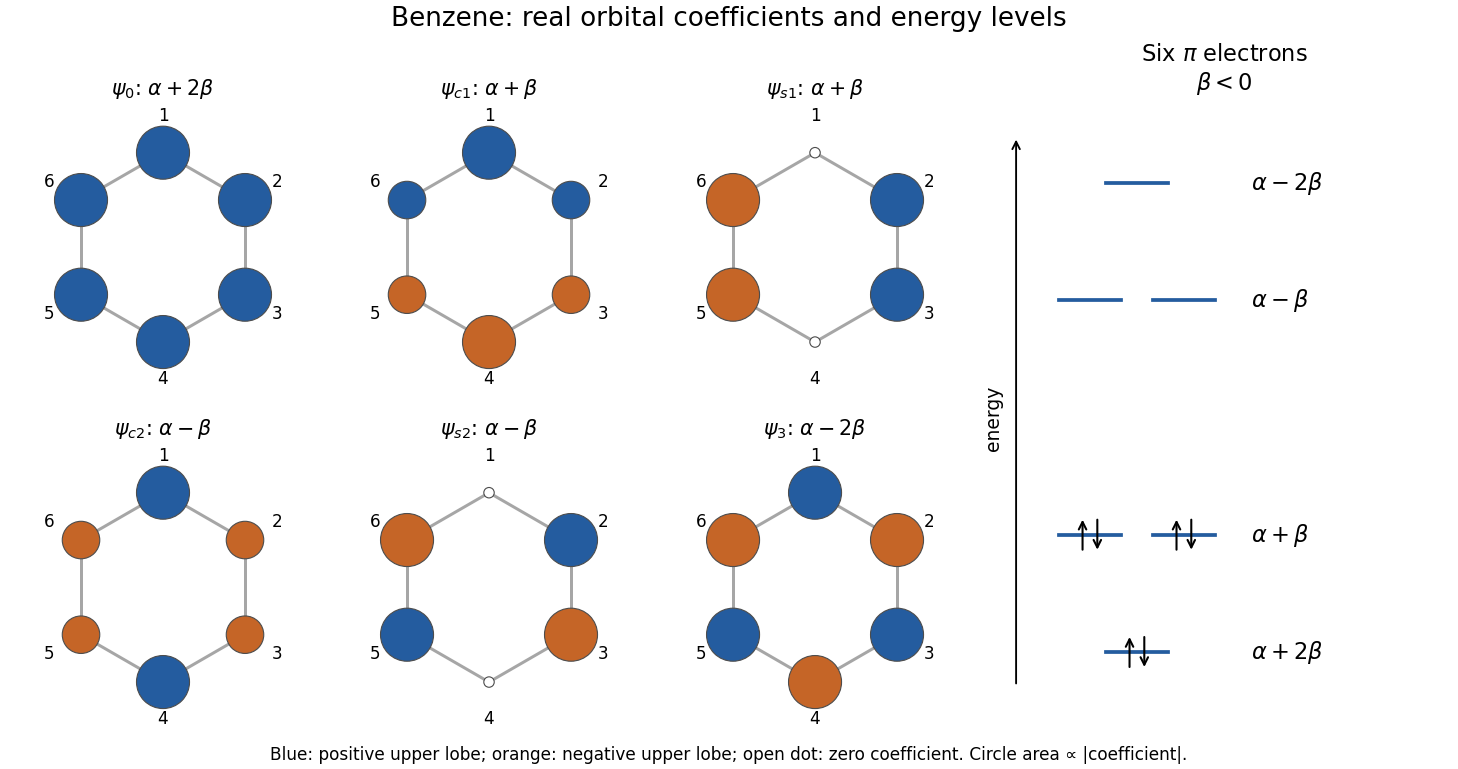
Original benzene pi-orbital energy diagram and six real orbital phase sketches in the printed atom numbering
. Details. 
The coloured circles show the signs and relative magnitudes of the lobes above the molecular plane. The lobes below it have the opposite signs; colours are quantum phases, not electric charges.
Filling the three bonding molecular orbitals with two electrons each givesThree isolated ethene-like bonds, evaluated with the same Hückel method parameters, have . Thus the signed delocalization energy isEquivalently, the positive stabilization is .
Benzene has a planar cyclic conjugated system with six electrons, satisfying the count with . All three bonding molecular orbitals are filled and the antibonding levels are empty, giving the closed-shell stabilization associated with aromaticity. The conclusion uses the continuous cyclic overlap as well as the electron count.
Articles by others on the same topic
There are currently no matching articles.