Use the printed numbering: site 1 is at the top on , sites 2 and 3 are on the right, site 4 is at the bottom, and sites 5 and 6 are on the left; is perpendicular to the ring. Let be consistently phased, orthonormal atomic orbitals at those sites.
In the Hückel method, and , including the 6–1 bond. Set , with the usual . The cyclic nearest-neighbour matrix has eigenvalues . One real, normalized orthonormal eigenbasis isEach row means . The three lowest molecular orbitals hold the six electrons. Any real orthogonal mixing within either degenerate pair is an equally valid choice of molecular orbitals; the coefficient vectors specify exactly which sketches are used here.
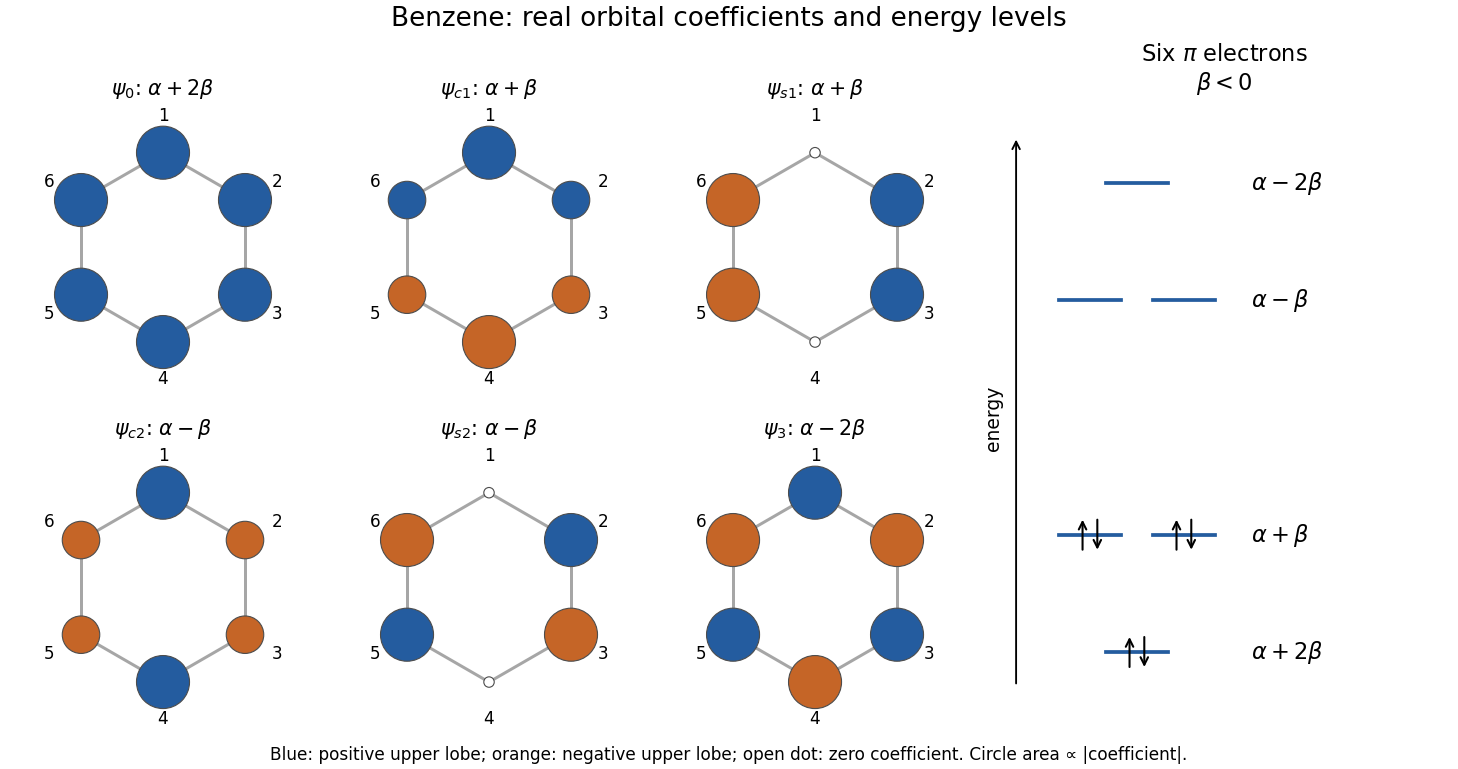
Original benzene pi-orbital energy diagram and six real orbital phase sketches in the printed atom numbering
. Details. 
The coloured circles show the signs and relative magnitudes of the lobes above the molecular plane. The lobes below it have the opposite signs; colours are quantum phases, not electric charges.
Filling the three bonding molecular orbitals with two electrons each givesThree isolated ethene-like bonds, evaluated with the same Hückel method parameters, have . Thus the signed delocalization energy isEquivalently, the positive stabilization is .
Benzene has a planar cyclic conjugated system with six electrons, satisfying the count with . All three bonding molecular orbitals are filled and the antibonding levels are empty, giving the closed-shell stabilization associated with aromaticity. The conclusion uses the continuous cyclic overlap as well as the electron count.
Pyrazine belongs to , the D2h point group. With the printed axes, its three twofold axes are ; it also has an inversion centre and the three coordinate mirror planes. The nitrogen atoms occupy sites 1 and 4 on the axis. Interchanging carbon and nitrogen is not a molecular symmetry operation, so the sixfold benzene symmetry is lost.
The nitrogen pair and the four-carbon set are separately invariant under the D2h point group. Construct symmetry-adapted linear combinations within these two sets; mixing equivalent representations across the sets is left for the Hückel method calculation.
For the nitrogen atomic orbitals, normalized combinations areFor the carbon atomic orbitals, takeThese six functions are orthonormal under the zero-overlap assumption. The suffixes describe coefficient patterns across the carbon sites; the sign acquired by each underlying function must also be included when assigning an irreducible representation. In particular, reflection through the molecular plane changes the sign of every function, while inversion sends to . Ignoring that orbital sign would give incorrect labels.
The complete group representation is thereforeThe diagram shows all six ring symmetry-adapted linear combinations and the resulting energy ordering used in part (iii).
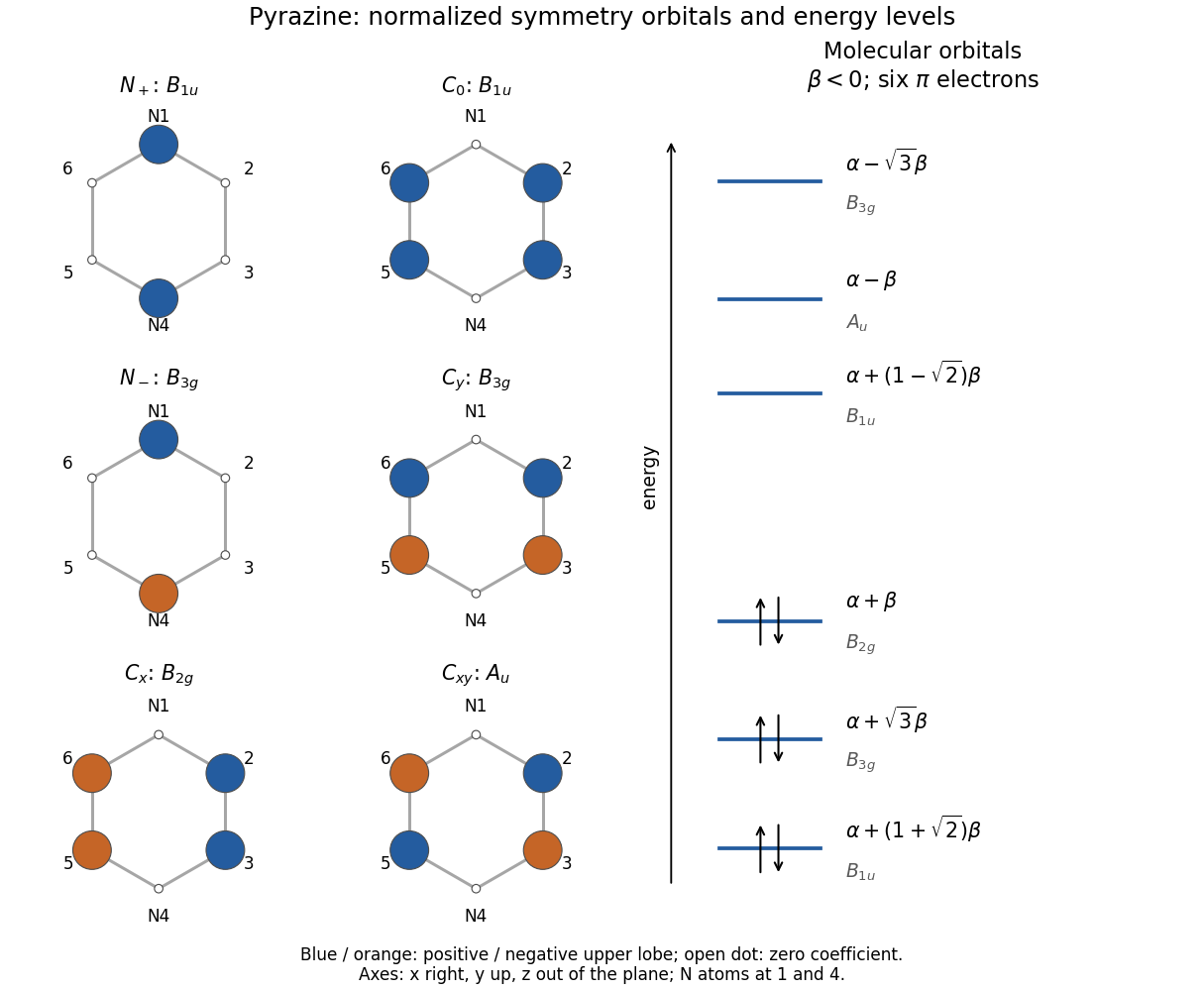
Original normalized pyrazine symmetry-orbital phase patterns and Hückel energy diagram, with nitrogen at sites 1 and 4
. Details. 
Work with . Its nearest-neighbour ring entries are , and its diagonal entries are on the nitrogen sites and on the carbon sites. Because commutes with each molecular symmetry operation, it only mixes symmetry-adapted linear combinations with the same irreducible representation.
In the bases and , the two nontrivial matrix blocks areTheir characteristic polynomials are and . The remaining single-function blocks are and . Thus, ordered from lowest to highest physical energy because , the molecular orbitals areAll six levels are nondegenerate in this parametrization. The right-hand ladder of the diagram in part (ii) shows these levels and occupations. The occupied level is the highest occupied molecular orbital, and the unoccupied level immediately above it is the lowest unoccupied molecular orbital.
The six electrons give the Hückel method energyThe appropriate localized reference contains two C=N bonds and one C=C bond. Three C=C bonds would incorrectly replace the nitrogen one-centre parameters. For one isolated C=N pair, the dimensionless matrix iswhose eigenvalues are . Since , the occupied bonding molecular orbital has energy . Two doubly occupied C=N bonds and one doubly occupied C=C bond consequently giveTherefore the signed delocalization energy isThe positive stabilization is , smaller than the benzene value in the stated model but still stabilizing.
Pyrazine is aromatic: its planar cyclic conjugated system contains six electrons and has a filled set of three bonding molecular orbitals. Each ring nitrogen contributes one electron; its in-plane lone pair is outside this system. The heteroatoms change orbital energies and coefficients without interrupting cyclic conjugation or the count. Aromaticity does not require the stabilization to equal benzene's.
Articles by others on the same topic
There are currently no matching articles.