In a body-centred cubic lattice, touching atoms lie along a body diagonal. Its length is and spans four radii, so
There are twelve model conduction electrons in the conventional unit cell. Hence . For a spin-twofold free electron gas,Numerically,The six-electron count is the stipulated model; treating transition-metal d states as completely free is an approximation.
The Fermi sphere volume in reciprocal space isThe primitive real-space cell has volume , so the first Brillouin zone has volumeEach band accommodates two electrons per primitive cell when spin is counted. Six electrons therefore require three such zone-volumes of occupied reciprocal-space states in the free-electron counting picture. The extended-zone sphere is not confined to the first zone; folding it produces multiple bands. It does not imply that the actual tungsten Fermi surface is spherical.
For , only electrons within an energy window of order around the Fermi energy can change occupation appreciably, because of the Pauli exclusion principle. The active fraction is of order . Giving each of these electrons energy of order estimates an excitation energy , and thereforePer mole of conduction electrons, , which is the quoted . Per mole of metal atoms with model conduction electrons each, the conduction-electron count in the molar electronic heat capacity instead gives . The numerical factor is only approximate: the Sommerfeld expansion gives for a three-dimensional free-electron gas.
The Fermi temperature isInserting it into the question's quoted estimate givesAs explained in (d), that count is per mole of conduction electrons. Using the stipulated six electrons per tungsten atom gives per mole of tungsten in the same rough model. The accurate free-electron Sommerfeld expansion coefficient would instead give per mole of tungsten. These are different approximations and counting conventions, not three interchangeable exact answers.
Lattice vibrations contribute a phonon heat capacity. At temperatures well below the Debye temperature, its leading contribution is proportional to , whereas the electronic part is proportional to :The lattice term can therefore become important rapidly as temperature rises, even if the electronic term dominates sufficiently close to zero. At higher temperature the lattice contribution approaches the Dulong-Petit law value per mole of atoms within the harmonic approximation. This is not a claim that the low-temperature law holds at all temperatures.
The sum of the three primitive vectors is , so the surface is a plane. Two in-plane translations areThey have length and included angle , giving a triangular top-layer lattice. Body-centred sites lie in offset parallel layers, not as additional sites in this same plane. A primitive surface cell is the rhombus spanned by , of area
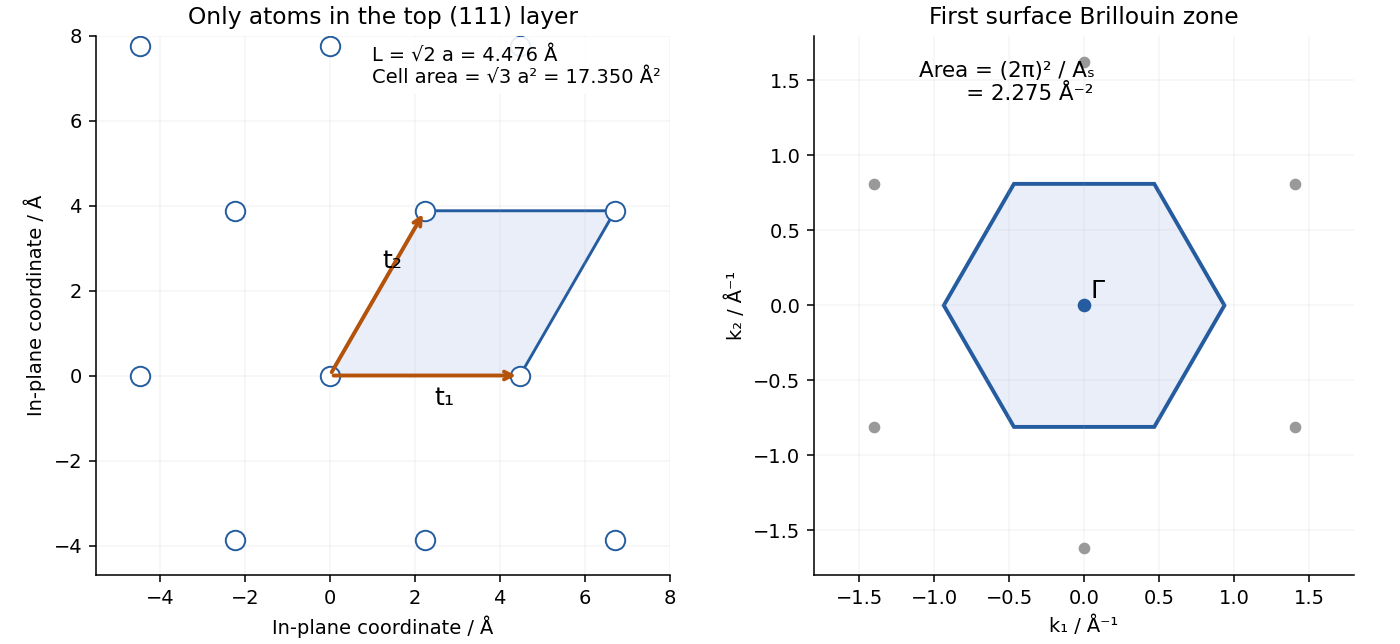

The reciprocal lattice of a triangular surface lattice is triangular, so its first Brillouin zone is a regular hexagon. Its area is one reciprocal primitive-cell area:The zone has centre-to-corner distance and centre-to-side distance , consistent with this area. These reciprocal lengths use the convention .
Articles by others on the same topic
There are currently no matching articles.