The internal energy is the population-weighted sum of the molecular energy levels:At fixed volume, assume the energy levels themselves are temperature-independent. Differentiating the molecular partition function givesChoosing the zero of energy changes by the corresponding constant per molecule, so the ground-level convention must be consistent throughout.
Relative to the ground state, the quantum harmonic oscillator levels are . Put . Summing the geometric series gives the vibrational partition function . Therefore the vibrational internal energy isThe omitted zero-point energy would add if absolute oscillator energies were used.
“Low” and “high” compare with the vibrational spacing , not temperature with an arbitrary number of kelvin. For , occupation of excited levels is exponentially suppressed andThis vanishing result uses the ground-relative energy zero. For , expand to obtainThis agrees with equipartition: the oscillator has one quadratic kinetic and one quadratic potential term, contributing each. The corresponding limiting vibrational heat capacity is zero at low temperature and at high temperature.
Subtracting the energy in the Morse oscillator givesThe first three relative wavenumbers are , , and . Thus, with and ,This is a three-level partition function, as stipulated, rather than an unrestricted sum of the anharmonic formula to arbitrarily large .
Differentiating each Boltzmann factor yieldsThe derivative is positive: warming increases occupation of both excited energy levels. At ,
For one mole, , so the three-level Morse oscillator result isFor the full quantum harmonic oscillator with the given wavenumber,The specified anharmonic calculation is about higher. Anharmonicity lowers the first excitation spacings and increases excited-state occupation. Both results remain small because is well below the vibrational temperature. The comparison also mixes a three-level anharmonic truncation with an infinite harmonic sum; omitted higher Morse levels would make a further small positive correction at this temperature.
For identical, non-interacting molecules, the translational canonical partition function is . Stirling's approximation gives the Helmholtz free energyAt fixed , , so differentiation gives . For one mole at the standard-state molar volume,Here the quoted molar translational quantity is per mole, and its ratio to is dimensionless. The derivative defining entropy is taken at fixed volume before inserting the standard-state volume; differentiating along a constant-pressure path would give the wrong additive constant.
For a linear rigid rotor in the high-temperature regime, . Its molar rotational entropy isThe rotational symmetry number must already be included in .
Under the stated vibrational-ground-state approximation and a nondegenerate electronic ground state, only translation and rotation contribute. ThereforeA temperature-independent ground-state energy, including zero-point energy, contributes no entropy. This estimate deliberately omits thermal vibrational excitation; it need not equal a tabulated value that includes all modes.
Use the same standard pressure and temperature, the same bond length, and the same electronic and vibrational-ground-state approximations. The translational partition function scales as mass to the power , giving the factor . For the original isotopologue, and the rotational symmetry number is two. For the isotope-substituted molecule, the two oxygen ends are distinguishable, so the symmetry number is one. HenceThe change in standard molar entropy issoThis uses a convention omitting a separate nuclear-spin entropy. If nuclear-spin degeneracies are instead included explicitly, the spin- carbon-13 nucleus adds a further relative to the spin-zero original isotopologue; that convention must be stated rather than silently mixed with the quoted partition functions.
The substituted molecule has the larger entropy. Increased mass and moment of inertia reduce translational and rotational spacings and make more states thermally accessible. The largest contribution here is the loss of the twofold rotational indistinguishability of the oxygen ends, contributing . It is a rotational symmetry number correction for one isotope-defined species, not an entropy of mixing between different molecules.
As a first estimate, neglect the small mass change and changes in geometry and vibrational populations. Removing an electron creates an unpaired spin, giving at least the spin-only electronic entropy increaseFor a more specific estimate, the actual cation ground term is , rather than an orbitally nondegenerate doublet. Ignoring spin-orbit coupling, its two orbital components and two spin components give electronic degeneracy four andThe ground-state assignment is confirmed by state-resolved photoionization measurements.[ref]
Photoionization of CO2: Experimental Procedure by the National Institute of Standards and Technology. Measurements restricted to channels leaving the cation in its X 2Πg ground electronic state
Spin-orbit splitting and changed vibrational/rotational constants refine this estimate; the question's supplied partition functions alone do not determine those corrections. The answer is a spin-only estimate, while additionally retains the orbital degeneracy.A potential energy surface gives the molecular electronic energy, with nuclear repulsion, as a function of the nuclear coordinates under the Born-Oppenheimer approximation. Its minima describe stable configurations and its saddle regions help identify reaction barriers.
A reaction coordinate parametrizes progress along a chosen path on the potential energy surface. It usually combines several bond lengths or angles; it need not be one literal bond distance or elapsed time.
A transition state is the configuration or dividing-surface region associated with passage between reactant and product basins. In the elementary saddle-point picture it is a first-order saddle of the potential energy surface: stable against small displacements in transverse directions but unstable along the reaction direction. Transition state theory counts forward crossings and, in its simplest form, neglects recrossing.
The quantities and are molecular partition functions per unit volume for the two reactants, with their internal rotational, vibrational and electronic factors included. Thus their translational factors are , rather than those factors multiplied by . Their energy zeros must match the separately displayed barrier convention.
The primed is the corresponding transition state partition function per unit volume with the unstable reaction-coordinate degree of freedom omitted. Its replacement by the crossing-frequency factor is already outside the partition-function ratio. For a diatomic atom-pair transition state, the omitted coordinate is the bond stretch, leaving translation and rotation.
The barrier is the energy difference between the transition-state reference level and the separated reactant reference levels. Consistent zero-point energies of stable transverse modes belong in this reference-level difference. It is an energy per reacting pair; a molar activation energy uses instead of in the exponential.
Write and . An atom has no rotational or vibrational internal factor under the stated electronic assumption. The transition-state moment of inertia is , so the high-temperature rigid rotor result isThe translational factors therefore giveSubstituting into the transition state theory expression and simplifying,For distinct atoms, . This is a number-density rate coefficient, with units of volume per time. A rate law in molar concentrations uses . The derivation assumes a classical high-temperature rotor at the dividing surface and a transmission coefficient of one.
If the relevant ground manifolds have electronic degeneracies , and , and their components are treated as energetically degenerate, multiply the result byOnly reactive transition-state electronic channels should be counted. Resolved electronic splittings require electronic partition functions rather than simple integer degeneracies.
For identical atoms, use and the homonuclear rotational symmetry number . With a rate defined as reaction events per volume and time, this halves the geometric prefactor relative to distinguishable labelled pairs. Do not independently count both ordered pairs and then add another unrelated factor of two. If the rate is instead defined by disappearance of A, each event consumes two atoms, so ; that rate coefficient is twice the event-rate coefficient.
Identify the transition-state separation with contact, , take distinct atoms so , and let . Then and , yieldingThe velocity factor is the mean relative speed from the Maxwell-Boltzmann distribution. Thus this simple transition state theory model reproduces the stated collision theory expression. Molecular orientation constraints, quantum transmission and reaction-surface recrossing can invalidate the equality outside these simplifying assumptions.
In a body-centred cubic lattice, touching atoms lie along a body diagonal. Its length is and spans four radii, so
There are twelve model conduction electrons in the conventional unit cell. Hence . For a spin-twofold free electron gas,Numerically,The six-electron count is the stipulated model; treating transition-metal d states as completely free is an approximation.
The Fermi sphere volume in reciprocal space isThe primitive real-space cell has volume , so the first Brillouin zone has volumeEach band accommodates two electrons per primitive cell when spin is counted. Six electrons therefore require three such zone-volumes of occupied reciprocal-space states in the free-electron counting picture. The extended-zone sphere is not confined to the first zone; folding it produces multiple bands. It does not imply that the actual tungsten Fermi surface is spherical.
For , only electrons within an energy window of order around the Fermi energy can change occupation appreciably, because of the Pauli exclusion principle. The active fraction is of order . Giving each of these electrons energy of order estimates an excitation energy , and thereforePer mole of conduction electrons, , which is the quoted . Per mole of metal atoms with model conduction electrons each, the conduction-electron count in the molar electronic heat capacity instead gives . The numerical factor is only approximate: the Sommerfeld expansion gives for a three-dimensional free-electron gas.
The Fermi temperature isInserting it into the question's quoted estimate givesAs explained in (d), that count is per mole of conduction electrons. Using the stipulated six electrons per tungsten atom gives per mole of tungsten in the same rough model. The accurate free-electron Sommerfeld expansion coefficient would instead give per mole of tungsten. These are different approximations and counting conventions, not three interchangeable exact answers.
Lattice vibrations contribute a phonon heat capacity. At temperatures well below the Debye temperature, its leading contribution is proportional to , whereas the electronic part is proportional to :The lattice term can therefore become important rapidly as temperature rises, even if the electronic term dominates sufficiently close to zero. At higher temperature the lattice contribution approaches the Dulong-Petit law value per mole of atoms within the harmonic approximation. This is not a claim that the low-temperature law holds at all temperatures.
The sum of the three primitive vectors is , so the surface is a plane. Two in-plane translations areThey have length and included angle , giving a triangular top-layer lattice. Body-centred sites lie in offset parallel layers, not as additional sites in this same plane. A primitive surface cell is the rhombus spanned by , of area
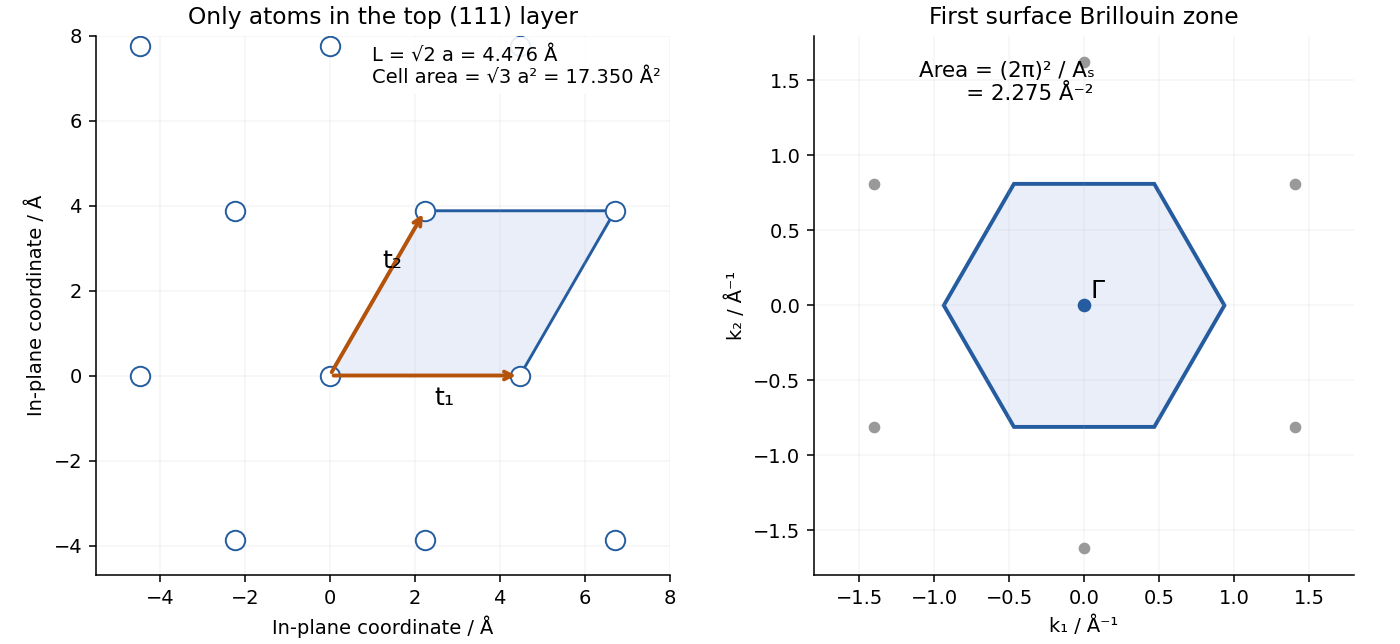

The reciprocal lattice of a triangular surface lattice is triangular, so its first Brillouin zone is a regular hexagon. Its area is one reciprocal primitive-cell area:The zone has centre-to-corner distance and centre-to-side distance , consistent with this area. These reciprocal lengths use the convention .
For an intrinsic, nondegenerate semiconductor, charge neutrality and the Boltzmann approximation to the Fermi-Dirac distribution give . Assume the two polymorphs have equal effective-density-of-states prefactors and retain the quoted band gaps at the temperature being estimated. Their carrier-density ratio is thenwith expressed in eV per kelvin. At ,Both absolute intrinsic densities are extremely small at this temperature; a large ratio does not imply that either material is a good intrinsic conductor. Defects or unintended dopants can dominate real “undoped” specimens.
Using the same intrinsic-carrier approximation at givesSimilar mass density and coordination do not prove equal electron and hole effective masses; this result isolates the exponential band-gap effect.
At , the same approximation givesAs temperature rises, the relative advantage from a fixed gap difference becomes smaller, even while the intrinsic carrier densities of both phases increase.
Suitable substitutional donors include Si on a Ga site and O on an N site. The former replaces a group-III atom with a group-IV atom; the latter replaces a group-V atom with a group-VI atom. Each provides an extra valence electron relative to its host site. Si is a plausible substitutional cation-site dopant, and the compact oxygen atom is compatible with an anion site. Site compatibility matters: merely choosing an element with an extra electron without considering which sublattice it occupies is insufficient.
A standard substitutional acceptor choice is Mg on a Ga site: a group-II atom replaces group III, leaving one fewer valence electron. Its size is sufficiently compatible with the cation sublattice to make substitution plausible. This identifies the intended acceptor chemistry; actual hole density also depends on activation, incomplete ionization and compensation. Size and valence rules alone do not guarantee a shallow, fully ionized acceptor.
At equilibrium, electrons initially diffuse from the n side and holes from the p side. Recombination leaves ionized donors and acceptors in a depletion region, producing an internal electric field and band bending. The Fermi level is constant across the equilibrium p-n junction. With p material on the left, both band edges lie higher on the p side, as in the left panel.
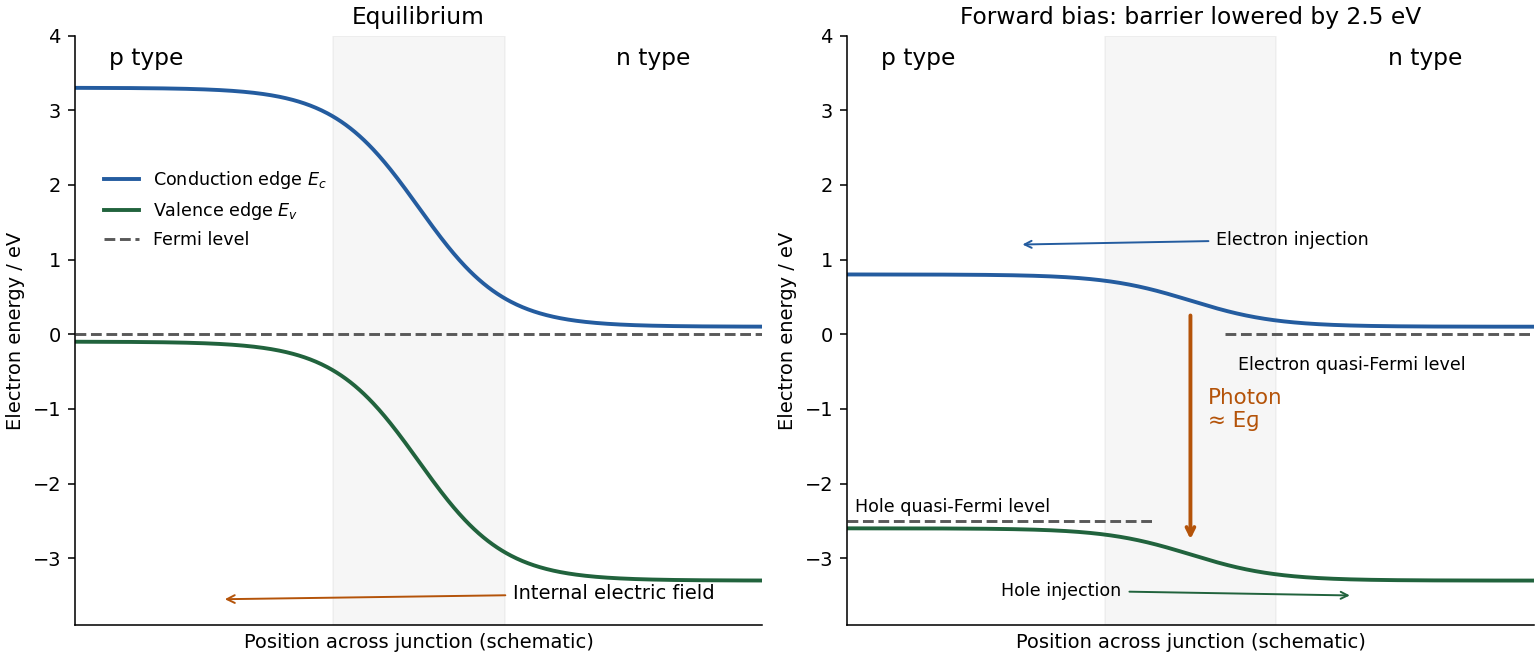
Equilibrium and forward-biased direct-gap p-n junction energy bands, with injection and photon emission
. Details. 
Forward bias, with the p side positive relative to n, reduces the injection barrier. Electrons and holes enter the junction region and can recombine radiatively, emitting photons with energy close to the band gap. Under bias, separate electron and hole quasi-Fermi levels replace a single equilibrium Fermi level.
Both GaN polymorphs have a direct band gap, so a conduction-band electron and valence-band hole can recombine without a large crystal-momentum change. Silicon and germanium have indirect band gaps, requiring phonon assistance for near-edge radiative recombination, which makes efficient band-edge light emission much harder. A direct gap enables the process; defects, carrier confinement and competing nonradiative channels still determine device efficiency.
Using and an ideal band-edge photon energy equal to the quoted gap,At low temperature an electron and hole can form a bound exciton. Its recombination releases approximately , so its wavelength is longer than evaluated using the gap at that same temperature. GaN excitation and emission measurements resolve such excitonic transitions below the fundamental gap.[ref]
Fundamental energy gap of GaN from photoluminescence excitation spectra by Bo Monemar. Photoluminescence-excitation, reflection and emission comparison; separation of exciton transition energy from the fundamental gap
For the quoted cubic-phase gap,The same exciton binding argument can shift the actual emission to longer wavelength; impurity-bound transitions can also lie below the fundamental gap. The comparison must use at the operating temperature. Ordinary temperature-dependent gap changes can shift the band edge in the opposite direction, so the numerical values based on fixed supplied gaps are not universal lower bounds for every cooled device.
GaN has a substantial band-gap advantage for high-temperature operation. Its gap is larger than those of GaAs and GaP, suppressing thermally generated intrinsic carriers through . A doped junction therefore retains its intended carrier imbalance and can have lower thermally generated leakage over a wider temperature range, other factors being equal. The wide gap also supports emission at higher photon energies.
This is a materials-based expectation, not a guarantee for every finished device. Dopant activation and compensation, defects, contact stability, heat extraction and nonradiative recombination can set the practical limit. Increasing temperature also reduces carrier mobility and can broaden or quench light emission. The relevant advantage is reduced intrinsic excitation; a comparison of operating temperatures needs those other device properties too.
Articles by others on the same topic
There are currently no matching articles.