Six inward-directed donor orbitals form symmetry-adapted linear combinations of symmetry. They mix respectively with metal , and orbitals. Thus the sigma framework contains six occupied bonding molecular orbitals and six corresponding antibonding molecular orbitals. The metal orbitals have no sigma-compatible partner and remain nonbonding orbitals in this model. The important metal-dominated octahedral splitting isThe orbitals point directly toward the donors; the orbitals point between them. The original diagram shows the entire sigma framework, rather than treating the five metal d levels as the whole molecular-orbital diagram.
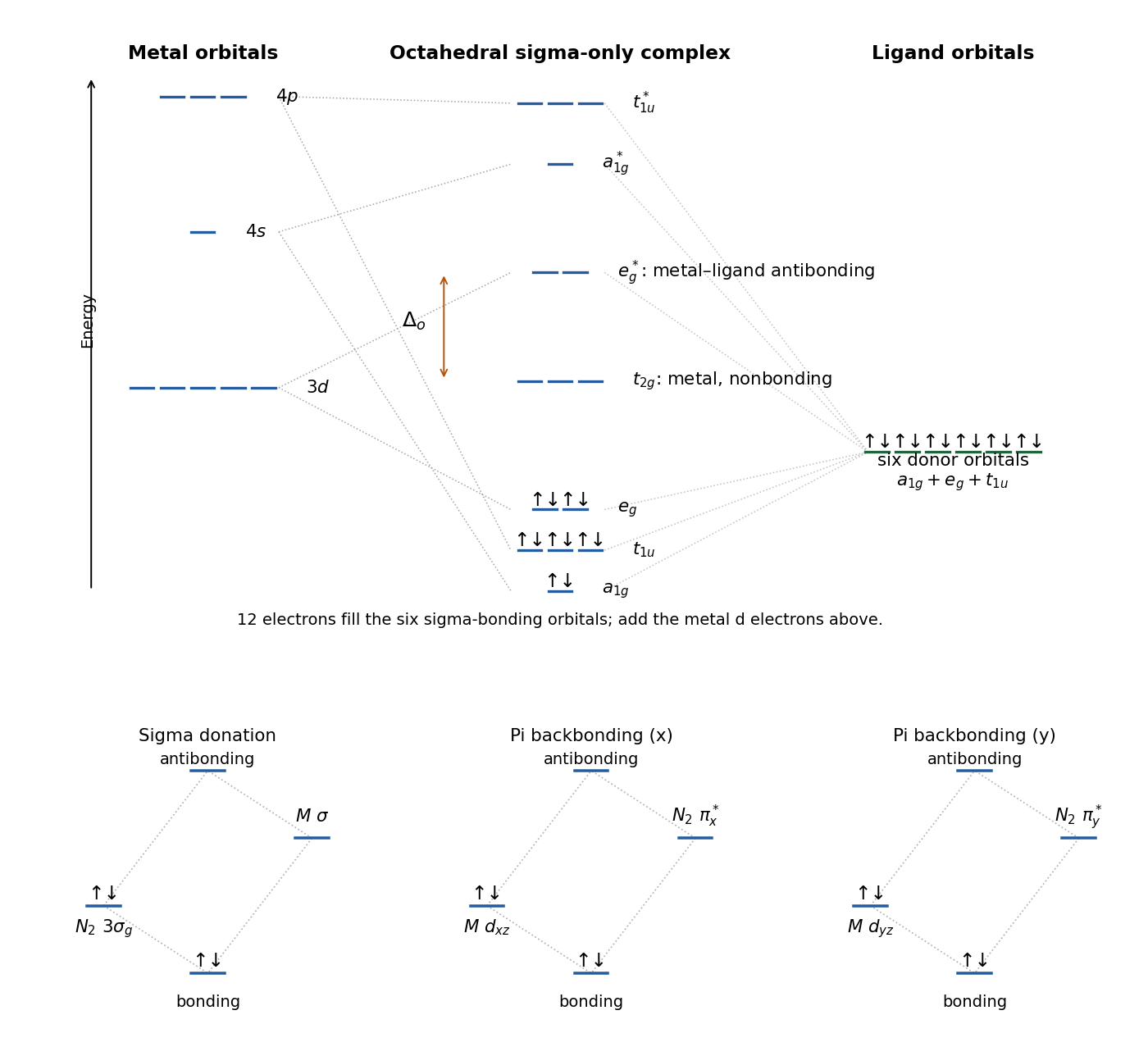
Sigma-only octahedral orbitals and the donation/backbonding channels of end-on dinitrogen
. Details. For the same donor set and approximately the same geometry, . The higher metal charge usually shortens the metal–donor distances and strengthens the interaction that raises . This comparison holds other chemical variables fixed: changing the ligand at the same time could reverse a comparison between two unrelated complexes.
Neutral pyridine contributes no formal charge. If of the two dioxolene ligands are dianions, the combined ligand charge is , so the cobalt oxidation state is . The distinct charge assignments are thereforeInterchanging the two ligand labels in the middle row does not make another charge combination. Co(IV) belongs in this unrestricted charge-balance list even though the subsequent magnetic analysis excludes it.
A Co(III) centre has , and charge balance requires one closed-shell catecholate ligand and one semiquinonate ligand. For low-spin Co(III), , the metal has , giving an independent-spin magnetic moment ofThus contains low-spin Co(III), , with its observed moment residing on the free radical ligand. High-spin Co(III), , would have and give under the stated independent-spin approximation, so it is inconsistent with this measurement.
For Co(II), , charge balance instead requires two semiquinonate ligands. High-spin Co(II) has and , soTherefore contains high-spin Co(II), . Low-spin Co(II), , would give when the two ligand spins are included. These four checks distinguish both oxidation state and metal spin.
The larger octahedral splitting at Co(III) exceeds the effective pairing energy and favours a low-spin complex; the smaller octahedral splitting at Co(II) favours a high-spin complex with occupation of both orbitals before further pairing. Interconversion also transfers an electron between cobalt and a dioxolene ligand, so this is valence tautomerism, rather than a metal-only spin change. Squared moments add here because the supplied model treats the centres as independent; adding the three spins first would be a different, exchange-coupled model.
water lies below pyridine and cyanide ligand in the spectrochemical series. At fixed metal and dioxolene charges, replacement by water decreases and favours the high-spin limits: Co(II) remains ; Co(III) can become if the splitting falls below the pairing threshold. Replacement by cyanide increases and favours Co(III), , and Co(II), . The two unchanged semiquinonate ligands would then give the Co(II) form a combined independent-spin moment of . The ranking predicts the direction of the change; two substituted donors alone do not guarantee a Co(III) spin crossover, since all six donors determine its splitting. A shift of the valence-tautomer equilibrium is also possible and is separate from this fixed-charge comparison.
Treat each semiquinonate ligand as a symmetric O,O chelate, with the free radical delocalized over the dioxolene framework. The ideal octahedral donor-connectivity structures are one trans form and two mirror-related cis forms, giving three stereoisomers. Trans refers to the two pyridine N donors, not to the two O atoms of a chelate, which must remain adjacent.
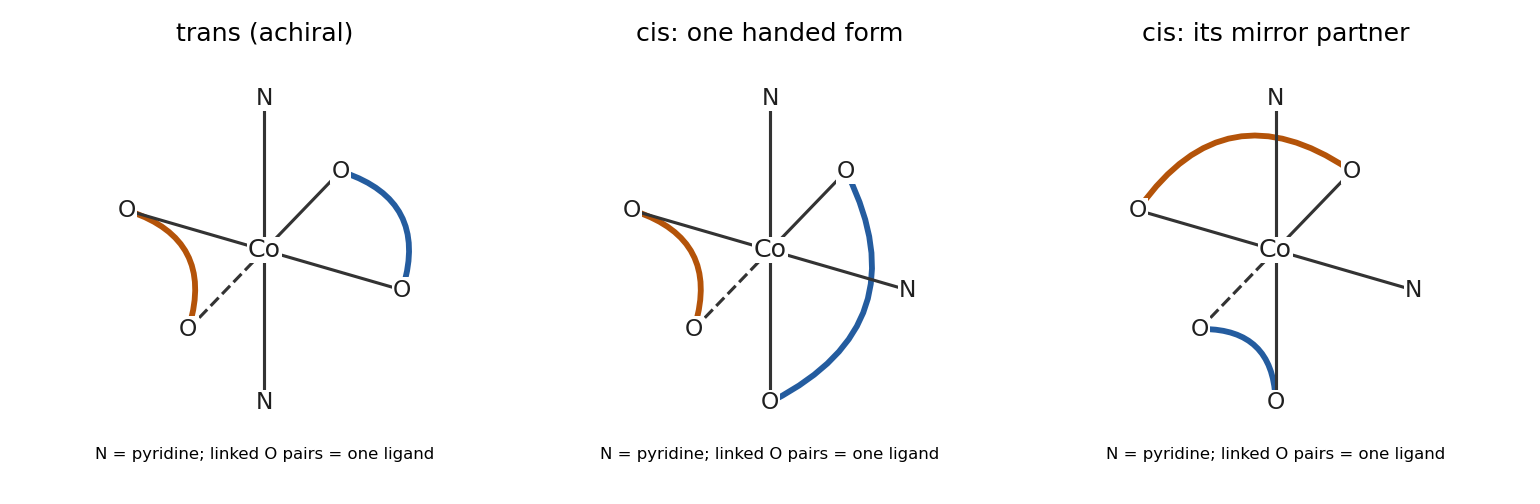
In the diagram, coloured curves join the two O donors belonging to one ligand. For an unambiguous coordinate specification, the trans form has Py at , with chelate pairs and . A cis pair has Py at , with chelates and ; reflecting gives the other cis form. Proper rotations cannot superpose those two cis arrangements. Ring conformations and pyridine rotations are not extra donor-connectivity isomers.
The Co(III) centre in has : every occupied d subset is orbitally balanced. There is no first-order metal-centred Jahn–Teller driving force in . This does not require all six experimental bond lengths to be equal, since pyridine and dioxolene are different donors.
The Co(II) centre in has . Its two orbitals each contain one electron, so that subset gives no first-order preference. The hole does give a weaker Jahn–Teller instability. To compare tetragonal distortions, take a positive small splitting parameter and retain each subset's orbital energy barycentre. On axial elongation let shift by and by . Five electrons then giveFor equal-magnitude compression the shifts reverse, and filling the lower orbital first givesThe two singly occupied orbitals contribute zero net shift in either case. Thus the elementary tetragonal splitting model favours elongation for high-spin , rather than equal electronic stabilization by the two signs. In a strictly sigma-only octahedral molecular orbital model is nonbonding, so this weak effect is absent; it arises when the electrostatic and non-sigma interactions neglected in that diagram are restored. spin-orbit coupling, unequal donors and chelate constraints can modify the actual distortion, so the argument does not establish which experimental Co–donor bonds must lengthen.
Four equivalents of base remove the four carboxylic-acid protons from two ligand molecules, giving two dianionic pyridine-2,5-dicarboxylate linkers per Pt/Mn pair. The ring nitrogen and neighbouring 2-carboxylate supply a five-membered N,O chelate. A consistent chain has Pt(II), NO, with square planar molecular geometry, and Mn(II), O, with octahedral molecular geometry.
At each Pt, two ligands bind through their ring N and one O of the adjacent 2-carboxylate; their remote 5-carboxylates point toward successive Mn sites. At each Mn, a remote carboxylate from each of two neighbouring Pt-containing units binds through both O atoms. Two coordinated water molecules complete Mn's six-coordinate sphere. The repeating connectivity, with each bracket denoting a single organic linker, isEach Pt has a second N,O chelate extending in the opposite chain direction; each Mn similarly receives two carboxylate chelates. The original donor-connectivity diagram makes those counts explicit.
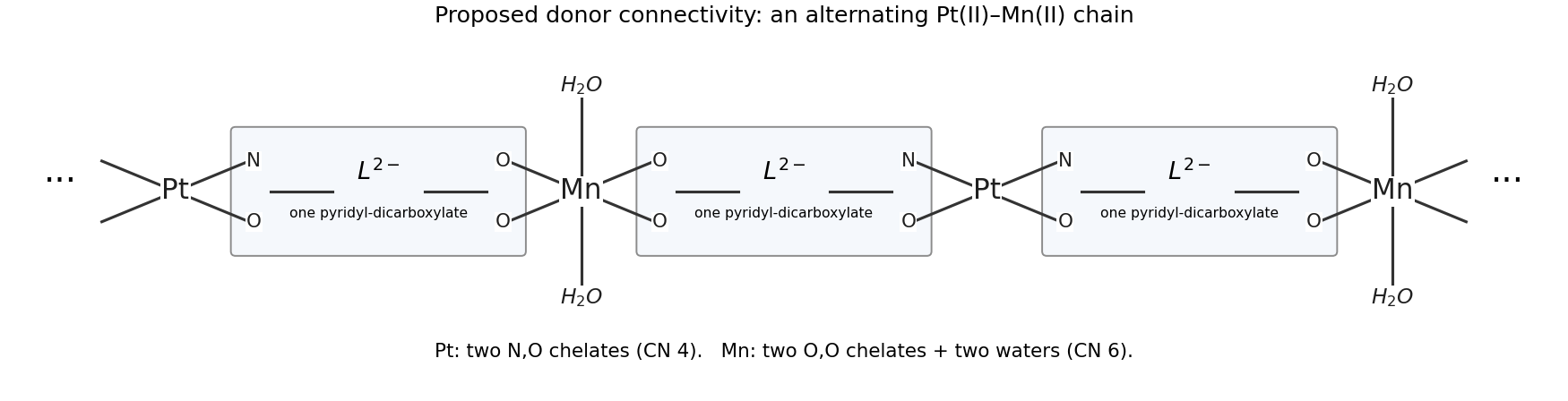


Pt(II) is and strongly favours square planar molecular geometry. Its affinity for the pyridyl N donor and the chelate effect select the mixed N,O pocket. Mn(II) is high-spin , is harder, and favours the carboxylate and water O donors; six-coordinate octahedral molecular geometry is natural in water. Charge balance per repeat is . A suitable repeat formulation is . This is a justified proposed coordination chain, not a unique crystal structure established from stoichiometry alone; water content, carboxylate bridging modes and actual porosity require structural characterization.
Articles by others on the same topic
There are currently no matching articles.