The cyclohexanone enamine attacks the beta carbon of the cyclopentenone. Its nitrogen lone pair forms an iminium C=N bond as the enamine pi bond forms the new C–C bond; simultaneously the enone pi system shifts onto its oxygen. proton transfer converts the resulting cyclopentanone enolate back to the ketone.
A final iminium deprotonation regenerates an enamine, but the position of its double bond matters. Label the nitrogen-bearing cyclohexane carbon , its initially nucleophilic neighbour , and the other neighbour . After addition, bears the cyclopentanone substituent. deprotonation at gives , the less substituted, less hindered enamine drawn in A. Merely restoring the original bond would give a different regioisomer. Interconversion through the iminium ion permits this enamine regioisomerization under the reaction conditions. The methyl and mesylate substituents are spectators during this first Michael addition.
Number the cyclopentanone ring at its carbonyl, then at the methyl-bearing carbon, at the mesylate-bearing carbon, at the carbon joined to cyclohexane , and at the remaining methylene. B has a enone and the enamine. triethylamine removes the hydrogen at while the –O bond breaks to release mesylate. An E2 elimination, with approximately antiperiplanar geometry in the puckered ring, gives the conjugated cyclopentenone. Elimination towards instead would give a nonconjugated alkene.
The enamine carbon now attacks enone beta carbon intramolecularly. nitrogen donates into to give the iminium ion, while the enone electrons move onto the ketone oxygen. protonation of the ketone enolate gives C. The second new bond is ; the first was . These two connections account for the bridged skeleton without a concerted cycloaddition or an aldol step. The formula of B is : relative to A, elimination removes overall, namely methanesulfonic acid after proton transfers.
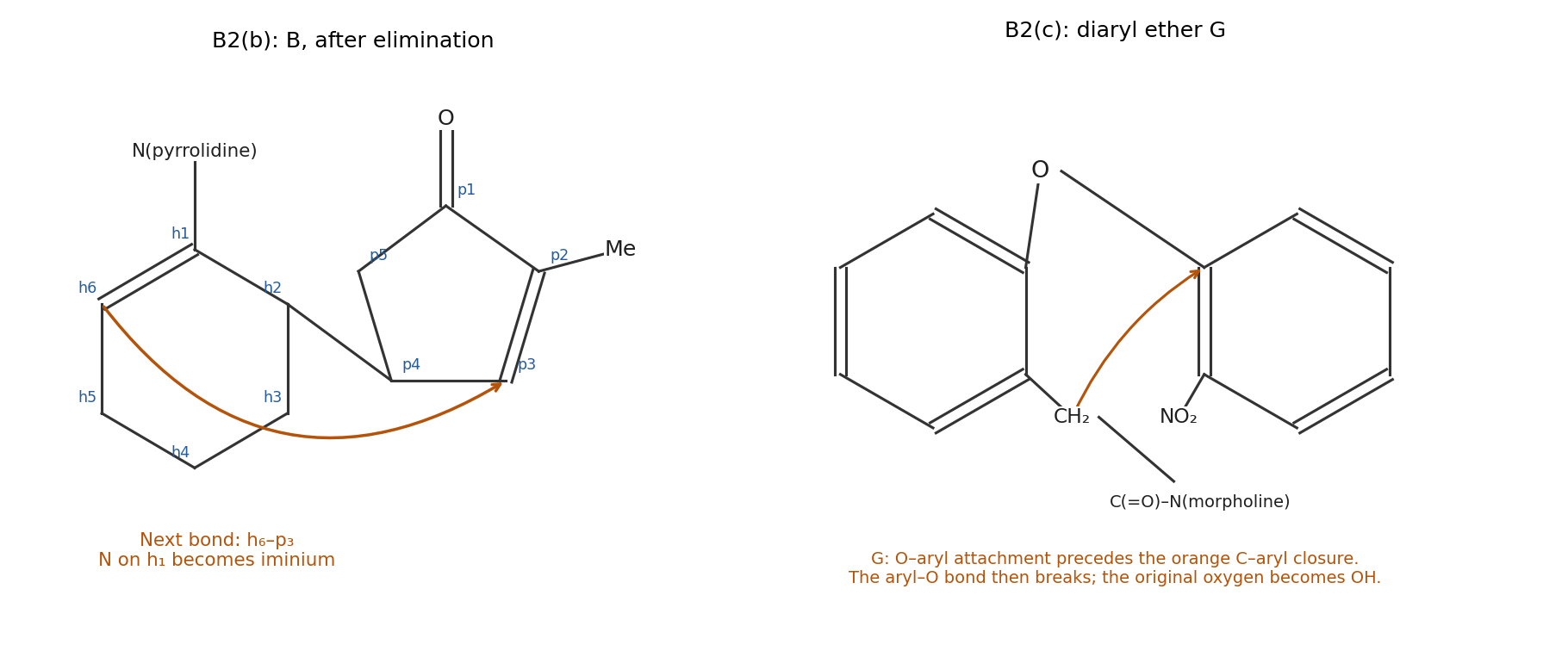
Original atom-numbered reconstruction of intermediate B and the diaryl ether G; coloured bonds identify the subsequent cyclization and aryl migration
. Details. 
Warm C with dilute aqueous acid to hydrolyse the iminium ion to the second ketone. water attacks the iminium carbon, proton transfers give a carbinolamine, and C–N cleavage releases pyrrolidine, present predominantly as its ammonium salt in the acidic medium. The two carbon–carbon bonds constructed in the preceding Michael additions remain intact. This replaces the iminium nitrogen substituent by oxygen and gives the diketone D; neither oxidation of the skeleton nor reduction of the original ketone is required.
Articles by others on the same topic
There are currently no matching articles.