The first reagent supplies a vinyl nucleophile, , rather than an allyl group. Two successive conjugate additions install vinyl at C2 and a 2-formylethyl chain at C1. Number the original nitro-bearing alkene carbon C1. Vinylmagnesium bromide attacks the beta carbon C2 of the nitroalkene, shifting the original C1=C2 electrons into a magnesium nitronate. The new C2–vinyl bond remains intact during the second stage; its terminal double bond is not the electrophilic site in that stage.
The carbon end of the nitronate at C1 then attacks the terminal beta carbon of acrolein. Move the acrolein C=C electrons towards its carbonyl and the C=O electrons onto oxygen. This forms the C1–CH2CH2CHO connectivity through an aldehyde enolate; protonation by methanol and tautomerization restore the aldehyde. The nitronate returns to a neutral nitro group as it makes the second C–C bond. Thus the chain is attached through the carbon formerly beta to the acrolein carbonyl, rather than by a direct addition to its aldehyde carbon.
After the first addition, C2 bears the vinyl group while the nitronate carbon C1 remains approximately planar. Approach of the second electrophile to the less crowded face, opposite the adjacent vinyl substituent, gives the new formylethyl chain trans to vinyl. Consequently nitro and vinyl are cis, as depicted: at C1 the chain and nitro group occupy opposite faces. This is a substrate-controlled diastereoselective tandem Michael addition. The reagents and starting material contain no chiral source, so the depicted product represents a racemic pair rather than an enantioselective synthesis. Steric facial selection explains the relative configuration without requiring a uniquely established magnesium aggregate or transition-state conformation.
The cyclohexanone enamine attacks the beta carbon of the cyclopentenone. Its nitrogen lone pair forms an iminium C=N bond as the enamine pi bond forms the new C–C bond; simultaneously the enone pi system shifts onto its oxygen. proton transfer converts the resulting cyclopentanone enolate back to the ketone.
A final iminium deprotonation regenerates an enamine, but the position of its double bond matters. Label the nitrogen-bearing cyclohexane carbon , its initially nucleophilic neighbour , and the other neighbour . After addition, bears the cyclopentanone substituent. deprotonation at gives , the less substituted, less hindered enamine drawn in A. Merely restoring the original bond would give a different regioisomer. Interconversion through the iminium ion permits this enamine regioisomerization under the reaction conditions. The methyl and mesylate substituents are spectators during this first Michael addition.
Number the cyclopentanone ring at its carbonyl, then at the methyl-bearing carbon, at the mesylate-bearing carbon, at the carbon joined to cyclohexane , and at the remaining methylene. B has a enone and the enamine. triethylamine removes the hydrogen at while the –O bond breaks to release mesylate. An E2 elimination, with approximately antiperiplanar geometry in the puckered ring, gives the conjugated cyclopentenone. Elimination towards instead would give a nonconjugated alkene.
The enamine carbon now attacks enone beta carbon intramolecularly. nitrogen donates into to give the iminium ion, while the enone electrons move onto the ketone oxygen. protonation of the ketone enolate gives C. The second new bond is ; the first was . These two connections account for the bridged skeleton without a concerted cycloaddition or an aldol step. The formula of B is : relative to A, elimination removes overall, namely methanesulfonic acid after proton transfers.
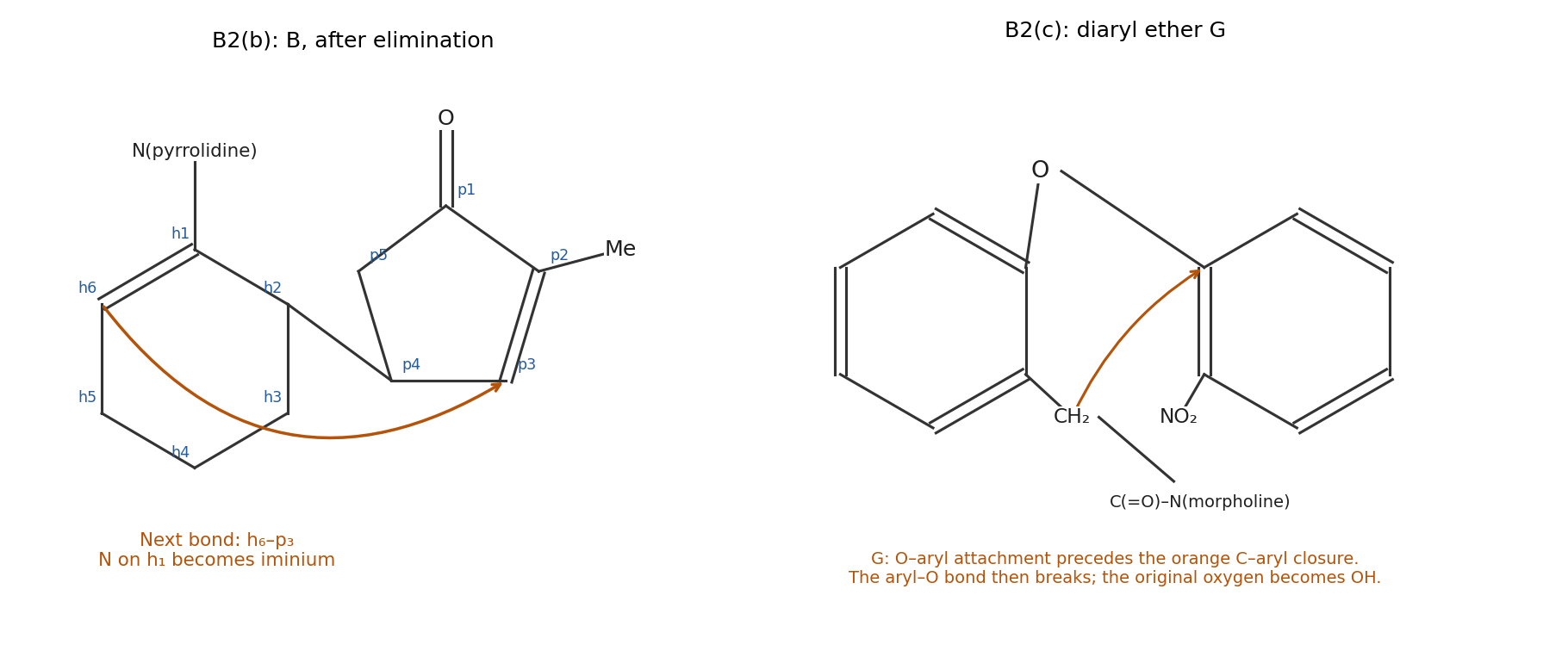
Original atom-numbered reconstruction of intermediate B and the diaryl ether G; coloured bonds identify the subsequent cyclization and aryl migration
. Details. 
Warm C with dilute aqueous acid to hydrolyse the iminium ion to the second ketone. water attacks the iminium carbon, proton transfers give a carbinolamine, and C–N cleavage releases pyrrolidine, present predominantly as its ammonium salt in the acidic medium. The two carbon–carbon bonds constructed in the preceding Michael additions remain intact. This replaces the iminium nitrogen substituent by oxygen and gives the diketone D; neither oxidation of the skeleton nor reduction of the original ketone is required.
The phenolic O–H is most acidic; the benzylic CH2 adjacent to the amide carbonyl is second. Phenolic deprotonation gives a phenoxide stabilized by resonance in chemistry. Removing an alpha-amide C–H gives an enolate/carbanion stabilized by the carbonyl and the adjoining aryl group, but requires substantially stronger basicity for a comparable equilibrium concentration. The morpholine nitrogen is an acylated tertiary amide nitrogen and has no N–H proton. The other morpholine and aromatic C–H positions do not have the same direct carbonyl stabilization.
G is the diaryl ether . Here denotes the nitrogen of the intact morpholine ring; the phenoxy oxygen and phenylacetamide chain are ortho on their original ring. potassium carbonate first generates phenoxide from F. Its oxygen attacks the fluorine-bearing carbon of 1-fluoro-2-nitrobenzene, forming a Meisenheimer complex. Delocalization of its negative charge into the ortho nitro group stabilizes this addition intermediate. Fluoride elimination restores aromaticity and completes nucleophilic aromatic substitution.
This first step forms an O–aryl bond, rather than immediately arylating the less acidic alpha carbon. The neutral product has formula , obtained from the two substrates by net loss of HF. The connectivity is shown beside B in the independently drawn diagram above. The amide-substrate O-to-C migration strategy has direct primary precedent.[ref]
Developing the Scope of O→C Aryl Migrations: Exploring Amide Substrates as Potential Precursors for Asymmetric Reactions by Dana Ameen and Timothy J. Snape. 2014, pp. 1925–1934, amide substrates and five-membered rearrangement pathways
base removes an alpha-amide proton from G, giving a carbon nucleophile. Its intramolecular attack on the nitroaryl ipso carbon, which currently bears the ether oxygen, forms a five-membered cyclic Meisenheimer complex. Count its atoms along the existing tether: alpha carbon, the original phenyl carbon bearing the side chain, its adjacent phenoxy carbon, ether oxygen, and attacked nitroaryl ipso carbon. The ortho nitro group again stabilizes the temporarily dearomatized anion.
Rearomatization now breaks the nitroaryl–O bond, leaving phenoxide on the original ring. proton transfer gives . This is a Truce-Smiles rearrangement: the nitroaryl group migrates from oxygen to carbon, while the original phenoxy oxygen stays on its original ring and becomes OH. No nitro-group migration or amide cleavage is needed. G and H have identical formulas; only the bond connections and a proton position change. carbonate need not produce a high equilibrium enolate concentration: a small population can be consumed by favourable intramolecular cyclization and rearomatization. The specified transformation alone does not establish its detailed proton-transfer sequence.
Articles by others on the same topic
There are currently no matching articles.