A chemically coherent mechanism combines zinc-activated water addition with a proton relay involving His238 and Glu217. In a simple route consistent with the displayed contacts, neutral His238 accepts a proton from zinc-bound water while protonated Glu217 donates to substrate N1. These transfers can be coupled to the bond-forming event rather than requiring accumulation of a free, doubly activated substrate. Zinc-bound hydroxide attacks C6; the C6=N1 pi electrons move onto N1, yielding the tetrahedral C6 intermediate bearing OH and NH while N1 bears H.
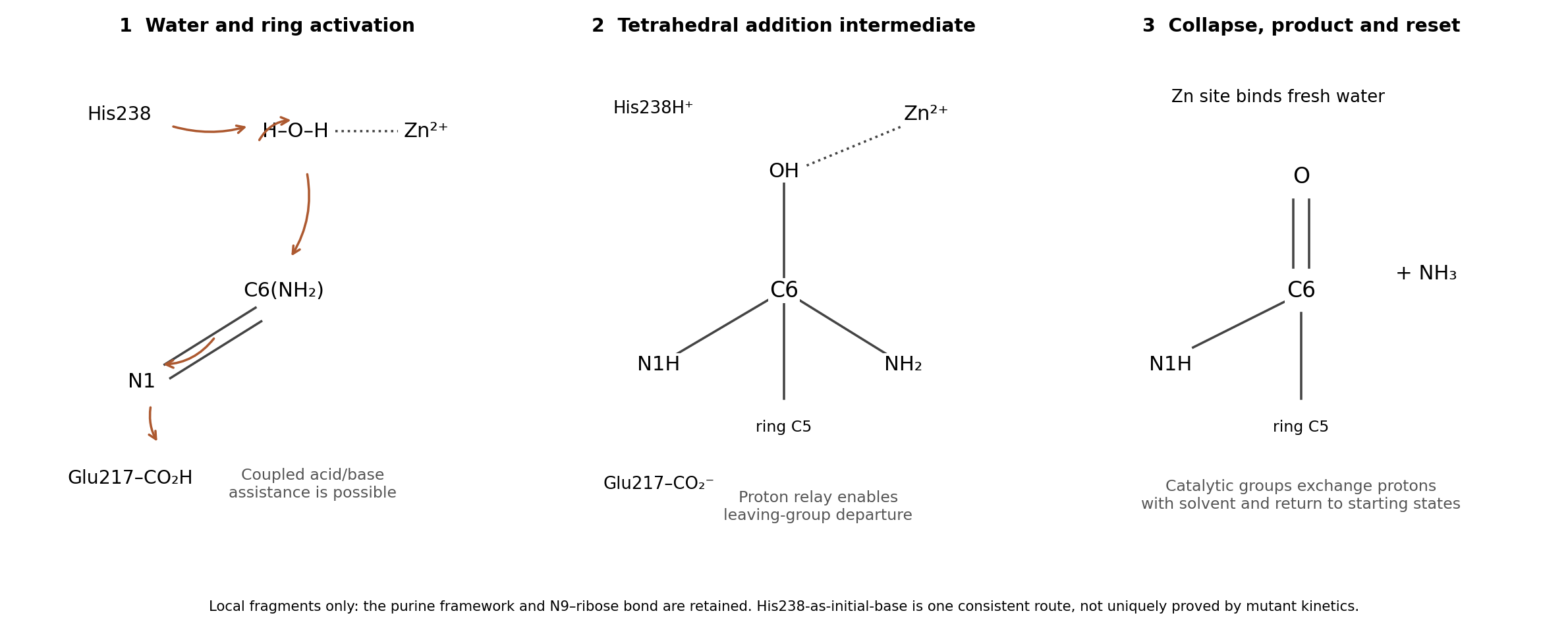

Next, the exocyclic amino group receives a proton, through His238, Glu217 and/or intervening water as permitted by the changing geometry. The oxygen is deprotonated as it forms the C6 carbonyl, and the C6–N6 bond cleaves to release ammonia. These transfers can be coupled in the collapse step, avoiding expulsion of . Zinc stabilizes the reacting oxygen and the organized intermediate; the ring regains conjugation in the inosine product. Product dissociation, fresh water binding and proton exchange with solvent reset the catalytic groups.
The core result is zinc-assisted addition–elimination, with acid/base proton transfers and water supplying C6 oxygen. The contributions are metal ion catalysis, general base catalysis, general acid catalysis, electrostatic catalysis and proximity and orientation catalysis. The proposed route does not require covalent catalysis by a protein side chain: a substrate–water C–O bond is not an enzyme–substrate covalent linkage. Asp296 can retain a structural hydrogen-bonding role without acting as an indispensable acid/base.
The data establish the importance of His238 and Glu217 but do not uniquely assign the entire proton relay. In particular, an alternative has Glu217 first deprotonate water and then deliver that proton to N1, with His238 assisting hydroxide stabilization and later amino-group protonation. The primary observation that His238 substitution need not abolish analogue hydration cautions against calling its initial-base role proven.[ref]
Site-directed mutagenesis of histidine 238 in mouse adenosine deaminase: substitution of histidine 238 does not impede hydroxylate formation by V. Sideraki and others. 1996, pp. 15019–15028, retained hydroxylate formation and proposed electrostatic contribution
pH-rate profiles, solvent isotope effects and time-resolved intermediate experiments would discriminate these refinements. The diagram is a proposed catalytic route, not a structure directly observed by the crystal experiment. Articles by others on the same topic
There are currently no matching articles.