The reactive fragment is the C6 amidine-like portion of the purine ring; the N9–ribose attachment is retained. Write it locally as , with the rest of the fused ring understood. One productive acid catalysis route protonates N1, making C6 more electrophilic. water then adds at C6 while the C6=N1 pi electrons move onto N1. Subsequent proton transfers generate a carbinolamine and then a protonated amino leaving group:These are local bonding fragments: C6 retains its bond to the adjoining ring carbon at every step. In the addition step, an oxygen lone pair forms C6–O and the C6=N1 pi bond opens. During collapse, an oxygen lone pair reforms C6=O and the C6–N6 bond breaks toward the departing nitrogen. Solvent mediates each proton transfer; no direct unsupported transfer across a long distance is required.
water supplies the new C6 oxygen, and ammonia is expelled after protonation of the leaving group. Final deprotonation gives the lactam form of inosine. In acidic bulk solution the released ammonia is largely trapped as ammonium. The catalytic proton transfers regenerate acid around the substitution cycle; ammonium trapping separately affects the net proton balance. This is hydrolytic deamination, not cleavage of the glycosidic bond.
A glutamic acid residue supplies a carboxyl group whose protonation state can change with the active site environment. The following five schematic contributions are possible in a hypothetical enzyme; they are alternatives and overlapping physical effects, rather than five independently established reactions of this enzyme. In the diagrams is the protein tether, and is the reacting purine carbon.
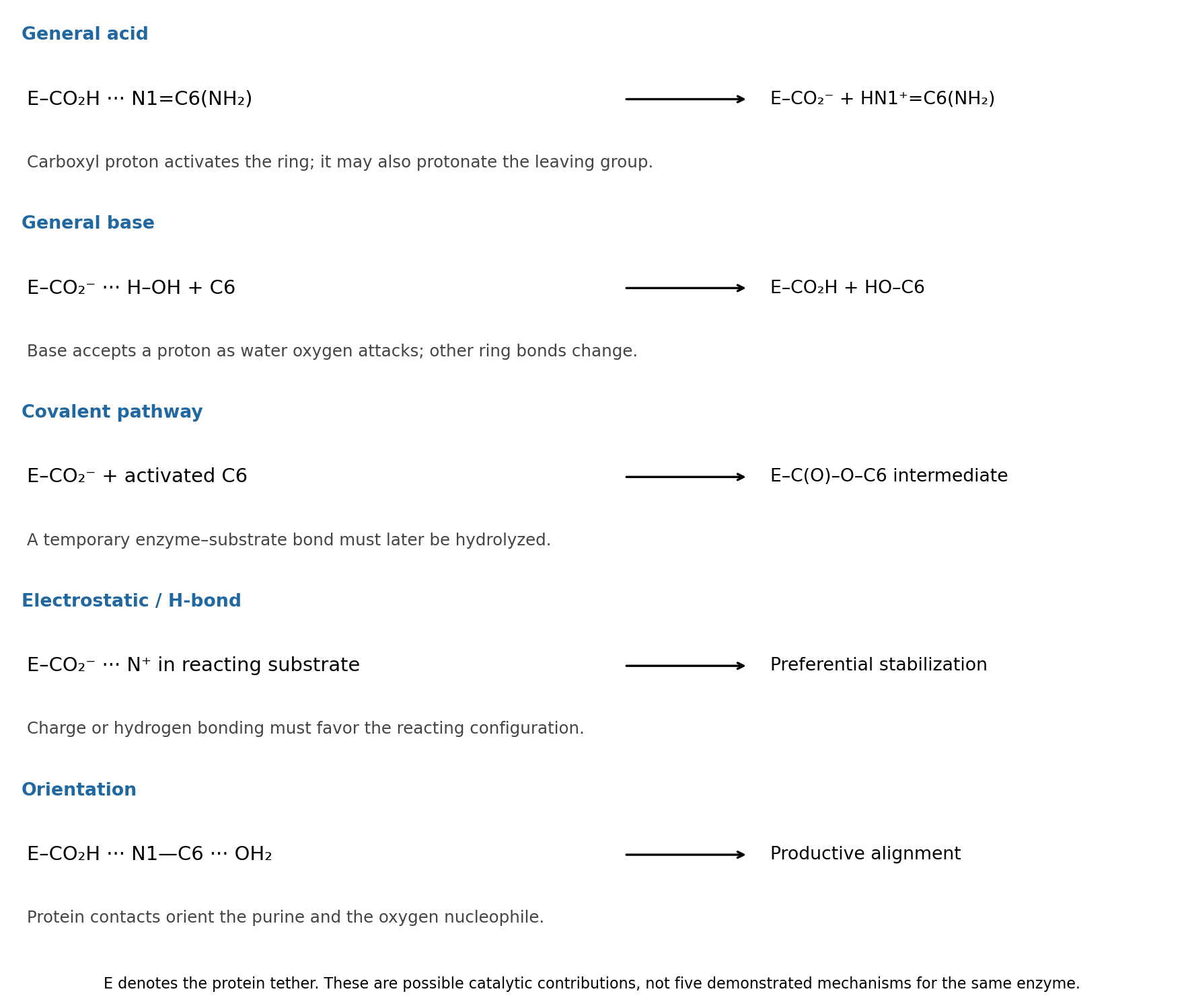
general acid catalysis: . Donation of the carboxyl proton activates the amidine-like C6 center for water attack. The same acid could instead assist the amino leaving group: . These are two locations for general acid catalysis, rather than two different categories.
general base catalysis: , coupled to oxygen attack on C6. Accepting a proton makes water a more effective nucleophile. This does not require an appreciable pool of free hydroxide in bulk solution.
covalent catalysis: a glutamate oxygen can in principle attack activated C6 to form . After addition/elimination replaces the amino group, water must hydrolyze that transient enzyme–substrate bond to release product and regenerate . Such a pathway is a chemically distinct possibility, not established by the given structure.
electrostatic catalysis: the carboxylate can stabilize a developing positive charge, for example in a protonated purine or amino leaving group; a protonated carboxyl can also donate a hydrogen bond to an oxygen developing negative charge. This contributes only if the reacting configuration is stabilized relative to the bound starting state. A carboxylate placed next to an oxyanion without compensating geometry would instead be unfavorable.
proximity and orientation catalysis: donor and acceptor hydrogen bonds can hold the purine and attacking water in a productive arrangement, schematically . Binding reduces unproductive orientations and can distort the substrate toward a reactive geometry. This last contribution is sometimes described through substrate binding or strain; a binding interaction is not automatically catalytic unless it improves access to the transition state.
The zinc ion is coordinated by protein donors and a water oxygen placed near the reacting C6 center. Zinc acts as a Lewis acid that activates and positions water. Its positive charge withdraws electron density from oxygen, lowers the effective p of coordinated water and facilitates formation of the attacking hydroxide, potentially with assistance from a nearby base. The same metal–oxygen interaction can stabilize developing negative charge as the addition intermediate forms. Zinc stays Zn(II); this is metal ion catalysis, not a zinc redox cycle.
The structure identifies a plausible reaction geometry, but a static X-ray model does not by itself establish the water's protonation state, proton-transfer order or the rate-limiting step. Structural work with bound transition-state analogues independently supports a zinc-containing catalytic center.[ref]
Atomic structure of adenosine deaminase complexed with a transition-state analog: understanding catalysis and immunodeficiency mutations by David K. Wilson and others. 1991, pp. 1278–1284, catalytic zinc and the bound transition-state analogue
An appropriate experimental test would compare native enzyme, a metal-depleted preparation and stoichiometrically zinc-reconstituted enzyme, checking retained fold and active enzyme concentration. Loss and recovery of activity with those controls distinguishes a catalytic metal requirement from nonspecific denaturation.His238 contributes strongly to turnover, with a plausible acid/base or electrostatic role near the attacking water. Replacing its imidazole by the methyl side chain of alanine removes both proton-transfer capacity and a positioned polar group, so the large fall in turnover number fits impaired chemical catalysis. A candidate role is acceptance of a proton from zinc-bound water, or stabilization and subsequent proton shuttling around the attacking oxygen.
Little change in the Michaelis constant suggests that the major kinetic defect is not a gross loss of substrate recognition, but is not generally a binding dissociation constant: for the elementary scheme. Nor does reduced uniquely prove that His238 is the initial general base. Purified-protein controls should check fold, zinc occupancy and active concentration. Importantly, primary mouse-enzyme experiments found that His238 mutants could still hydrate a substrate analogue, directly illustrating this mechanistic limitation.[ref]
Site-directed mutagenesis of histidine 238 in mouse adenosine deaminase: substitution of histidine 238 does not impede hydroxylate formation by V. Sideraki and others. 1996, abstract and pp. 15019–15028, purine-riboside hydration by mutant enzyme
An ionizable Asp296 carboxyl group is not essential to the measured catalytic pathway at pH 7. Asparagine retains a similar side-chain size and an amide donor/acceptor pair, while losing the carboxyl group's ordinary acid/base chemistry and negative charge. Preserved kinetics are therefore consistent with a binding or positioning hydrogen bond that survives the conservative substitution, or with a dispensable/redundant contact.
This does not prove that Asp296 makes no interaction in the native enzyme, nor that every substitution at that position would be harmless. The displayed Asp296 contact is also distinct from Asp295, which coordinates zinc; their neighboring residue numbers must not be conflated. Other pH values could expose a contribution hidden by the assay condition.
Glu217 is important for catalysis, most naturally through proton transfer at the purine ring. Changing a glutamic acid residue to glutamine preserves much of the side-chain size and hydrogen-bonding geometry, while removing an ordinary carboxylic acid/base pair. Its placement near N1 makes acid donation there a plausible way to activate C6 for water addition and stabilize the resulting nonaromatic intermediate. The large turnover defect with little change in the Michaelis constant supports that catalytic interpretation, subject to the same and protein-integrity qualifications as above.
The protonated carboxyl drawn at pH 7 need not behave like free glutamate in water: local electrostatics and burial can shift its p, and protonation may change during the cycle. The mutation alone cannot choose between an initially protonated Glu217 acid and a Glu217 residue that first accepts and then relays a proton. Primary mutational work supports catalytic roles for active-site histidine and glutamate groups while explicitly comparing purified enzymes and zinc content.[ref]
Mutational analysis of active site residues of human adenosine deaminase by D. Bhaumik and others. 1993, pp. 5464–5470, kinetic and zinc-content comparisons
The oxygen installed at C6 is derived from solvent water. An attacking zinc-bound water or hydroxide therefore provides the straightforward explanation of the oxygen-18 label. The result supports hydrolytic addition rather than direct oxygen transfer from a pre-existing protein carboxyl group as the sole oxygen source.
It does not by itself establish the identity of the base, the timing of proton transfers, or exclusion of a transient covalent enzyme intermediate: water could introduce the labeled oxygen during breakdown of such an intermediate. Product oxygen exchange must also be excluded. Incubate preformed unlabeled inosine in labeled water with and without enzyme, and use early-time quenched reactions to compare incorporation with product formation. These controls test whether labeling reports the formation step rather than later exchange.
A chemically coherent mechanism combines zinc-activated water addition with a proton relay involving His238 and Glu217. In a simple route consistent with the displayed contacts, neutral His238 accepts a proton from zinc-bound water while protonated Glu217 donates to substrate N1. These transfers can be coupled to the bond-forming event rather than requiring accumulation of a free, doubly activated substrate. Zinc-bound hydroxide attacks C6; the C6=N1 pi electrons move onto N1, yielding the tetrahedral C6 intermediate bearing OH and NH while N1 bears H.
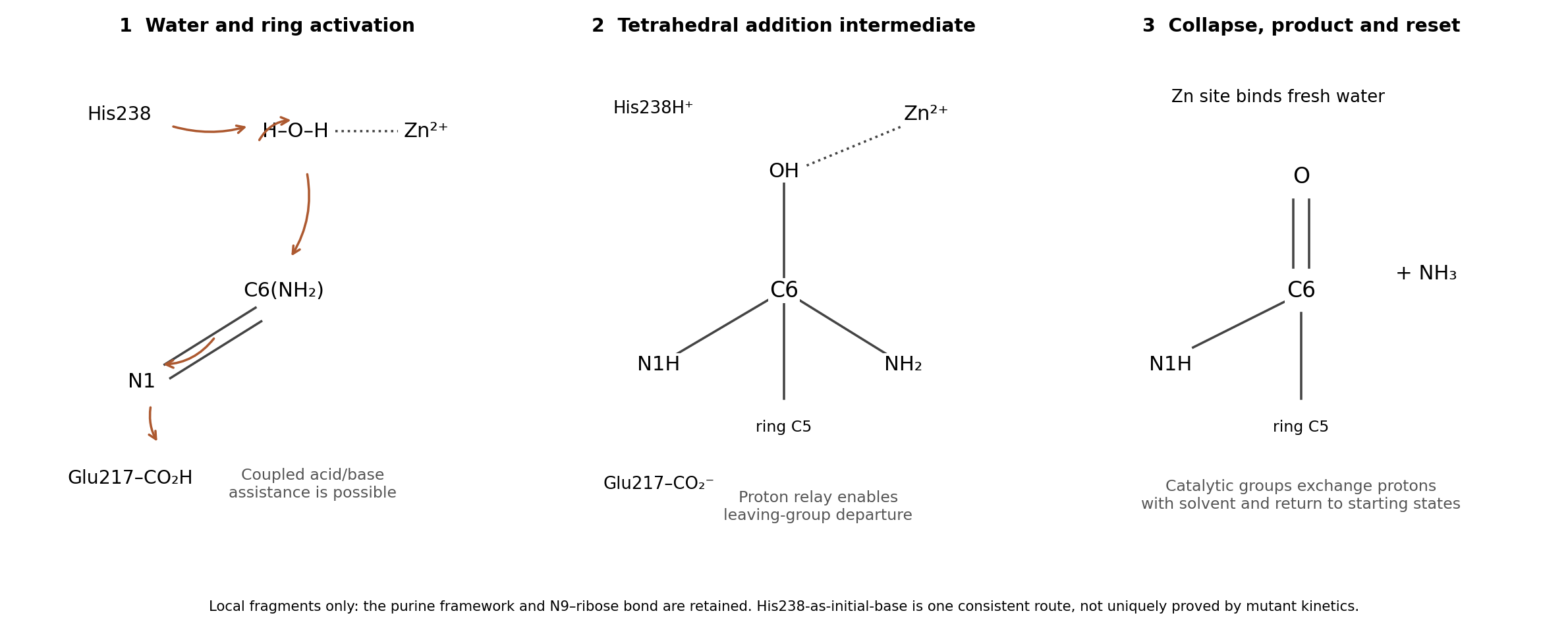


Next, the exocyclic amino group receives a proton, through His238, Glu217 and/or intervening water as permitted by the changing geometry. The oxygen is deprotonated as it forms the C6 carbonyl, and the C6–N6 bond cleaves to release ammonia. These transfers can be coupled in the collapse step, avoiding expulsion of . Zinc stabilizes the reacting oxygen and the organized intermediate; the ring regains conjugation in the inosine product. Product dissociation, fresh water binding and proton exchange with solvent reset the catalytic groups.
The core result is zinc-assisted addition–elimination, with acid/base proton transfers and water supplying C6 oxygen. The contributions are metal ion catalysis, general base catalysis, general acid catalysis, electrostatic catalysis and proximity and orientation catalysis. The proposed route does not require covalent catalysis by a protein side chain: a substrate–water C–O bond is not an enzyme–substrate covalent linkage. Asp296 can retain a structural hydrogen-bonding role without acting as an indispensable acid/base.
The data establish the importance of His238 and Glu217 but do not uniquely assign the entire proton relay. In particular, an alternative has Glu217 first deprotonate water and then deliver that proton to N1, with His238 assisting hydroxide stabilization and later amino-group protonation. The primary observation that His238 substitution need not abolish analogue hydration cautions against calling its initial-base role proven.[ref]
Site-directed mutagenesis of histidine 238 in mouse adenosine deaminase: substitution of histidine 238 does not impede hydroxylate formation by V. Sideraki and others. 1996, pp. 15019–15028, retained hydroxylate formation and proposed electrostatic contribution
pH-rate profiles, solvent isotope effects and time-resolved intermediate experiments would discriminate these refinements. The diagram is a proposed catalytic route, not a structure directly observed by the crystal experiment. Articles by others on the same topic
There are currently no matching articles.