The methyl nucleophile attacks an electrophilic ring boron. That boron becomes tetrahedral, bearing its original methyl, the incoming methyl, and its two ring nitrogen neighbors. This interrupts its p-orbital participation, so the metal attaches to the remaining five-atom conjugated segment. is the anionic heptamethylated-ring Cr(CO) complex, paired formally with ; solvent ligation and ion pairing at magnesium are not specified by the spectrum. The original connectivity, with the attacked boron labeled , is shown in the first panel below.
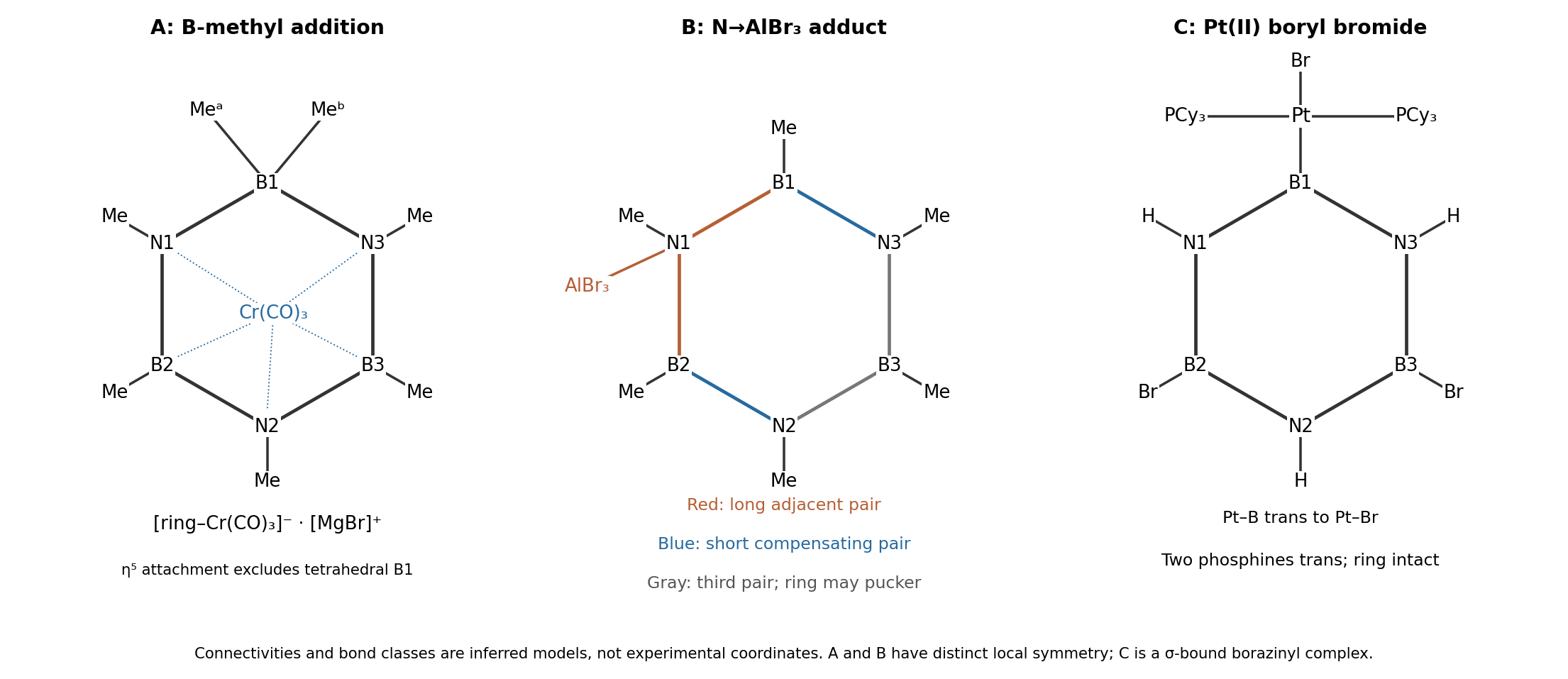

There are seven methyl groups. The two attached to tetrahedral are inequivalent because the chromium-bound face distinguishes their environments: one signal of relative integral one for each. The other two B–Me groups are equivalent to one another, giving a signal of integral two. The two N–Me groups adjacent to form another equivalent pair, while the N–Me opposite is unique. The predicted methyl-group multiplicities are therefore , the same unordered set as the observed ratio. Multiplying by three gives proton integrals totaling 21. This assignment assumes no fast process interchanging the two methyl environments.
The six-electron neutral ring donor has become an anionic six-electron donor, so Cr(0) retains an 18-electron count: . This borazine dearomatization explains both the changed hapticity and the extra methyl without requiring attack at chromium or loss of a carbonyl.
is a 1:1 nitrogen-bound adduct, with at one ring nitrogen. Its lone pair is diverted from N-to-B pi donation into the new coordinate bond. That nitrogen becomes approximately tetrahedral and the ring can pucker. The two B–N bonds adjacent to it lose pi character and lengthen; the neighboring unbound nitrogen atoms can donate more strongly into those borons, shortening the next pair of B–N bonds. The remaining pair forms a third class. The second structural panel marks these three two-bond sets; it represents connectivity and bond classes, not a measured geometry.
In the slow-exchange structure, two boron atoms flank the bound nitrogen and are equivalent to one another, while the third boron is unique. This gives two B environments in a ratio. At room temperature, rapid exchange of the Lewis acid among the three equivalent nitrogen sites averages every boron over the same environments, giving one boron-11 nuclear magnetic resonance signal. Cooling slows exchange relative to the resonance-frequency difference and resolves the two environments.
This is Chemical exchange in NMR, not restoration of equal instantaneous B–N bonds. A spectrum alone cannot distinguish intramolecular migration from reversible dissociation and reassociation; concentration dependence and crossover experiments would test that distinction. Related N-bound borazine adducts have been characterized by diffraction and variable-temperature NMR, supporting the structural logic while not supplying the exact temperature dependence of this particular hexamethyl compound.[ref]
Aluminium and gallium trihalide adducts of 2,4,6-triorganylborazines and the synthesis of triorganylborazinium tetrabromoaluminates by B. Gemünd and others. 2008, pp. 137–142, N-bound adduct structures and variable-temperature NMR
Articles by others on the same topic
There are currently no matching articles.