In borazine, each B and N is approximately trigonal planar. The alternating ring contains a sigma framework with perpendicular p orbitals; the nitrogen lone pairs can donate into the boron acceptor orbitals. Six pi electrons can therefore be distributed around the ring, giving partial B–N multiple-bond character rather than six ordinary isolated single bonds. Equal ring distances are compatible with this symmetric delocalization.
The electronegativity difference makes each B–N bond strongly polar, . The occupied pi orbitals are weighted toward N, and the empty acceptors toward B. In benzene, equivalent carbon centers give much more even pi distribution and strong resistance to addition that destroys the aromatic system. borazine resembles benzene geometrically but has substantially more polarized, more reactive bonding. It presents electrophilic boron sites to nucleophiles and nitrogen donors to Lewis acids. Polar reagents can add across B–N, and water can cleave the ring; benzene ordinarily favors substitution under suitable conditions rather than facile polar addition or hydrolysis. The label “inorganic benzene” should therefore not be interpreted as identical aromatic stabilization or reactivity. nitrogen-bound Lewis-acid adducts and hydrogen-halide additions demonstrate this contrast experimentally.[ref]
The methyl nucleophile attacks an electrophilic ring boron. That boron becomes tetrahedral, bearing its original methyl, the incoming methyl, and its two ring nitrogen neighbors. This interrupts its p-orbital participation, so the metal attaches to the remaining five-atom conjugated segment. is the anionic heptamethylated-ring Cr(CO) complex, paired formally with ; solvent ligation and ion pairing at magnesium are not specified by the spectrum. The original connectivity, with the attacked boron labeled , is shown in the first panel below.
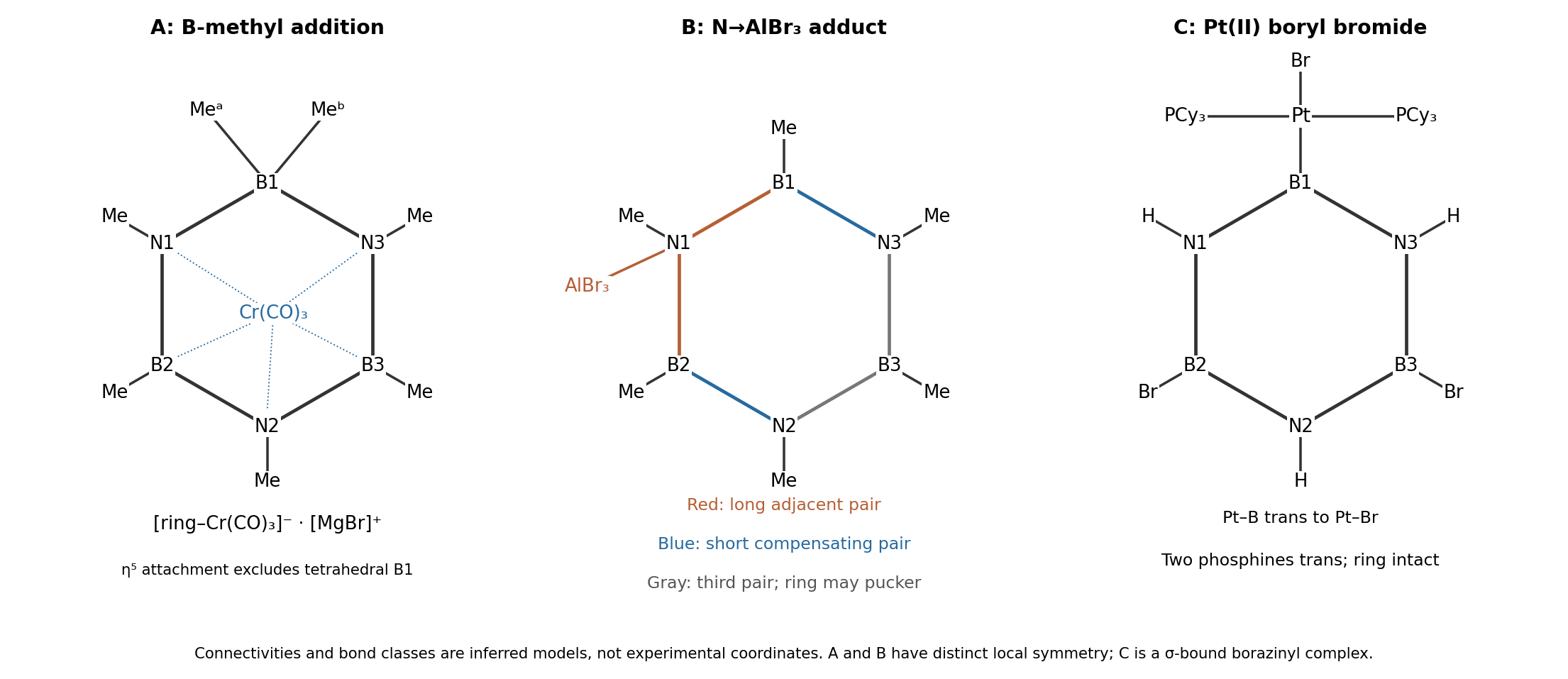

There are seven methyl groups. The two attached to tetrahedral are inequivalent because the chromium-bound face distinguishes their environments: one signal of relative integral one for each. The other two B–Me groups are equivalent to one another, giving a signal of integral two. The two N–Me groups adjacent to form another equivalent pair, while the N–Me opposite is unique. The predicted methyl-group multiplicities are therefore , the same unordered set as the observed ratio. Multiplying by three gives proton integrals totaling 21. This assignment assumes no fast process interchanging the two methyl environments.
The six-electron neutral ring donor has become an anionic six-electron donor, so Cr(0) retains an 18-electron count: . This borazine dearomatization explains both the changed hapticity and the extra methyl without requiring attack at chromium or loss of a carbonyl.
is a 1:1 nitrogen-bound adduct, with at one ring nitrogen. Its lone pair is diverted from N-to-B pi donation into the new coordinate bond. That nitrogen becomes approximately tetrahedral and the ring can pucker. The two B–N bonds adjacent to it lose pi character and lengthen; the neighboring unbound nitrogen atoms can donate more strongly into those borons, shortening the next pair of B–N bonds. The remaining pair forms a third class. The second structural panel marks these three two-bond sets; it represents connectivity and bond classes, not a measured geometry.
In the slow-exchange structure, two boron atoms flank the bound nitrogen and are equivalent to one another, while the third boron is unique. This gives two B environments in a ratio. At room temperature, rapid exchange of the Lewis acid among the three equivalent nitrogen sites averages every boron over the same environments, giving one boron-11 nuclear magnetic resonance signal. Cooling slows exchange relative to the resonance-frequency difference and resolves the two environments.
This is Chemical exchange in NMR, not restoration of equal instantaneous B–N bonds. A spectrum alone cannot distinguish intramolecular migration from reversible dissociation and reassociation; concentration dependence and crossover experiments would test that distinction. Related N-bound borazine adducts have been characterized by diffraction and variable-temperature NMR, supporting the structural logic while not supplying the exact temperature dependence of this particular hexamethyl compound.[ref]
Aluminium and gallium trihalide adducts of 2,4,6-triorganylborazines and the synthesis of triorganylborazinium tetrabromoaluminates by B. Gemünd and others. 2008, pp. 137–142, N-bound adduct structures and variable-temperature NMR
A ring-retaining bromination replaces the three hydridic B–H positions while preserving N–H. Its net stoichiometry isUse controlled bromination and conditions allowing elimination of hydrogen bromide from addition intermediates, rather than identifying the first bromine adduct as the final ring product. Boron-bound hydrogen has hydride-like character because boron is less electronegative than hydrogen; its replacement is consistent with electrophilic attack by bromine. The primary preparative work reports B-tribromoborazines obtained by bromination of borazine and its N-methyl analogue.[ref]
B-Tribromoborazines from the Bromination of Borazine and N-Trimethylborazine by Reed F. Riley and Carl J. Schack. 1964, pp. 1651–1653, bromination and formation of B-tribromoborazines
The product must retain the unsaturated BN ring. Merely adding three HBr molecules to borazine initially gives a saturated hydrogen-halide addition product, not the required formula. Addition followed by suitable elimination is distinct from simply asserting direct B–H protonolysis by HBr.
oxidative addition inserts Pt into one B–Br bond. All three B–Br positions of the starting ring are equivalent, so there is no distinct choice among them before the first substitution. The product is the square-planar Pt(II) boryl bromide , with the two phosphines trans, the Pt–B bond trans to Pt–Br, and the six-membered ring intact. The third panel shows this connectivity. This is a metal–boron sigma bond, not attachment of the whole ring as an pi ligand. Formal electron counting gives Pt(II), , with electrons, appropriate for square-planar coordination. The primary synthesis establishes this trans-bromo(borazinyl) structure.[ref]
Synthesis of η1-borazine complexes of palladium and platinum by Holger Braunschweig and others. 2008, pp. 3531–3534, oxidative addition products and their structural characterization
The electron-rich Pt(0) reacts at the polarized B–Br bond, whose electrophilic boron and departing bromide provide a favorable bond-activation pathway. This accounts for B functionalization without needing cleavage of a ring B–N bond or selection of a nitrogen-bound product. It does not imply that arbitrary N–H activation is impossible under every condition.
Replacing an electronegative bromine substituent by a metal fragment changes the boron's electron demand. Relative to the B–Br sites, the metal-bound boron is less effective at accepting N-to-B pi donation, so its adjacent B–N bonds are expected to have less multiple-bond character and be longer; donation toward the remaining B–Br sites produces compensating unequal ring bonds. The original threefold equivalence is lost. The detailed lengths depend on the full electronic structure; a localized drawing with three rigid alternating double bonds would conceal the redistribution that the unequal lengths reveal.
In the chromium complex, Cr(0) is and receives substantial donation from four carbonyl ligands. Its occupied orbitals can give pi backbonding into the boron-rich acceptor orbitals of the BN ring, while the nitrogen-rich occupied ring orbitals donate to the metal. This favors binding across the ring face, approximately , with all four ring atoms participating. A nearly planar ring maintains the p-orbital alignment needed for that interaction and accounts for comparable Cr–B and Cr–N distances. A four-electron ring donor also gives the useful count .
Ti(IV) in TiCl is and strongly electron deficient. It is a good acceptor for the two nitrogen lone pairs, but has no filled set for comparable backbonding into the boron acceptors. chromium therefore favors a face-bound pi complex, while titanium favors N,N sigma coordination. Donation makes the nitrogen environments more nearly tetrahedral and permits the 2,4-Diazadiboretidine ring to pucker. The borons are not directly bound in the same way, explaining . The distinction follows from electron availability, rather than simply calling every short metal–ring contact a separate ordinary sigma bond.
Articles by others on the same topic
There are currently no matching articles.